

Sexual Abuse and Assault Injury Lawyers


Online Sexual Exploitation Lawyer
Popular internet platforms, including games and social media, have enabled predators to access vulnerable victims due to a lack of oversight. An online sexual exploitation lawyer from our law firm holds these organizations responsible for failing to prevent harm.
If you or your child has been a victim of online exploitation, we can help. Contact us today for a free consultation about your legal rights.
What Is Online Sexual Exploitation Under Civil Law?
The Global Platform for Child Exploitation Policy explains that while individual perpetrators may face criminal charges for sexual abuse, the platforms that enable abuse can also face civil liability due to negligence. This means the organization failed to take steps that would have prevented harmful or exploitative behavior.
Our attorneys can handle cases involving “sextortion,” non-consensual image sharing, child exploitation material, and grooming.
Grooming
Thousands of families have filed Roblox sexual abuse lawsuits, alleging that the popular gaming platform failed to enforce basic safety standards that could have prevented grooming.
Grooming occurs when an adult manipulates a child into sexual activity, such as by pretending to be the victim’s friend or offering them gifts. It is often a slow process that unfolds over days, weeks, or months, giving platforms like Roblox or Discord time to intervene if they identify concerning behavior. Failure to monitor interactions between a child and an adult is considered negligence.
Child Pornography
Child pornography, also known as child sexual abuse material (CSAM), is defined as any visual material that depicts sexually explicit conduct (18 U.S. Code § 2256). The child does not need to be engaging in a sexual act for it to be considered sexually explicit.
The US Supreme Court case New York v. Ferberdetermined that child pornography is not protected by the First Amendment due to the harm it may pose to child victims. As such, service providers are obligated to monitor and intervene when they identify the storage or transmission of child pornography.
They can be held liable for failing to alert law enforcement when an explicit image was shared, downloaded, or stored on their servers.
Digital Deepfakes
Under federal law, digitally generated child pornography is treated the same as that depicting an actual child (18 U.S.C. § 2252A(a)(3)(B)). As such, platforms that enable the creation, transmission, or storage of digitally generated CSAM can be held equally liable, even if no human was harmed.
Now, the use of artificial intelligence has enabled users to virtually undress victims with a single click.
Any image-sharing platform or AI tool must include safeguards that prevent harmful usage. When they fail to ensure these, the company can be liable.
Sexual Blackmail (Sextortion)
Sextortion occurs when a perpetrator threatens to publicly expose a person, such as by sharing explicit images of them, if the victim does not do what is asked of them.
This tactic may be used against victims of any age. With child victims, it is closely related to grooming, where the perpetrator collects child pornography to be used as blackmail. With adult victims, there may be a preexisting relationship.
Every platform has a responsibility to prevent child pornography from being stored or shared, but they also should respond to takedown requests for sextortion cases. If they fail to do so, they can be liable.
Who Are the Victims of Digital Sexual Exploitation?
The typical victims of sexual abuse are children or vulnerable adults. In many cases, there is a power imbalance, such as an adult interacting with a minor on a child-friendly gaming platform like Roblox or Minecraft. Through grooming behaviors, the perpetrator establishes themselves as an authority figure, then exploits this for personal gain.
Due to the nature of these platforms, victims may live in a different state or even a different country than the perpetrator. This, and the anonymity these platforms offer, can encourage perpetrators and make it difficult for law enforcement to track and prosecute them.
Who Can Be Held Liable for Digital Sexual Exploitation?
A civil claim does not focus on criminal prosecution, but on negligence. An attorney must prove that the liable party failed to take reasonable precautions to prevent abuse, such as failure to monitor user activity or address complaints.
The individual perpetrator is often the first defendant in a claim, but other parties can also be held liable.
Facilitators: Service providers should intervene if they identify potentially dangerous activity, like child pornography downloads over wireless connections or uploaded to cloud storage.
Employers: If the abuse occurred while the defendant was working, the employer may be liable for failing to monitor the defendant’s activities.
Platforms: Social media and gaming platforms must implement safeguards to prevent harmful interactions between children and adults. They also must be responsive to user complaints, such as a victim reporting that they were blackmailed or had their photos shared without consent.
Organizations: An organization that is aware of inappropriate conduct but fails to intervene may be held liable. It must be proven that they had or should have had knowledge of the behavior.
Does Digital Sexual Exploitation Constitute Child Sexual Abuse?
Yes, predatory behavior on social media platforms or gaming apps can be considered child sexual abuse. This is true even if there is no direct contact between the victims and perpetrators.
A civil case focuses on the financial and emotional damages resulting from the conduct, such as therapy, emotional distress, loss of normal life, or damage to reputation. Civil courts provide additional safeguards for child victims, including the option to file under a pseudonym, redacting sensitive information, and limiting contact with the accused.
Understanding the time limitations for filing a claim is essential. Statutes of limitations on child abuse vary by state. For example, some states have extended the filing deadlines by up to 20 years after the victim turns 18.
An experienced attorney can help you determine the applicable statutes in your area and ensure your claim is filed on time.
How Our Law Firm Can Help
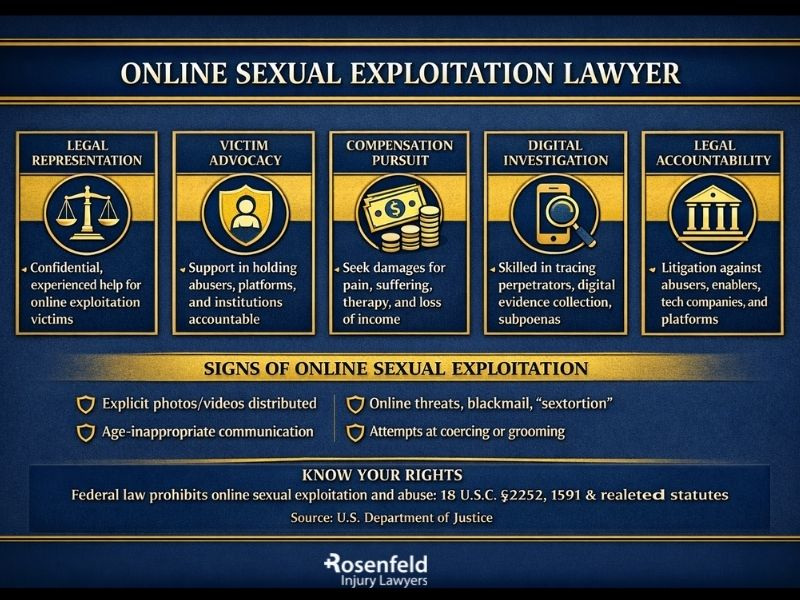
Our sexual abuse law firm is here to protect your rights and privacy through civil litigation, content removal, and protective measures. We can facilitate the takedown of exploitative images from social media platforms through legal demands or request protective orders to limit a perpetrator’s access to you.
These cases often involve complex evidence, like emails, messages, and digital files. We will use our specialized legal expertise, like digital forensics, to demonstrate institutional liability and negligence while preserving the evidence. Additionally, we can consult with child safety experts to explain how the liable parties failed to uphold their duties of care.
Injury Lawyer Team takes a trauma-informed approach to civil litigation, ensuring our clients’ comfort and safety at each step of the process. We are a Super Lawyers-rated firm with over 100 years of combined legal experience and a 98% success rate. Through our work, we hold negligent parties accountable while maintaining the highest standards of professionalism.
Our law firm helps clients nationwide on a contingency-fee basis: no legal fees unless we get justice.
Call us at 866-757-6452 or use our online contact form to schedule your free case review. All information shared in your initial consultation is kept confidential under the attorney-client privilege.
All content undergoes thorough legal review by experienced attorneys, including Jonathan Rosenfeld. With 25 years of experience in personal injury law and over 100 years of combined legal expertise within our team, we ensure that every article is legally accurate, compliant, and reflects current legal standards.