

Sexual Abuse and Assault Injury Lawyers


Mormon Church Sexual Abuse Lawsuits
Justice for Victims of Sexual Abuse in the LDS Church
At Injury Lawyer Team, we stand with survivors pursuing Mormon Church sexual abuse lawsuits and seeking justice for the harm caused by trusted church officials and leaders within the LDS Church.
Many of our clients were children or teens when the abuse occurred, and it often took years or decades before they felt able to speak openly about what happened. We believe in your case, and we are here to support you every step of the way.
As an experienced Mormon Church sexual abuse lawyer team, we have worked with many survivors, and we remain committed to holding the Mormon Church accountable for the failures that allowed abuse to occur.
Mormon Sexual Abuse Lawsuit Updates
As a firm focused on LDS sexual abuse lawsuits, we closely follow major cases, investigations, and court rulings involving the Church of Jesus Christ of Latter-day Saints.
Survivors regularly come to us with child sex abuse claims, asking whether their experiences qualify for a sex abuse lawsuit and if recent court rulings or investigation findings have strengthened other Mormon sexual abuse cases like theirs.
What we see is a long, painful timeline: early program-related claims, confidential resolutions, criminal prosecutions, groundbreaking investigative reporting, revival windows in state laws, and a growing wave of civil actions aimed at holding the LDS Church accountable. Below is a concise, chronological overview of key Mormon sexual abuse lawsuit updates.
Early Cases, Native American Programs, and Internal Records (1960s–2000s)
Long before today’s headlines, children were being harmed in LDS-affiliated homes and programs. From the 1960s through the early 1980s, Native American youth placed in Mormon foster homes through the Indian Student Placement Program later reported sexual abuse.
By 2018, multiple members of the Navajo Nation and Crow Tribe had filed lawsuits alleging they were abused in these homes. The LDS Church ultimately resolved several of these claims confidentially.
In April 2018, West Virginia survivors alleged that LDS Church member Christopher Michael Jensen abused children for years despite earlier warnings and charges. A civil case there claimed the Mormon Church knew of his history but failed to protect vulnerable youth. That matter later ended in a confidential resolution after he was imprisoned for abusing minors.
In August 2017, Mormon Leaks published internal documents describing more than 300 reports of sexual abuse by Mormon Church leaders between 1959 and 2017, spanning California, Idaho, Utah, Arizona, Washington, Oregon, Florida, and other states. For many survivors, this compilation confirmed that their stories were not isolated. Instead, they fit into a well-documented pattern of abuse and institutional failure.
2019–2021: Families Speak Out and New Lawsuits Surface
By 2019, national outlets were profiling families who had filed lawsuits against the LDS Church, describing how a trusted church bishop, youth leader, or other authority figure abused their children. Parents and survivors shared that they believed their faith community would protect them, only to discover that institutional reputation often came first.
In February 2021, an Oregon man sued the Mormon Church, alleging he was abused as a minor by youth leader Ron Kerlee in the 1980s. The complaint asserted that, even after a criminal conviction for sexual misconduct, Kerlee remained in trusted roles and continued working as a counselor for years. This case highlighted a recurring problem: earlier red flags did not always lead to removal from positions around children.
2022: The Mormon Church Help Line Scandal and New Criminal Charges
In August 2022, the Associated Press published a major investigation into the LDS Church’s confidential help line for leaders. One central example involved Paul Adams, an Arizona father who told his bishop he was sexually abusing his young daughter. The bishop called the help line and, according to later court records, was advised not to contact authorities. Without a report, Adams continued to abuse multiple daughters for years and posted videos of the abuse online before he was arrested and later died by suicide in jail.
This Mormon Church help line scandal revealed how internal procedures could be used to contain allegations instead of protecting children. It also raised urgent questions about the LDS Church’s reliance on internal legal guidance rather than mandatory reporting laws when leaders learn about child abuse.
In September 2022, former Mormon Church bishop and West Bountiful mayor Carl Matthew Johnson was arrested on charges that he sexually abused multiple children in the 1980s and 1990s. Investigators said some victims were as young as two and reported that they had been urged to stay quiet, reinforcing the perception that the institution, not children, was being shielded.
2023: Risk Management, Privilege, and Record-Breaking Verdicts
In January 2023, the Mormon Church resolved another suit in Washington state brought by a man abused as a preschooler by a teenage volunteer in his Tacoma congregation. The lawsuit alleged that when his parents told a bishop about the abuse in the 1980s, the bishop admitted the volunteer had been previously accused but discouraged them from going to law enforcement.
In April 2023, a Riverside County, California jury issued a record-breaking verdict for a woman who had been sexually abused for years by her stepfather in LDS-related settings. Evidence at trial indicated that when she disclosed her abuse, local leaders held a meeting, instructed her to forgive, and shamed her into silence instead of contacting authorities. The LDS Church settled its portion of the case before the jury’s award, while denying liability, illustrating how high the stakes can be when institutional negligence is proven.
In December 2023, another Associated Press article examined how the Mormon Church’s Risk Management Division and internal legal processes operated when allegations arose. The story focused on John Goodrich, a former LDS bishop in Hailey, Idaho, accused by his daughter and another member of serious sexual assault. According to the reporting, LDS Church-connected lawyers used payments, confidentiality agreements, and Utah’s clergy-penitent privilege law to prevent full disclosure of abuse, raising concerns about how far institutional protection could go.
2024: New Charges and Expanded California Litigation
In January 2024, Pennsylvania State Police charged stake president Rhett Hintze with failing to report abuse allegations involving a former Mormon bishop and Boy Scout leader. The charges were tied to a broader investigation into child sex abuse, underscoring how clergy obligations to report are being tested in multiple jurisdictions.
In September 2024, a lawsuit in St. Louis County, Missouri, alleged that Mormon Church leaders in both Arizona and Missouri ignored repeated warnings about Larry Deutsch, a man who served in multiple leadership roles and groomed a teenage girl through church activities and youth bicycle trips. The complaint claims an Arizona bishop facilitated contact despite an order of protection and that a church-employed counselor, who was a mandated reporter, failed to notify authorities.
In the same month, another suit in Napa County, California, alleged two male members of the local LDS congregation abused a girl in and around the Napa meetinghouse in the 1980s. According to the complaint, she disclosed the abuse to her foster mother, grandmother, and police in the mid-1990s, yet church leaders allegedly never followed up with her to investigate or ensure safety.
2025: Revival Windows, Multi-State Lawsuits, and the Arizona Appeals Decision
In February 2025, a woman filed a federal lawsuit in Oregon alleging that Mormon Church leadership failed to act on credible, documented reports that her adoptive father, Craig Ford, was abusing her while the family actively attended an LDS congregation. According to the complaint, a stake president was told of the abuse and shown evidence but did not report it, blamed the victim, and allowed Ford continued access. Authorities only learned the full extent of the abuse later, and Ford eventually pleaded guilty in Washington state court.
In March 2025, California’s three-year look-back window for adult survivors had generated nearly 100 lawsuitsalleging childhood sexual abuse by Mormon leaders. Themes across these cases include grooming, spiritual manipulation, misuse of authority, and threats of spiritual consequences if victims disclosed what happened.
In April 2025, a survivor filed suit describing abuse in two California cities, Hayward and Modesto, allegedly beginning when she was six. She claims a deacon in the Aaronic Priesthood groomed and abused her during Sunday classes in Hayward, then, after her family moved, a bishop’s son in Modesto assaulted and repeatedly raped her during Mormon Church events, with the abuse continuing until she moved away.
That same month, a federal judge issued a pivotal decision in an insurance dispute tied to earlier Jensen-related cases. The court found that once the LDS Church knew Jensen posed a risk to members, it had a duty to stop future harm and failed to act, rejecting the Church’s effort to shift responsibility to its insurers.
In May 2025, the Church of Jesus Christ of Latter-day Saints agreed in principle to resolve more than 100 sexual abuse claims filed in San Diego and across California. These Mormon sexual abuse cases alleged that church leaders and bishops either committed sexual abuse or failed to stop it, despite knowing or suspecting that abuse was occurring. These filings marked one of the largest concentrated waves of LDS sexual abuse lawsuits to date.
In July 2025, the Arizona Appeals Court issued a major opinion in the Adams case. The court allowed a civil lawsuitagainst the LDS Church to move forward, holding that a jury could decide whether the bishop had a duty to report once Adams admitted the abuse in front of his wife and later discussed it during excommunication proceedings. The judges cited the Church’s own handbook, which instructs bishops to disclose information to authorities to prevent life threatening harm or serious injury, and questioned whether clergy-penitent privilege truly applied. For many survivors, this decision marked a turning point in the legal debate over privilege and mandatory reporting.
In October 2025, four men in Washington state filed suit alleging that the LDS Church allowed convicted pedophile and High Priest David Herget to remain active in the Mountlake Ward in Mountlake Terrace and abuse more children. Herget had earlier been convicted of raping his daughter. Yet, according to the complaint, after serving a short portion of his sentence he returned to the Mormon Church, was given responsibilities involving children, rebaptized, and eventually restored as a High Priest. The plaintiffs described repeated abuse between 2001 and 2005, incidents in the church parking lot and involving boys as young as five, before Herget was arrested on multiple child-sex charges and died by suicide in jail.
The LDS Church Sexual Abuse MDL (MDL No. 3150)
As lawsuits multiplied in federal courts, plaintiffs’ lawyers requested consolidation of an LDS Church sexual abuse MDL, a multidistrict litigation that would centralize federal Mormon abuse cases for coordinated discovery and pretrial rulings.
The proposed MDL sought to streamline the process, avoid conflicting decisions, and address shared issues like institutional negligence and clergy-penitent privilege in one forum.
When the Judicial Panel on Multidistrict Litigation considered MDL No. 3150 in early 2025, submissions referenced institutional decision-making and communications tied to the Church of Jesus Christ of Latter-day Saints headquarters in Salt Lake City.
The Panel ultimately declined to centralize the cases, reasoning that existing district courts could coordinate informally. Even so, the attempted MDL illustrates the scale and complexity of the litigation now facing the LDS Church and the attention courts are paying to patterns in these cases.
LDS Church Loses Lawsuit Over Abuse-Related Coverage
A separate but important development involves who pays for sexual abuse settlements. In the Jensen-related coverage dispute, the LDS Church sued its own insurance carriers, arguing they should reimburse the Church of Jesus Christ of Latter-day Saints for money paid to resolve abuse claims.
The federal court rejected that argument, concluding that once the Church knew Jensen posed a risk, it had a duty to protect members and failed to do so.
This ruling did not decide the underlying survivor claims (they had already been resolved), but it did highlight how courts are scrutinizing institutional conduct and rejecting efforts to shift responsibility for long-term patterns of failure.
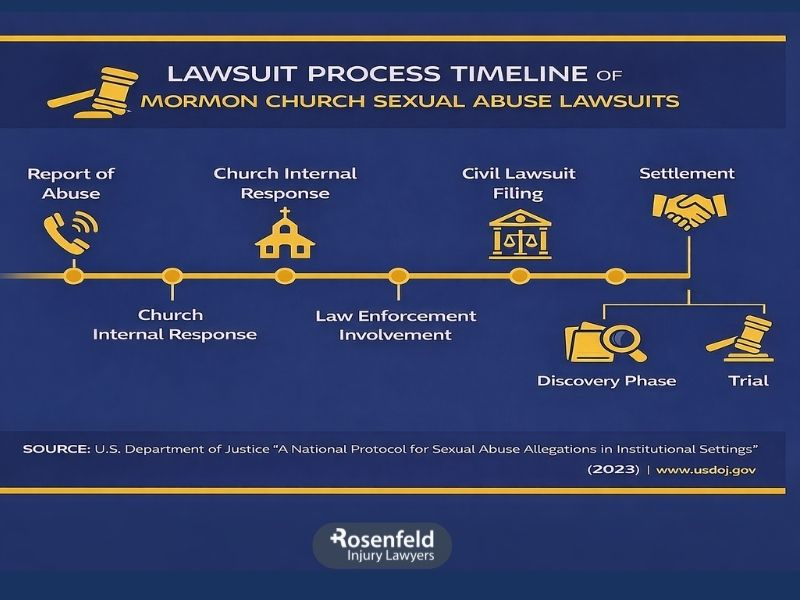
How the Mormon Church Handles Sexual Abuse Allegations and Lawsuits
When survivors ask how the LDS Church handles sexual abuse allegations, we explain that there is often a gap between official policy and lived experience. On paper, the Church of Jesus Christ of Latter-day Saints condemns abuse and instructs leaders to act. In many of the lawsuits and accounts we see, however, LDS Church leaders:
- Call the internal help line instead of law enforcement
- Treat abuse as a private sin rather than a crime
- Encourage silence within congregations
- Invoke clergy-penitent privilege to resist disclosure
- Rely on confidential agreements and internal discipline instead of transparent reporting
For many victims, this created an environment where they were left unprotected, and future abuse was more likely to continue. As sexual abuse lawyers representing people harmed in religious environments, we believe that real accountability and transparency are essential to protecting children going forward.
What These Updates Mean for Survivors Today
Taken together, these events show that Mormon Church sexual abuse lawsuits are part of a broad reckoning with institutional abuse, not a series of isolated disputes. Courts, lawmakers, journalists, and survivors are all examining how abuse could happen, how it was handled, and what must change.
While the Mormon Church moves forward publicly, survivors continue to seek justice through civil actions, criminal investigations, and policy reforms. If you experienced sexual abuse connected to the LDS Church, even if it happened decades ago, these developments may affect your rights, your ability to file, and the defenses the Church can raise.
We stand with you, and we are here to help you understand how this evolving landscape applies to your story and your options for seeking justice.
How Much Are LDS Church Sex Abuse Settlements?
The value of Mormon Church sexual abuse lawsuits varies widely based on the severity of the abuse, the length of time it occurred, the survivor’s age, available evidence, and whether institutional failures can be proven. While many settlements remain confidential, several publicly reported cases provide a clearer picture of what survivor recoveries can look like.
$2.28 billion verdict (California, 2023): A jury awarded $2.28 billion to a woman who was sexually abused by her stepfather from the age of 5 to 14. The lawsuit alleged that local church officials were told about the abuse and failed to act, instead pressuring her to forgive and remain silent. Before trial, the Church of Jesus Christ of Latter-day Saints agreed to settle its portion of the case for $1,000,000, and the victim’s mother settled for $200,000.
$4.2 million Washington jury award against the LDS Church (2005): A Seattle-area jury ordered the Mormon Church to pay $4.2 million to two sisters who were abused by their stepfather. The case centered on claims that a bishop failed to report the abuse and protect the children. Utah’s news outlets reported the verdict as the first time in that state where the Church was held liable for abuse that occurred in the home rather than on church property.
$3,000,000 settlement in the Jeremiah Scott case (Oregon, 2001): The Mormon Church agreed to pay $3 million to Jeremiah Scott, who sued after a fellow ward member and Sunday School teacher was convicted of repeatedly sexually abusing him as a child. The Church denied legal liability and characterized the payment as a litigation-cost decision rather than an admission of fault.
$1,100,000 settlement (Washington): The LDS Church agreed to pay $1.1 million to settle claims that a man was sexually abused as a small child by a church-affiliated volunteer. The lawsuit alleged Church leaders had prior knowledge of the perpetrator’s risk but failed to stop or report the abuse.
Proposed $250,000,000 contribution (Boy Scouts of America bankruptcy, 2022): The LDS Church was set to contribute $250 million to a national abuse-claims fund in exchange for legal protection tied to Scouting cases, but a federal judge rejected the plan as overly broad. The contribution was withdrawn, and the Church of Jesus Christ of Latter-day Saints did not receive the liability shield for sexual abuse claims it sought.
These cases show that when evidence of abuse and institutional failure is strong, recovery can reach seven, eight, or even nine figures. Even lower-profile cases can result in meaningful compensation if a Mormon Church leader or institution failed to protect a victim or ignored known risks.
However, many LDS Church sexual abuse settlements are intentionally kept confidential, meaning the true financial scope is likely much larger than publicly available data suggests. If you are considering legal action, we can review the facts of your situation privately and explain what range of compensation may be possible in your individual case.
What Damages Can Mormon Church Sexual Abuse Victims Recover?
At Injury Lawyer Team, we help survivors understand the compensation that may be available in LDS sexual abuse lawsuits. While every case is different, courts generally recognize three main types of damages in a civil suit involving child sexual abuse or adult sexual abuse perpetrated within a religious organization.
Economic damages may include:
- Medical and mental health treatment (past and future)
- Therapy, counseling, and medication costs
- Lost wages and reduced earning capacity
- Relocation and personal safety expenses
Non-economic damages address the personal impact of the abuse, such as:
- Emotional distress, anxiety, and PTSD
- Pain and suffering
- Loss of enjoyment of life
- Relationship damage and spiritual harm
Punitive damages may be awarded when the LDS Church or its leaders ignored known risks, failed to report abuse, or concealed misconduct. These are intended to punish harmful behavior and prevent future abuse.
Who Can Be Held Liable in LDS Sexual Abuse Lawsuits?
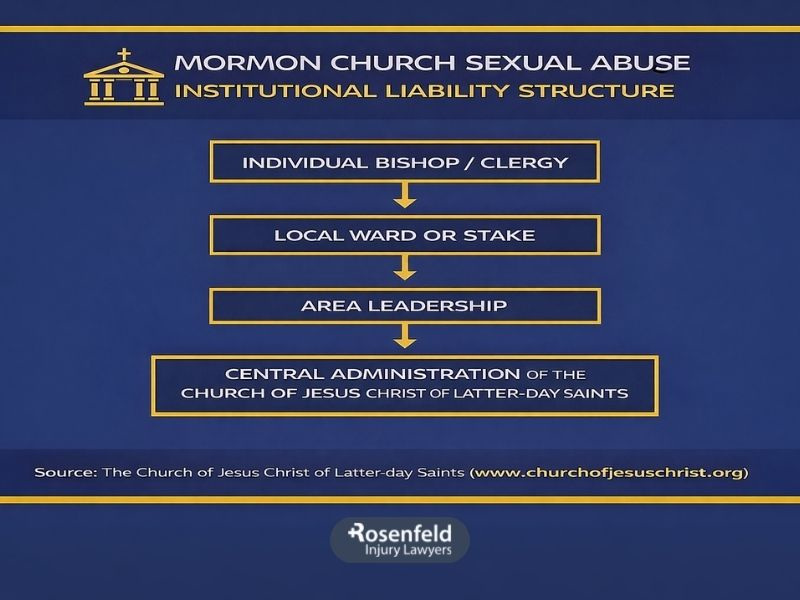
In LDS sexual abuse lawsuits, accountability is not limited to the individual who committed the abuse. We pursue civil action against every party whose negligence, silence, or misconduct allowed sexual abuse to occur or continue, especially when the abuse involved a trusted role within the Church of Jesus Christ of Latter-day Saints.
Potentially liable parties may include:
- The individual who sexually abused or assaulted the victim
- Church leaders, including bishops, stake leaders, and other church officials who ignored or dismissed reports
- The LDS Church or affiliated entities for negligent supervision, retention, or failure to report
- Church departments connected to risk management or internal handling of abuse claims
- Local congregations, wards, or church-run programs where the abuse occurred
- Institutions or individuals who knowingly allowed the perpetrator to remain around children
In many cases, lawsuits allege that the Mormon Church prioritized its reputation over the safety of sexual abuse victims, creating conditions for repeated sexual abuse and future abuse to occur.
Who Can File an LDS Church Lawsuit?
Anyone who experienced childhood sexual abuse or other forms of sexual harassment committed by a church leader, church member, or affiliated individual may be eligible to file an LDS Church lawsuit.
This may include:
- Survivors who were abused as children or teenagers
- Adult survivors whose abuse happened decades ago
- Family members or guardians filing on behalf of a minor
- Adults who were harmed by an LDS bishop, youth leader, missionary, or volunteer
- Individuals whose abuse occurred in church buildings, activities, or church-related programs
Even if you were previously told it was “too late” to take action, recent state revival laws related to Mormon Church sexual abuse lawsuits may have created new opportunities to file lawsuits and seek justice.
Every situation is different. That is why we review each case privately and carefully, help you understand your rights, and stand with you at every step of the legal process.
How Long After the Sexual Abuse Occurred Can Victims Take Legal Action?
The time survivors have to file a civil lawsuit depends on the state where the sexual abuse took place, the survivor’s age at the time, and whether state revival laws related to Mormon Church sexual abuse lawsuits apply. Each state sets its own statute of limitations for both criminal and civil cases involving child sexual abuse and sexual assault, and many have expanded or eliminated deadlines in recent years.
Below are examples of three states with large Mormon populations to show how these laws can differ.
Utah
Under Utah law, there is no statute of limitations for criminal prosecution of serious felony sexual abuse offenses. This means that prosecution may be commenced at any time, and there is no time limit for the state to bring criminal charges in many child sexual abuse cases. Civil statutes still vary depending on specific circumstances.
California
California has some of the most survivor-friendly laws in the country for child sex abuse cases. For incidents after January 1, 2024, there is no civil statute of limitations for child sex abuse claims. For incidents before January 1, 2024, survivors can file until age 40 or within 5 years of discovering the harm, whichever is later.
Idaho
In Idaho, filing civil claims must occur within 5 years of turning 18 or 5 years of discovering the harm caused by the abuse, whichever is later.
Even with expanded laws, some windows are still temporary. If you were sexually abused by an LDS bishop, church leader, or other church member, even if the abuse took place decades ago, you may still have options. We help survivors understand deadlines and file claims before any window closes.
Why You Need a Lawyer When Filing Claims Against Religious Institutions
Filing claims against the Mormon Church is not like a typical personal injury case. These institutions have extensive legal resources and a long history of handling sexual abuse allegations internally. Working with an experienced church abuse lawyer is critical to protecting your rights and strengthening your claim.
Part of what’s making Mormon Church sexual abuse lawsuits unique is the mix of complex constitutional issues, internal policies, and state-specific laws. Each state enforces its own statute of limitations for child sexual abuse, adult sexual abuse, and related claims.
Some states have eliminated time limits, while others have created temporary revival windows for cases where the abuse occurred decades ago. Missing a deadline can permanently bar a case, which is why we act quickly and strategically.
These cases also involve unique hurdles, including clergy privilege, which churches may use to block disclosure. An experienced clergy abuse lawyer knows how to challenge these defenses and focus on institutional negligence and failure to protect.
We also guide survivors through all the steps to file an LDS Church sexual abuse lawsuit, including a private case review, evidence evaluation, identifying liable parties, confirming deadlines, filing the civil complaint, and preparing the case for negotiation or trial. Throughout the process, we stay focused on your safety, your voice, and your path forward.
How Injury Lawyer Team Can Help
At Injury Lawyer Team, we know how difficult it is to come forward about sexual abuse committed by someone connected to faith, trust, or authority. You do not have to navigate this alone. We support survivors step by step, from the initial conversation through resolution.
A critical part of building a strong case involves gathering the evidence needed to support LDS Church sexual abuse claims. This may include:
- Personal statements and survivor testimony
- Witness accounts and family statements
- Church records, membership information, and internal documents
- Counseling and mental-health treatment records
- School, medical, or employment history showing impact
- Prior complaints against the same church leader or church member
- Any reports to law enforcement or child protection agencies
As your case progresses, our services include:
- Detailed case investigation and documentation
- Coordination with trauma-informed medical and mental-health professionals
- Legal filings and court representation
- Negotiation with opposing counsel
- Ongoing communication and emotional support
- Trial preparation, if your case goes that far
- Representation in court
Our sexual abuse lawyers believe in your case. We stand with you, and we stay focused on protecting victims, pursuing accountability, and working to prevent future abuse in religious and community environments.
Sexual Assault Settlements Recovered by Our Law Firm
We have represented survivors in difficult and deeply personal cases involving abuse by trusted authority figures. While every case is different and past outcomes never guarantee future results, the following examples of church abuse settlements show how survivors have pursued justice through the civil court system.
$14,200,000 recovery: Six young men were groomed and fondled by a priest while attending a religious school. Despite a known record of abuse from other parishes, the priest was hired and given access to students. The prolonged psychological and emotional harm, combined with institutional negligence and prior warning signs, played a significant role in the outcome.
$2,500,000 settlement: A survivor came forward after being abused by a defrocked priest who continued to access vulnerable individuals even after concerns had previously been raised. The settlement reflected the long-term trauma, mental health impact, and clear failure of oversight by the religious organization.
$2,000,000 recovery: A man was sexually assaulted by a maintenance worker at a large Catholic Church while the worker had unsupervised access to church facilities. Evidence pointed to a lack of proper background checks and supervision, which significantly influenced the resolution of the case.
These amounts represent legal recognition of the serious harm caused by clergy sexual abuse and institutional negligence. In many cases, survivors are not just seeking financial recovery; they are seeking accountability, acknowledgment, and change.
FAQ
What is the scale of alleged abuse in the Mormon Church?
Hundreds of survivors across multiple states have come forward over many decades, leading to a growing number of civil claims and investigations. Uncovering how widespread Mormon Church sex abuse is continues to evolve as more people report what happened and as courts review long-hidden records.
Can the identity of sexual abuse victims remain hidden?
Yes. In many cases, lawsuits can be filed anonymously, allowing survivors to pursue justice while protecting their privacy and personal safety.
What if the abuser is no longer with the LDS Church?
You may still be able to file a claim. The LDS Church and affiliated entities can remain legally responsible for failing to protect you, regardless of whether the individual abuser is still connected to the Church.
How much does it cost to hire a sexual abuse lawyer?
We work on a contingency fee basis, which means there are no upfront costs and no legal fees unless we recover compensation. We also offer a free consultation so you can understand your options without any pressure.
Book a Free, Confidential Consultation
If you are considering legal action against the Church of Jesus Christ of Latter-day Saints, we invite you to contact us for a free, confidential consultation. We handle these cases on a contingency fee basis, meaning you pay nothing upfront and nothing unless we successfully recover for you. We stand with you, and you are not alone.
All content undergoes thorough legal review by experienced attorneys, including Jonathan Rosenfeld. With 25 years of experience in personal injury law and over 100 years of combined legal expertise within our team, we ensure that every article is legally accurate, compliant, and reflects current legal standards.