

Sexual Abuse and Assault Injury Lawyers


LDS Church Sexual Abuse MDL
At Injury Lawyer Team, we work with survivors across the country who are trying to understand the evolving legal landscape surrounding LDS Church sexual abuse MDL discussions and what that means for their own path forward.
Many of our clients were harmed within environments associated with the Church of Jesus Christ of Latter-day Saints, and they now want clarity, accountability, and truth. As Mormon Church sexual abuse lawyers, we have closely followed every development tied to this proposed MDL and how it affects LDS sexual abuse lawsuits in multiple states.
For survivors of sexual abuse and child sexual abuse tied to religious institutions like the Mormon faith and the broader LDS community, the legal process can feel overwhelming, unfamiliar, and deeply emotional. We approach every case in a trauma-informed way. We stand with you, and we believe in your case.
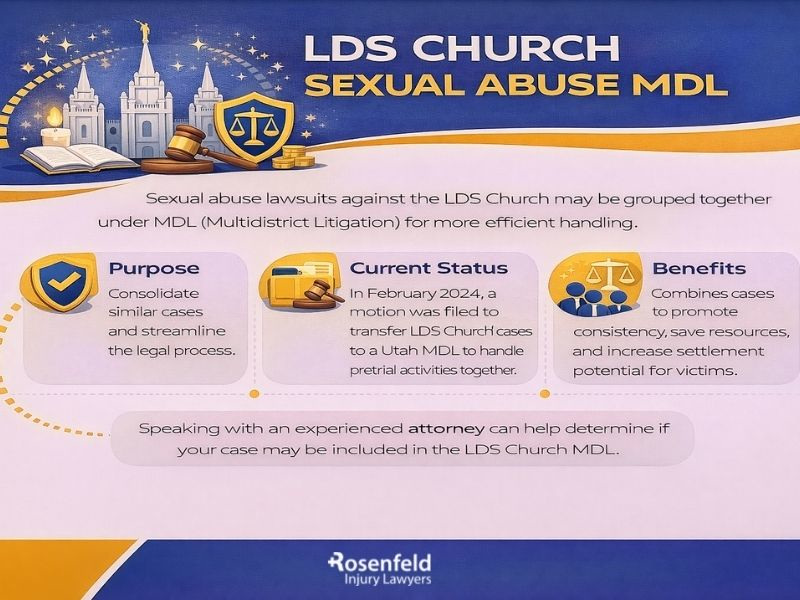
What an MDL Is and Why It Was Proposed for LDS Church Sex Abuse Claims
A multidistrict litigation (MDL) is a process used to consolidate similar cases into one federal court for coordinated pre-trial proceedings. When multiple lawsuits share common legal or factual issues, the Judicial Panel on Multidistrict Litigation (JPML) can decide to move those cases into a single forum for efficiency.
In the context of Mormon Church sexual abuse cases, consolidation was proposed because of repeated patterns appearing across states involving church authorities, internal reporting procedures, and the Help Line.
Survivors reported that when they tried to alert leaders about sex abuse or sexual misconduct, their complaints were often directed through the Help Line and filtered through internal decision-makers instead of being reported to law enforcement. These patterns raised legal questions about institutional responsibility, reporting obligations, and the use of clergy-penitent privilege.
Several key reasons were cited when asking the judicial panel to consider an abuse MDL:
- Repeated allegations of institutional mismanagement within the Church and local leadership
- Similar factual patterns appearing in sexual abuse cases across different states
- Overlapping issues involving internal reporting, the Help Line, and the application of clergy-penitent privilege
- The efficiency of having one court oversee discovery and shared motions instead of duplicating them in dozens of separate courts
- Multi-state mobility among Mormon families and missionaries, which made individual litigation more complex and fragmented
For many adult survivors who experienced sexual abuse involving Mormon faith communities, the idea of MDL felt like an opportunity for the voices of many to be heard together.
JPML Motions and Hearing Updates
In response to growing numbers of sexual abuse claims, plaintiffs petitioned the JPML to create a centralized MDL for LDS sexual misconduct cases. The goal was to bring federal cases from various states into a single jurisdiction for coordinated discovery, expert witness development, and legal arguments.
During this time, the Church and its legal representatives, along with other involved law firms, requested delays and extensions. They cited the possibility of mediation and resolution discussions, asking the panel to pause while those efforts played out.
Ultimately, the JPML declined to form an MDL. The panel said that the abuse lawsuits varied too widely in time periods, geographic locations, defendants, and fact patterns to justify centralization. The cases spanned decades, from earlier claims involving different church policies to more recent abuse allegations. They involved different wards, stakes, reporting requirements, and state-specific laws.
As of now, LDS sexual abuse lawsuits continue individually in state and federal courts rather than as a centralized MDL. However, the panel did acknowledge that if future filings show greater uniformity, there may be another opportunity to revisit consolidation.
Why the JPML Denied Centralization of Mormon Church Sexual Abuse Lawsuits
One of the primary reasons given for denial was that cases related to the Church of Jesus Christ of Latter-day Saints were too fact-specific to be treated as a single group.
Key points in the denial included:
- The abuse cases span decades of differing church policies and leadership structures
- Allegations involve different wards, stakes, and governing church authorities in multiple states
- Reporting obligations and internal processes changed over time
- Factual issues in each abuse case were highly individualized
- There was no single “common event” uniting all claims
- Differences in state revival laws significantly affecting LDS Church sexual abuse cases made uniform treatment difficult
State revival laws, which reopen the statute of limitations for certain survivors, may allow one person to file a lawsuit in one state while another survivor in a different state may not have the same opportunity. These differences played a major role in the JPML’s decision.
What MDL Denial Means for Survivors
Even though the JPML denied the creation of a consolidated MDL, this does not mean that LDS sexual abuse claims are weakened or invalid. In fact, for many survivors, individual cases allow for a more personalized and survivor-centered approach.
Without an MDL:
- Each sexual abuse case proceeds in its own state or federal court
- Discovery rules and timelines vary depending on jurisdiction
- Survivors retain greater individualized control over their cases
- Local evidence, witnesses, and sexual abuse reports can be tailored to the specific community
- Law firms representing survivors may still coordinate strategy and research informally
- Future global or large-scale settlement discussions are still possible
We remind our clients that the absence of consolidation does not diminish the seriousness of sexual abuse allegations or the wrongdoing that occurred. The path to justice still exists.
How Filing Works Without an MDL
Many survivors now ask us how to file an LDS sexual abuse lawsuit without the structure of an MDL. We help guide them through that process step by step.
In general:
- Claims may be filed in state or federal court, depending on jurisdiction and defendants
- Cases may be brought against individual church members, local LDS entities, or central governing bodies
- Each sexual abuse case must independently establish facts, evidence, and legal claims
- Discovery is not automatically shared, so evidence must be requested in each case
- Timelines are heavily influenced by the state’s laws, including any revival statutes
If you are considering filing LDS sexual abuse lawsuits or have questions about a potential claim, we can explain your options clearly and compassionately.
How Our Legal Team Can Help
At Injury Lawyer Team, our legal team actively monitors all developments involving LDS Church sexual misconduct MDL discussions, trends, and major court rulings involving religious institutions. We understand how the structure of the Mormon Church, the role of LDS communities, and internal governance can affect sexual abuse lawsuits.
We are committed to trauma-informed representation. Our firm believes survivors. We know it takes courage to narrate what happened, and we honor that courage in every step we take together.
We support survivors by:
- Explaining your legal rights in simple, understandable terms
- Analyzing how state revival laws may apply to your abuse case
- Identifying responsible parties, including church officials and institutions
- Preparing evidence and abuse reports with care and accuracy
- Filing and managing your civil lawsuit with discretion and respect
- Advocating for your voice to be heard in court
- Protecting your privacy and dignity throughout the process
By holding church officials and institutions accountable, we support survivors on their path to justice and help expose systemic failures to protect children from future harm.
All cases are handled on a contingency fee basis, which means there are no legal fees unless we recover compensation for you. We also offer a free and confidential consultation so you can speak with our team without pressure or obligation. If you or someone you love is ready to explore your options for sexual abuse lawsuits, we invite you to contact us today.
All content undergoes thorough legal review by experienced attorneys, including Jonathan Rosenfeld. With 25 years of experience in personal injury law and over 100 years of combined legal expertise within our team, we ensure that every article is legally accurate, compliant, and reflects current legal standards.