

Sexual Abuse and Assault Injury Lawyers


How Widespread Are Mormon Church Sexual Abuse Claims
At Injury Lawyer Team, we help survivors understand how widespread are Mormon Church sexual abuse claims and what legal options may exist. For many, the harm is tied to a trusted religious institution, making it difficult to speak out. We now know that Mormon Church sex abuse spans more than five decades of reported misconduct, silence, and institutional failure.
If you are searching for answers or an experienced LDS Church sexual abuse attorney, you are not alone. We stand with you, we believe in your case, and we are here to guide your first steps toward accountability and healing.
How Many LDS Church Lawsuits Have Been Filed for Sex Abuse?
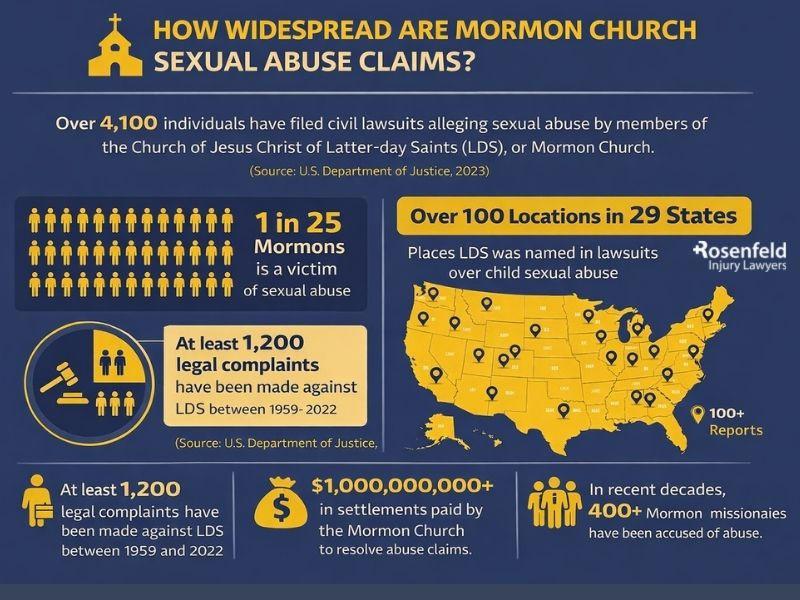
Tracking the true number of claims against Mormon Church members is challenging because many survivors chose to remain silent for years, and some claims were resolved confidentially, without public filings.
Even today, not every survivor is ready to share their experience in a legal setting. Yet despite these gaps, documents, investigative reports, and court filings indicate a persistent and widespread pattern connected tothe LDS Church abuse.
A leaked document titled “Instances of Child Sexual Abuse Allegedly Perpetrated by Members of the Church of Jesus Christ of Latter-day Saints” outlined dozens of allegations dating back decades. The accounts covered multiple states, age groups, and alleged perpetrators, showing a disturbing pattern that repeated in different communities over time.
In multiple reports, legal observers note that over 300 lawsuits were filed over a relatively short period, including nearly 100 in California alone. These cases involved a Mormon Church bishop or someone operating in a position of trust within church-connected environments.
Some cases have also emerged in places such as West Virginia, showing that this is not a localized issue but part of a broader national pattern. Survivors in both rural and urban areas have described similar experiences, even though they had no connection to one another.
Importantly, the U.S. JPML rejected consolidating Mormon Church sexual abuse lawsuits into an MDL, meaning survivors’ cases remain largely in separate filings rather than being grouped into one large action in state and federal courts. As a result, each survivor’s circumstances are evaluated independently, allowing for individualized accountability and advocacy.
Sexual Abuse Allegations in Lawsuits Involving the Mormon Church
The allegations raised in these cases span a wide range of contexts. Many involve clergy sexual abuse committed by local church leaders, while others involve volunteers, youth workers, or adults placed in positions of authority over children and teenagers.
Survivors describe abuse occurring during private meetings, overnight activities, counseling sessions, missionary preparation, and youth programs connected to the Mormon Church.
In countless stories, the same theme emerges: trust was broken, and when victims tried to speak, they were discouraged, ignored, or told to stay silent. For some, the experience was treated as an abuse secret, something to be hidden to protect the institution’s image rather than addressed to protect children.
One widely cited issue is the LDS Church Help Line scandal. Reports describe how a helpline meant for reporting abuse often redirected leaders to legal counsel instead of law enforcement. Instead of immediate action to keep children safe, decisions were filtered through legal channels, delaying or preventing proper intervention.
These patterns have raised concerns far beyond a single faith group. Across many religious organizations, survivors continue to question why abuse was not reported, why leaders were not removed, and why safety was not prioritized.
Bishops Not Always Required to Report Abuse
A major obstacle in many cases is how the law has treated disclosures made to clergy. In Utah, for example, while most professionals (such as medical staff) are bound by mandatory reporting laws, the law includes an explicit exemption for members of the clergy when information is revealed in the context of confession, a protection tied to both clergy-penitent privilege and clergy privilege.
In 2020, House Bill 90 sought to remove that exemption that was, in a way, shielding the Mormon Church. However, the bill was ultimately struck down at the state capitol in Salt Lake City, leaving the exemption intact. As a result, in many cases, disclosures of abuse may have remained confidential instead of being reported to authorities who could have intervened.
For survivors, this reality is devastating. Many believed that by speaking to a religious leader, they were protecting themselves and others, when, in fact, no external report was ever made. This legal gap has had long-term consequences for victims, their families, and their communities.
Who Are the Perpetrators of Sexual Assault in the LDS Church?
In LDS Church sexual abuse lawsuits, the alleged perpetrators come from a variety of roles and positions, including:
- Local congregation leaders and other church officials
- Adult volunteers working with youth groups
- Individuals assigned to mentorship or guidance roles
- Participants in church-sponsored activities
- Adults placed in positions of supervision over children
In many cases, the person accused was someone the family trusted completely. The survivor may have been encouraged to spend time alone with that person or to seek guidance from them, believing they were safe.
A recurring theme in these claims is that warning signs were missed, dismissed, or ignored. In some situations, concerns were raised, but no meaningful action from the Mormon Church followed. In others, the accused was quietly transferred or removed without a report to authorities, allowing risk to continue elsewhere.
These repetitive failures are central to many cases alleging church sex abuse, where institutional decisions are examined alongside the individual’s conduct.
Why Sexual Abuse Victims Are Taking Legal Action?
The decision to come forward is never easy. Many survivors spent years blaming themselves, doubting their memories, or believing no one would believe them. Some continued to attend church, internalizing their trauma as part of their identity.
Now, more sexual abuse survivors are stepping forward and taking action for several important reasons:
- They want acknowledgment of the harm they endured
- They want those responsible to be held accountable
- They want to protect others from child sex abuse
- They want to regain control of their own narrative
Many have experienced sexual abuse and lived with its impact on relationships, mental health, finances, and personal safety. The trauma often follows survivors into adulthood, affecting careers, family life, self-worth, and physical health.
Another important reason why sexual abuse survivors are taking legal action against the Mormon Church is that new civil pathways have opened. Even if criminal prosecution is no longer possible, a civil lawsuit may still provide an avenue for accountability. Changes in statutory time limits and new legal interpretations have allowed more survivors to finally pursue justice and bring forward a long-buried sex abuse case.
How We Can Help You File Child Sexual Abuse Claims
At our law firm, we specialize in providing compassionate and experienced legal counsel for sexual abuse lawsuits, including those involving the Church of Jesus Christ of Latter-day Saints. If you suffered child abuse by a church member, in a church-sponsored program, or under the oversight of church leaders, we can help you take the next step.
Here’s how we support you:
- We listen to your story confidentially and explain your rights
- We assess whether your sexual abuse case qualifies under current laws
- Our services are provided on a contingency basis, which means there are no legal fees unless we recover for you
- We handle the legal process from investigation through resolution
- We stand with you every step of the way as you seek justice
If you were sexually abused within the Mormon Church or by its leaders, we are here for you. Contact us today for a free consultation. Let’s explore your legal options together and take meaningful action toward healing and accountability.
All content undergoes thorough legal review by experienced attorneys, including Jonathan Rosenfeld. With 25 years of experience in personal injury law and over 100 years of combined legal expertise within our team, we ensure that every article is legally accurate, compliant, and reflects current legal standards.