

Sexual Abuse and Assault Injury Lawyers


Immigration Detention Sexual Abuse Lawsuit
Seek Justice for Sexual Abuse in Immigration Detention Facilities
Seeking justice after sexual harm in custody is never easy, but you are not alone. At our firm, we stand with survivors who have been hurt while detained, and we believe in your case. An immigration detention sexual abuse lawsuit can be a powerful way to protect your rights, demand accountability, and begin healing.
Many people are detained for civil immigration reasons, not because of a criminal conviction. Even so, their daily reality may resemble incarceration: restricted movement, limited privacy, dependence on staff for basic needs, and separation from family and community support. Those conditions can create an environment where sexual abuse is more likely and where reporting can feel impossible.
Injury Lawyer Team represents people who have experienced sexual abuse in immigration detention centers across the country. We understand the fear, isolation, and power imbalance that often define life in detention. Our role is to listen, protect your dignity, and pursue legal action under federal law, step by step, at your pace.
What Constitutes Sexual Abuse at DHS or ICE Facilities?
The definition of sexual abuseincludes any sexual acts, sexual assault, coerced sexual contact, sexual harassment, or unwanted sexual touching, whether committed by facility staff, contractors, or detainees, particularly where consent cannot be freely given due to detention conditions.
Sexual abuse in immigration detention can take many forms, including:
- Sexual assault by guards, medical staff, contractors, or detainees
- Coerced or pressured sexual acts in exchange for necessities, privileges, or protection
- Threats, intimidation, or sexual harassment by people in positions of authority
- Unwanted touching during searches or “medical” encounters that lack a legitimate purpose
- Retaliation after reporting sexual abuse or requesting protective measures
In such facilities, consent is often complicated by the power imbalance. When someone holds authority over your housing, movement, discipline, and access to health care, coercion can be subtle but still legally and ethically significant.
Statistics and Oversight Failures
According to a report by Freedom for Immigrants, a non-profit based in California, oversight has repeatedly failed detainees reporting sexual violence.
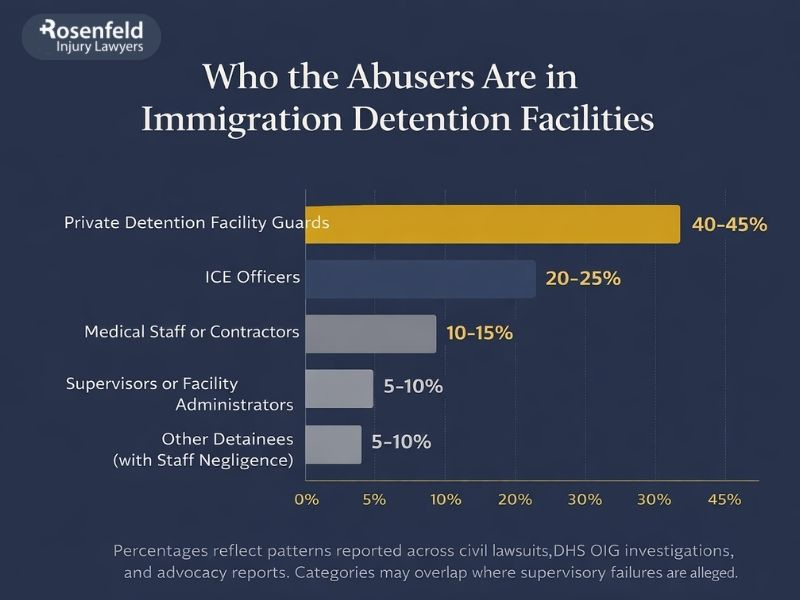
Between January 2010 and July 2016, the OIG received more than 33,000 complaints alleging sexual assault or physical abuse involving DHS component agencies. Yet the Inspector General investigated fewer than 1% of those complaints.
During a shorter period, from May 2014 through July 2016, people held in detention filed at least 1,016 reports of sexual abuse, averaging more than one complaint per day. Despite the volume and severity of these allegations, the OIG investigated only 24 cases, representing just 2.4% of the total reports.
Beyond those sexual abuse and sexual assault complaints, detainees also submitted 402 reports of coerced sexual contact, 196 complaints of sexual harassment, and 380 complaints of physical or sexual abuse against ICE.
Immigration & Customs Enforcement (ICE) received more complaints than any other DHS component. Nearly 44.4% (approximately 14,700 complaints) were lodged against ICE, followed by Customs and Border Protection (CBP).
For survivors, this well-documented history matters because it shows the risk of being sexually abused is not hypothetical, and it highlights why external reporting, documentation, and legal representation can be critical.
What Laws Protect Detainees’ Civil Liberties?
People in ICE custody still have basic protections. Detention does not erase your rights. In many cases, sexual abuse and assault in detention can implicate due process, bodily integrity, and civil rights, especially when officials ignore reports or fail to safeguard detainees from known risks.
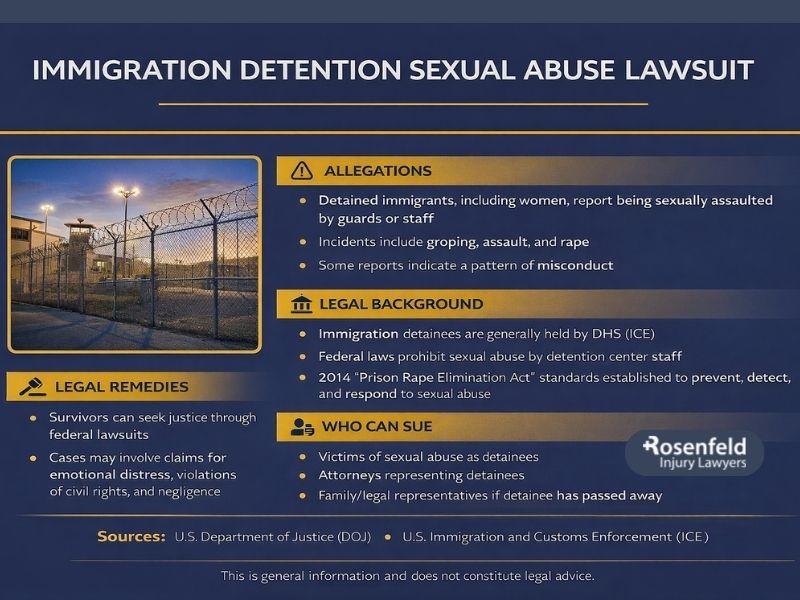
The Prison Rape Elimination Act (PREA) is a federal law intended to prevent, detect, and respond to sexual abuse in confinement settings. PREA standards focus on:
- Prevention policies and staff training
- Safer reporting pathways and anti-retaliation protections
- Timely response procedures
- Access to medical treatment, evidence collection, and support services
- Better monitoring and accountability measures
PREA does not always provide survivors with a direct private lawsuit, but PREA-related failures can be powerful evidence in civil litigation. When a detention facility ignores PREA standards, fails to train staff, or blocks reporting, those facts can support claims that the system failed to protect detainees.
PREA is also relevant because it sets expectations for how detention facilities should operate. When private companies that run detention centers cut corners, are understaffed, or ignore complaints, PREA standards help demonstrate what reasonable safety practices should have looked like.
Who Can Be Held Liable for Sexual Assault at an Immigration Detention Center
A sexual abuse case in immigration detention often involves more than one wrongdoer. Liability may extend to the person who committed the harm, supervisors who ignored warning signs, contractors who failed to follow policy, or federal agencies responsible for oversight and safety.
Individual Abusers, Including Other Detainees
Some survivors are assaulted by staff; others are harmed by other detainees. In either situation, individual accountability matters. We focus on identifying the perpetrator, documenting the incident, and documenting the detention facility’s response (or lack thereof). If the facility had notice of danger, such as prior complaints, known threats, or poor housing assignments, that can be central to proving negligence.
Immigration and Customs Enforcement (ICE) and the Department of Homeland Security (DHS)
When safety systems fail due to inadequate staffing, poor classification, ignored reports, or delayed medical treatment, ICE and Homeland Security policies and oversight may become part of the case.
Sometimes misconduct is tied to systemic failures: a culture of disbelief, barriers to reporting, retaliation against complainants, or persistent noncompliance across ICE facilities. These issues may help establish patterns relevant to broader relief, including injunctive changes or, in some contexts, a class action lawsuit.
The Federal Tort Claims Act (FTCA) can be a pathway to seek compensation from the federal government for certain misconduct by federal employees. FTCA cases are procedural and deadline-driven. They typically require an administrative claim before filing suit and can involve complex questions about whether specific individuals qualify as federal employees or independent contractors.
Even when a facility is operated by private companies, FTCA issues still matter because federal agencies may retain oversight, contracting, and detainee safety responsibilities. Our job is to evaluate the facts and select the strongest legal path.
Another potential legal avenue is a Bivens claim. Named after the Supreme Court case Bivens v. Six Unknown Named Agents, these claims allow individuals to sue federal authorities for certain constitutional violations. A Bivens claim requires proving that a federal officer, acting under federal authority, violated a constitutionally protected right.
However, the Supreme Court has significantly curtailed the availability of Bivens claims in recent years, making them a more challenging path for relief.
That doesn’t mean we ignore this option. It means we evaluate it carefully alongside FTCA and other legal theories to pursue the most realistic and effective strategy for our clients.
What to Do If You Have Experienced Sexual Abuse at a DHS or ICE Detention Center
If you have experienced sexual abuse in a DHS or ICE detention center, your safety and health come first. We never want survivors to feel pressured to navigate this alone.
Here are practical steps that can help protect you and preserve your rights:
- Get medical attention immediately, if possible. Request medical care and ask that injuries and symptoms be documented. Medical records can become critical evidence.
- Request mental health support. Trauma is real, and counseling can help, both for healing and for documenting harm.
- Preserve evidence. If safe, write down details: dates, times, names, locations, what was said, and any witnesses. Keep copies of grievances or requests.
- Report to external oversight bodies. You can report the abuse to external oversight bodies, such as the DHS Office for Civil Rights and Civil Liberties (CRCL) or the Office of Inspector General (OIG). Reporting outside the facility can reduce some risks and create a record.
- Seek protective measures. Ask to be separated from the abuser, request a housing change, and document any retaliation.
- Avoid signing statements you don’t understand. Language barriers are common. If anything is unclear, request a translation and legal assistance.
- Contact an attorney as soon as you can. Deadlines can apply, and early legal support helps preserve evidence and protect your rights.
- Document ongoing symptoms and treatment. Keep track of medical care, medications, therapy, sleep disruption, fear, anxiety, and the impact on daily functioning.
We know these steps may be difficult in detention. Our role is to reduce that burden and guide you with clarity and care.
How Injury Lawyer Team Can Help Protect Detainees’ Human Rights
When survivors call our firm, we start by listening. We do not rush your story or treat you like a file number. We stand with you, and we believe in your case.
Our services in this context include:
- Confidential intake and case assessment: We explain your options for legal action under federal law, including potential FTCA and civil paths.
- Evidence preservation: We move quickly to identify documents, medical records, grievance history, witness names, and potential video or incident reports.
- Investigation of facility practices: We evaluate staffing, supervision, access to reporting, and compliance with PREA-related expectations.
- Identifying responsible parties: We assess the role of federal agencies, contractors, private companies, and individual perpetrators.
- Reporting guidance and advocacy: We help survivors understand their reporting options to oversight bodies.
- Claim preparation and filing: We prepare administrative filings as required and build cases that withstand scrutiny by federal officials and defense teams.
- Negotiation and litigation: We pursue accountability through settlement discussions or court action, always aligned with our clients’ goals.
- Case resolution: Whether the case settles or is decided by the court, we stay focused on dignity, privacy, and long-term support.
FAQs
Why are immigration detainees vulnerable to sexual violence?
Immigration detention often involves isolation from family, limited legal access, dependence on facility staff, and fear of retaliation. Many detainees also face language barriers and trauma histories. When detention centers lack robust oversight or when reporting systems are not trusted, perpetrators may feel protected. These conditions can make sexual abuse in immigration more likely and harder to stop.
What are the consequences of sexual assault in immigration detention centers?
The impacts can include physical injury, chronic pain, and long-term trauma. Many survivors experience depression and PTSD, as well as anxiety, sleep disruption, panic, or difficulty functioning. Access to medical care and medical attention is crucial, and mental health support can be equally important.
Is there a class action lawsuit for sexual assault at immigration detention centers?
A class action lawsuit may be possible when patterns of misconduct or systemic failures affect many detainees in similar ways, such as recurring abuse, barriers to reporting, retaliation, or widespread noncompliance. Whether a class case can proceed depends on shared facts, common legal questions, and the scope of the evidence.
How long do victims have to take legal action?
Time limits vary depending on the claims involved, including FTCA requirements and other federal civil rights deadlines. Because these cases can be procedural, we encourage survivors to consult counsel as soon as possible to meet deadlines and preserve evidence.
Book a Free Consultation
If you are searching for a sexual abuse lawyer who understands immigration detention, civil rights, and the realities of abuse in immigration detention centers, we are here to help. We offer a free, confidential consultation and handle cases on a contingency-fee basis, meaning you pay nothing up front and we are paid only if we recover compensation for you. Contact us when you are ready.
All content undergoes thorough legal review by experienced attorneys, including Jonathan Rosenfeld. With 25 years of experience in personal injury law and over 100 years of combined legal expertise within our team, we ensure that every article is legally accurate, compliant, and reflects current legal standards.