

Sexual Abuse and Assault Injury Lawyers


Diocese of Springfield Sexual Abuse Claims
The Diocese of Springfield, established to serve the spiritual needs of a significant Catholic population, has long been a cornerstone of faith in Central and Southern Illinois.
Spanning communities from Quincy to Decatur and Granite City to Jacksonville, the diocese has fostered devotion through its churches, schools, and outreach efforts, such as those by Catholic Charities.
Despite its role in shaping Catholic life, the diocese has been marred by allegations of clergy sexual abuse, which have deeply affected the faithful and raised serious questions about institutional accountability.
The Diocese of Springfield sexual abuse attorneys at Injury Lawyer Team stand with survivors, offering compassionate representation and the expertise to pursue compensation and accountability.
Background and Influence of the Roman Catholic Diocese of Springfield
The Diocese of Springfield in Illinois, originally established as the Diocese of Alton in 1853, was renamed in 1923 to reflect its relocation to the state capital.
Encompassing 28 counties in Central and Southern Illinois, the diocese serves a Catholic population spread across cities like Decatur, Quincy, Alton, and Granite City. Its influence extends through parishes, schools, and charitable organizations that strive to embody the teachings of the Roman Catholic Church.
The cathedral of the diocese, the Cathedral of the Immaculate Conception in Springfield, stands as a spiritual and architectural landmark. It reflects the diocese’s commitment to fostering a vibrant Catholic faith.
Over the years, prominent bishops have shaped the diocese, emphasizing its commitment to education, service, and evangelization. However, the diocese’s legacy has been marred by allegations of clergy sexual abuse, exposing systemic failures and calling into question its ability to protect vulnerable individuals.
Credible Allegations of Sexual Abuse Within the Diocese of Springfield in Illinois
The Diocese of Springfield in Illinois has faced numerous allegations of sexual abuse by clergy members, with cases spanning several decades.
One of these egregious cases involves Father Alvin L. Campbell, who began abusing children immediately after he was named pastor at Assumption of the Blessed Virgin Mary in Assumption in 1979. In December 1981, a family reported the priest’s misconduct with their daughter to Bishop McNicholas.
The priest quickly resigned, citing “health reasons.” However, within months, he was reassigned to another parish.
From 1982 to 1985, the priest served at Saint Maurice in Morrisonville, where diocesan records show he abused 26 children. Survivors’ descriptions of the abuse include masturbation, group masturbation, photographing abuse acts, groping, oral sex performed on children, anal sex performed on the priest, anal sex performed on children, fondling, kissing, and pornography.
While the diocese failed to act on the priest’s abuse, law enforcement stepped in, and in 1985, he was indicted for molesting boys aged 11 to 15. The priest pleaded guilty but mentally ill and received a 14-year prison sentence.
Diocesan records confirm he abused 34 children while serving in the Diocese of Springfield, and 26 of these abuses occurred after the diocese received its first report of misconduct from Assumption of the Blessed Virgin Mary parish.
Another notable case is that of Father Walter Weerts, who gained their parents’ trust, gifted the boys, took them to luxurious restaurants, and even on private plane trips.
The Diocese of Springfield’s records show that both Bishops William O’Connor and Joseph McNicholas knew of the priest’s abuse of young boys as early as the 1960s and 1970s. Instead of addressing the abuse, the diocese reassigned him to at least three different parishes, allowing him to abuse around 20 more boys before his criminal indictment in 1985.
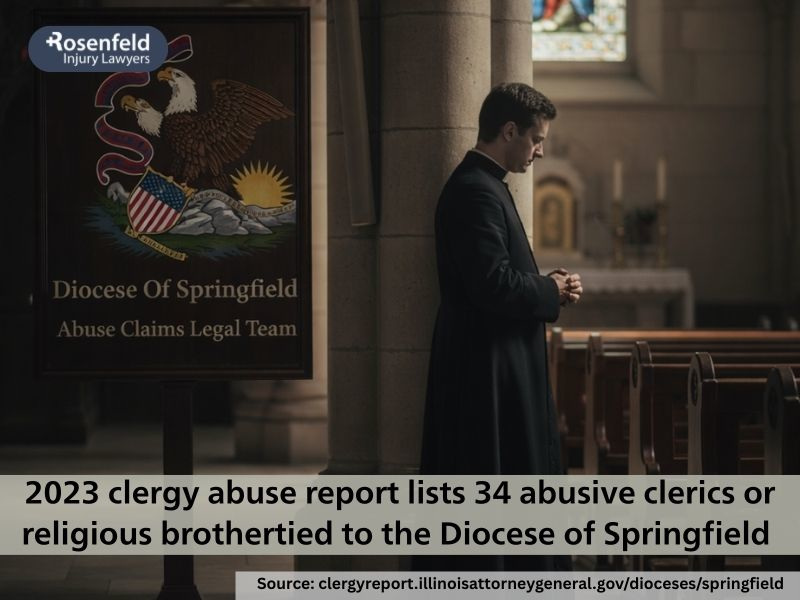
The published list of Illinois priests accused of child abuse in the Diocese of Springfield includes:
- Fr. Alvin L. Campbell
- Fr. Joseph D. Cernich
- Fr. Eugene E. Costa
- Fr. Garrett Neal Dee
- Fr. Robert DeGrand
- Fr. Robert Dodd
- Fr. Kevin J. Downey
- Fr. Michael Owen Driscoll
- Fr. Robert Eagear
- Fr. George Faller
- Fr. Ray Franzen
- Fr. Joseph Havey
- Fr. George Kromenaker
- Fr. Peter Mascari
- Fr. Richard Niebrugge
- Fr. Joseph Cullen O’Brien
- Fr. Frank J. O’Hara
- Fr. James Patrick O’Hara
- Bishop Daniel L. Ryan
- Fr. Louis Schlangen
- Fr. Aloysius Schwellenbach
- Fr. Louis C. Shea
- Fr. Francis Tebangura
- Fr. Walter M. Weerts
- Fr. Frank D. Westhoff
- Fr. Stanislaus Yunker
Legal Proceedings and Investigations into the Diocese of Springfield
The Diocese of Springfield in Illinois has faced extensive legal scrutiny and public outrage over its handling of clergy sexual abuse cases.
Besides the criminal prosecutions of priests mentioned above, in July 2004, the diocese reached a $1.2 million settlement with eight men who alleged they were sexually abused by former priest Walter M. Weerts during the 1970s.
The abuse reportedly occurred in various locations, including a Granite City apartment. The priest, who was laicized in 1989, had a history of misconduct, including flying boys in his private plane and taking them to his apartment, where the abuse occurred.
In February 2004, the diocese agreed to a $3 million settlement with 28 individuals who accused 14 priests of sexual abuse. This settlement aimed to provide compensation for the victims and address the failures in handling previous allegations.
The Diocese of Springfield in Illinois has faced significant criticism for its handling of clergy sexual abuse allegations, with evidence of systemic failures and institutional negligence that allowed abuse to persist.
In many cases of alleged abuse, the diocese disregarded clear warnings about a priest’s misconduct. Bishop Joseph McNicholas was informed by a senior U.S. Army chaplain of Campbell’s “moral problem with boys,” yet allowed him to minister in multiple parishes, where he abused dozens of children.
The diocese frequently reassigned priests credibly accused of abuse instead of removing them from ministry. This practice placed more parishioners at risk by moving priests between assignments despite allegations of abuse involving boys and young men.
Investigations have revealed that the diocese often failed to report abuse allegations to law enforcement or disclose the extent of misconduct to parishioners. Settlements with survivors were often accompanied by confidentiality agreements, limiting public knowledge of the scope of the abuse.
Even after receiving direct reports of abuse, the diocese was slow to act. In one case, diocesan officials were aware of abuse as early as 1980, yet allowed him to remain in ministry for years, during which he abused additional children.
The diocese’s approach to handling abuse allegations has been criticized as prioritizing institutional reputation over the safety of children. A lack of oversight, combined with efforts to conceal misconduct, created an environment where abusers could operate with impunity.
While the Diocese of Springfield has since implemented measures such as abuse prevention training and mandatory reporting policies, survivors and advocates argue that these steps are insufficient to address past failures.
Legal Options for Survivors
Survivors of clergy abuse in the Diocese of Springfield can seek justice by reporting abuse to law enforcement for potential criminal prosecution or filing claims for compensation and holding the diocese accountable for negligence.
At Injury Lawyer Team, we are dedicated to supporting survivors of clergy abuse in the Diocese of Springfield. With extensive experience in handling these sensitive cases, we provide compassionate advocacy and expert legal guidance. Our Illinois clergy abuse attorneys work tirelessly to hold abusers and institutions accountable, helping survivors secure justice and the compensation they deserve.
What Is the Time Limit to File a Civil Claim Following Clergy Abuse of a Minor in Springfield, IL?
In Springfield, Illinois, survivors of misconduct involving minors by Catholic clergy are not constrained by a traditional statute of limitations.
Illinois law (735 ILCS 5/13-202.2) permits a civil lawsuit based on childhood sexual abuse to be filed at any time, regardless of when the abuse occurred. This applies to claims involving intentional misconduct by an ordained priest or other church employees acting in an official capacity, as well as claims against diocesan offices when institutional failures contributed to harm.
Civil cases may examine whether abuse occurred during a priest’s assignments in the diocese, whether appropriate procedures were followed once concerns arose, and whether church leadership took reasonable steps to protect children and vulnerable adults. These claims are brought in court, independent of church processes, and focus on accountability under civil law.
Public discussions concerning clergy abuse in the Diocese of Springfield in Illinois have referenced a range of parishes and institutions—such as Sacred Heart Parish, Saint John, and Saint Joseph—as part of broader reporting and diocesan disclosures.
These references reflect the scope of parish life in the region rather than determinations of wrongdoing at any specific location. In some instances, diocesan statements have addressed whether a priest was placed on temporary administrative leave or otherwise restricted while an internal review was conducted.
The diocese has stated that it maintains internal safeguards, including a review board, victim assistance resources, and safe environment policies administered through the diocesan chancery office.
When allegations are reviewed, the diocese may publicly disclose outcomes by maintaining a published list of clergy when claims are determined to be credible, while noting that such determinations are administrative in nature and distinct from credible findings by a court.
Civil litigation is separate from any inquiry by civil authorities and does not depend on whether criminal charges were filed or whether allegations were addressed in another jurisdiction.
A civil claim may proceed regardless of the current status of the accused, including whether an individual is presently accused or no longer in ministry. The focus remains on whether abuse occurred and whether institutional responses were adequate.
For survivors and families seeking accountability, pursuing a civil claim can be part of accessing support and recognition of harm. Our attorneys can explain how Illinois law applies, what evidence may be relevant, and what options are available, while respecting the survivor’s dignity and individual circumstances.
Book a Free, Confidential Consultation
If you or someone you love has been affected by clergy abuse in the Diocese of Springfield, Injury Lawyer Team is here to help. We offer confidential consultations and work on a contingency fee basis, meaning you pay nothing unless we recover compensation for you.
Contact us to schedule a free consultation with a clergy sex abuse lawyer.
All content undergoes thorough legal review by experienced attorneys, including Jonathan Rosenfeld. With 25 years of experience in personal injury law and over 100 years of combined legal expertise within our team, we ensure that every article is legally accurate, compliant, and reflects current legal standards.