

Sexual Abuse and Assault Injury Lawyers


Diocese of Peoria Sexual Abuse Claims
The Diocese of Peoria, a prominent Catholic institution in Central Illinois, has been deeply rooted in faith and discipleship, with efforts to grow disciples guided by the teachings of Jesus Christ and the Holy Spirit.
Celebrated for its spiritual contributions and the legacy of Archbishop Fulton J. Sheen, a native son of the diocese, Peoria has long been a center of Catholic life. However, recent allegations of sexual abuse within the diocese have raised critical questions about accountability and trust.
At Injury Lawyer Team, our Diocese of Peoria sexual abuse lawyers are committed to providing survivors with the compassionate representation they need to seek accountability and healing.
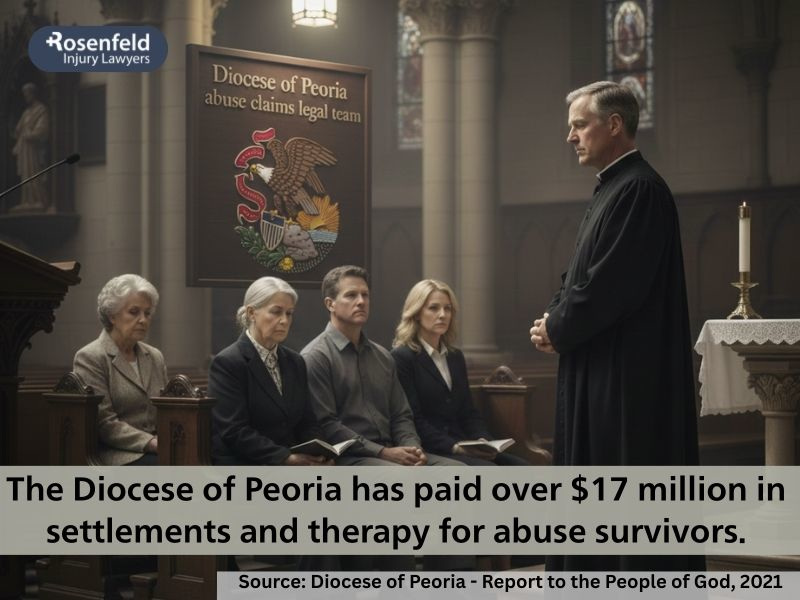
Background and Influence of the Catholic Diocese of Peoria
The Diocese of Peoria, established in 1877, serves as a spiritual and educational hub for Catholics in Central Illinois. Encompassing 26 counties, the diocese has played a vital role in shaping the faith of its community through parishes, schools, and outreach programs.
With a mission to grow disciples and foster a deep connection to Jesus Christ, the diocese has inspired generations to embrace their faith and share the love of God.
One of its most revered figures is Venerable Archbishop Fulton J. Sheen, a native son celebrated for his contributions to Catholic media, evangelization, and theology. His legacy continues to influence the diocese’s mission, as the faithful often invoke, “Venerable Archbishop Sheen, pray for us.”
Under the leadership of Bishop Louis Tylka, the Diocese of Peoria strives to embody its Catholic mission while addressing challenges and maintaining its commitment to education, particularly through institutions like Trinity High School. Despite its storied history, the diocese has faced allegations of clergy abuse that have marred its reputation and shaken the trust of its faithful.
Child Sex Abuse Allegations Within the Diocese of Peoria
The Diocese of Peoria has faced numerous allegations of child sex abuse by clergy members, with cases spanning several decades.
In 2005, Jean Anderson filed a lawsuit alleging that Father Edward Bush sexually assaulted her in 1964 or 1965, when she was 13 or 14 years old and a student at St. Thomas Catholic School in Peoria Heights. Bush was removed from public ministry in 2002.
Mary Krusz accused Father Louis Condon of sexually assaulting her between 1958 and 1960, starting when she was 6 years old and a student at St. Mary’s Catholic School in Lincoln. Condon retired from ministry in 1986 and was later removed from ministry.
A lawsuit filed in 2018 alleged that Father John Anderson sexually abused a boy between 1979 and 1984 at St. Edward’s Catholic Church in Chillicothe, beginning when the victim was 8 years old. Anderson has since been publicly removed from the priesthood.
List of Abusive Clerics in the Diocese of Peoria
The list of Illinois priests accused of child sexual abuse in the Diocese of Peoria includes:
- Fr. John C. Anderson
- Fr. Robert O. Barnett
- Fr. Charles Beebe
- Fr. Patrick B. Brennan
- Fr. Walter A. Breuning
- Fr. Edward E. Bush
- Fr. Terry Cassidy
- Fr. J. George Cody
- Fr. Louis Condon
- Fr. Robert J. Creager
- Fr. Francis Engels
- Fr. Norman D. Goodman
- Fr. William Harbert
- Fr. George H. Hiland
- Fr. Robert Thomas Hughes
- Fr. William D. Isermann
- Fr. J. Eugene Kane
- Fr. M. Duane Leclercq
- Fr. John Edward Lohan
- Fr. Thomas W. Maloney
- Fr. Thomas R. Miller
- Fr. John M. Onderko
- Fr. Victorian Ostmeyer
- Fr. Toussaint J. Perron
- Fr. Jerome Pilon
- Fr. Gregory J. Plunkett
- Fr. Samuel D. Pusateri
- Fr. John J. Ryan
- Fr. Donald R. Schladen
- Fr. Laurence C. Schumacher
- Sister Mary Jane
- Fr. Richard Slavish
- Father Bernard Tomaszewski
- Fr. John B. Turnbull
- Fr. Michael R. Van Acker
Such cases highlight systemic failures within the Diocese of Peoria to protect vulnerable individuals and adequately address allegations of abuse.
Legal Proceedings and Child Abuse Investigations into the Diocese of Peoria
The Illinois Attorney General’s 2023 report identified 51 clergy members in the Diocese of Peoria with credible allegations of sexual abuse. The investigation uncovered decades of abuse, with diocesan leaders accused of failing to address credible complaints and reassigning abusive priests to new parishes.
The Diocese of Peoria has faced significant legal scrutiny for its handling of child abuse allegations, with survivors pursuing justice through both criminal and civil actions.
In 2013, the Diocese of Peoria settled a lawsuit for $1.35 million with a former altar boy who accused Monsignor Thomas Maloney of child sex abuse during the 1990s at Epiphany Catholic Church in Normal. The lawsuit claimed that diocesan leadership, including then-Bishop Myers, failed to act on prior allegations against Maloney.
A 2004 report indicated that the Peoria Diocese had incurred slightly more than $900,000 in settlements related to sexual misconduct allegations involving 14 diocesan priests since 1950.
The Diocese of Peoria has faced significant criticism for its handling of alleged abuse, with investigations revealing patterns of negligence and systemic failures that enabled abuse to persist.
In many cases, diocesan leaders were aware of allegations against clergy members but failed to take decisive action.
For example, lawsuits alleged that diocesan officials ignored prior complaints about Monsignor Thomas Maloney, allowing him to continue serving in ministry where further abuse occurred. In the case of Father John Anderson, despite early allegations of misconduct, he remained in ministry for years, continuing to interact with vulnerable parishioners.
The diocese has been accused of reassigning priests with known abuse allegations to other parishes instead of removing them from ministry. This practice exposed additional communities to harm and highlighted a prioritization of institutional reputation over the safety of parishioners.
The Illinois Attorney General’s report criticized the Peoria Diocese for its failure to disclose the full extent of abuse cases and its reliance on confidential settlements to avoid public accountability. Survivors and advocates have noted that this lack of transparency has perpetuated harm and prevented systemic reform.
While the Diocese of Peoria has implemented measures such as mandatory reporting and abuse prevention programs, survivors and advocates argue that these efforts do not adequately address past failures. Calls for independent oversight and a more survivor-centered approach remain urgent to rebuild trust within the Catholic community.
Legal Options for Survivors of Abuse Within the Diocese of Peoria
Survivors of clergy abuse in the Peoria Diocese have several legal avenues to seek justice, accountability, and compensation for the harm they endured. They can report abuse to law enforcement, leading to potential criminal prosecution of the perpetrators. Criminal cases aim to hold abusers accountable through penalties such as imprisonment.
Survivors can also file civil lawsuits against the diocese or individual clergy members. These lawsuits focus on obtaining financial compensation for the emotional, psychological, and physical harm caused by the abuse and for the diocese’s negligence in addressing or preventing misconduct.
At Injury Lawyer Team, we are dedicated to supporting survivors of clergy abuse in the Diocese of Peoria and beyond. With extensive experience handling sensitive and complex cases, we offer compassionate advocacy and expert legal guidance.
Our Illinois clergy abuse lawyers remain committed to helping survivors navigate the legal process, hold perpetrators and institutions accountable, and secure the justice and compensation they deserve.
How Long Do Catholic Clergy Abuse Victims Have to Take Legal Action in Peoria, IL?
In Peoria, Illinois, survivors of child sexual abuse connected to the Peoria Diocese are not limited by a traditional statute of limitations.
Illinois law (735 ILCS 5/13-202.2) allows civil lawsuits based on child sexual abuse to be filed at any time, regardless of when the abuse happened. This applies to claims involving sexually abusing children by clergy, as well as claims against diocesan leadership when abusive behavior was allowed to continue or was not properly addressed.
This change in the law reflects the reality that many survivors—especially those harmed as young people—are unable to come forward until years later.
Civil cases may examine whether diocesan leadership fulfilled its responsibilities to protect children and other vulnerable individuals and whether appropriate steps were taken to prevent possible abuse across parishes, schools, and affiliated programs.
Public reporting and diocesan disclosures have addressed alleged abuse involving Peoria priests and the ways allegations were handled over time.
References to parishes and institutions such as Saint Mary, Saint John, Saint Edward, Saint Bede, Holy Trinity, Vincent de Paul Parish, Immaculate Conception, and schools like Schlarman High School appear in broader discussions about how allegations surfaced and how the diocese responded.
These discussions have raised questions about internal decision-making, oversight, and the movement of priests following complaints, without presuming knowledge or intent in every instance.
The Diocese of Peoria has stated that it has implemented measures such as safe environment programs, a diocesan review commission, and internal procedures to acknowledge credible allegations when they are substantiated.
Various Catholic bishops associated with the diocese over time—including Bishop Joseph Schlarman, Bishop Myers, Bishop Jenky, and Bishop Daniel—have been referenced in historical coverage discussing diocesan responses to abuse concerns at different periods.
Civil lawsuits may be filed in the appropriate county court, including courts serving Peoria County or, depending on where events occurred, Logan County. These civil claims are separate from investigations by civil authorities and do not depend on whether criminal charges were filed or the status of a priest within the clerical state.
The focus of civil litigation is whether abuse occurred and whether institutions responded appropriately when allegations surfaced, including in other instances where cases were not addressed publicly at the time.
Some cases discussed in public records have involved priests who later pleaded guilty, while others involved allegations evaluated through civil or internal review processes.
For survivors, pursuing a civil claim can be part of a broader path toward accountability and healing. Our attorneys can explain how Illinois law applies to a specific situation, review the diocese’s public statements and diocese claims, and discuss available legal options while prioritizing the dignity and well-being of survivors.
Take the First Step Toward Justice!
If you or a loved one has experienced clergy abuse within the Diocese of Peoria, Injury Lawyer Team is here to help. We handle every case with care, confidentiality, and a commitment to achieving justice for survivors. Our firm works on a contingency fee basis, meaning you pay nothing unless we recover compensation on your behalf. Contact us to schedule a free consultation.
All content undergoes thorough legal review by experienced attorneys, including Jonathan Rosenfeld. With 25 years of experience in personal injury law and over 100 years of combined legal expertise within our team, we ensure that every article is legally accurate, compliant, and reflects current legal standards.