

Sexual Abuse and Assault Injury Lawyers


Explore Your Legal Rights to File a Civil Lawsuit During a Free Case Evaluation
Dozens of hotel and motel sex trafficking lawsuits accuse major hotel chains of turning a blind eye to sexual exploitation taking place in hotel rooms nationwide. Injury Lawyer Team stands with trafficking survivors, helping them secure financial compensation from negligent corporations.
If you’ve been trafficked in a hotel, we’re here to help you heal. Contact us today for a confidential and no-obligation consultation about the legal process.
Notable Hotel Sex Trafficking Lawsuits and Allegations
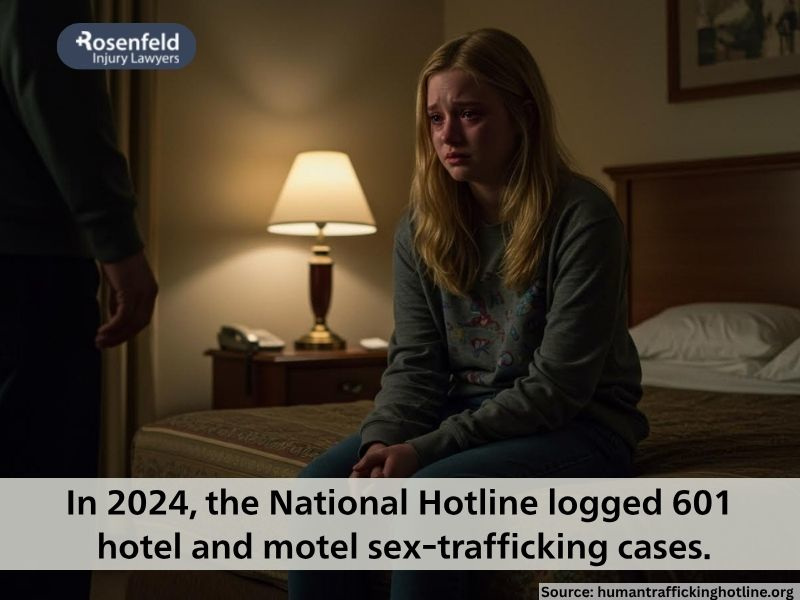
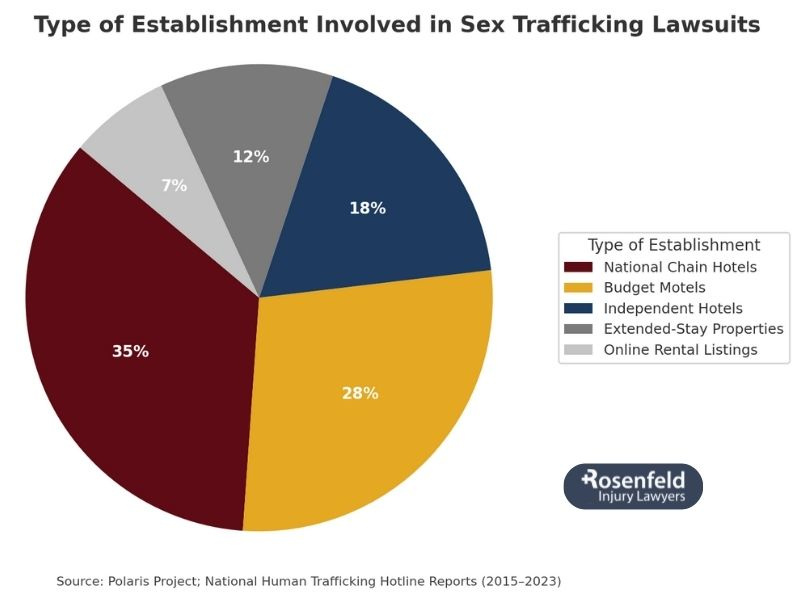
Sex trafficking lawsuits have highlighted the hotel industry’s complicity in the sexual abuse of vulnerable individuals throughout the United States. A significant percentage of exploitation and commercialized assault takes place in hotels due to their anonymity and transient nature, but hotels are still required to enforce federal regulations and intervene in potential abuse.
Some of the most prominent hotel human trafficking lawsuits include the following. In many cases, multiple hotel companies were named in the same lawsuits, as the traffickers would move their victims between different hotels.
Additionally, certain hotel brands have been acquired by larger parent companies, which operate hotels under both the parent brand and the subsidiary brand. This complex network of subsidiaries and parent companies means that, in many cases, one company facilitates trafficking across multiple brand names.
Red Roof Inn
In July 2024, The Independent reported that at least 117 Red Roof Inn locations have been accused of facilitating sex trafficking. There are at least 42 federal lawsuits currently ongoing against the company, and additional victims are also working to file lawsuits.
According to attorneys for some of the victims, Red Roof Inn employees were aware of what was occurring but refused to intervene, even making jokes about the presence of trafficking victims. In fact, one victim testified that the traffickers specifically chose Red Roof Inn because of its lax attitude toward sex work.
Motel 6
Motel 6 has been named in sex trafficking lawsuits across the country. In one February 2025 case from California, a woman accused the hotel chain and others of failing to intervene in clear trafficking operations, resulting in her being raped over 1,000 times.
The lawsuit stated that chains like Motel 6 turn a blind eye to prostitution because they “enjoy the steady stream of income that sex traffickers bring to their hotels.”
In a case from Philadelphia, three women received a $17.5 million settlement from Motel 6, Days Inn, and North American Motor Inn for abuse that occurred in their facilities while the women were underage.
A December 2024 lawsuit filed in Contra Costa County, California, accused Motel 6 Embarcadero and four other Bay Area hotels of profiting off sexual exploitation. Of the Motel 6 specifically, the lawsuit stated that the motel staff allowed traffickers and buyers to “[parade] in and out of rooms rented for the purpose of trafficking.”
United Inn Motel
In July 2025, a federal jury awarded a trafficking survivor $40 million for abuse she suffered at a Georgia hotel. She was only 16 years old when she was trafficked in 2018 and 2019, raped over 200 times in just 40 days. Some of the abuse took place in plain sight of employees, who did nothing to help her.
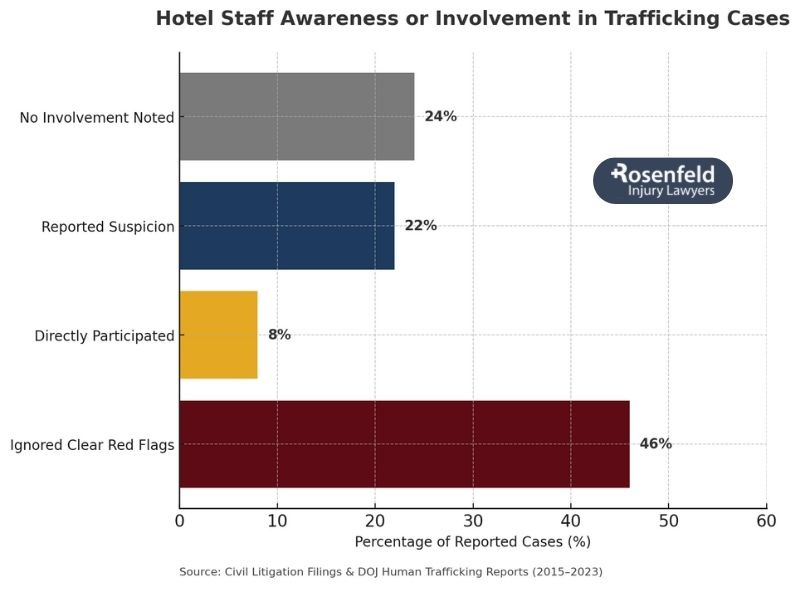
According to the victim’s attorneys, hotel employees ignored blatant signs of trafficking, such as a high volume of men going in and out of the room in a short period of time, and the underage girl asking for condoms at the front desk.
The minor, identified only as J.G. in the suit, had been reported missing to law enforcement. The hotel had been issued a Be On the Lookout (BOLO) alert from police, which included a recent photograph of J.G., and staff still did not intervene.
At the jury trial, a DeKalb County, Georgia, detective testified that the United Inn & Suites was one of the top five commercial sex hotspots in the country at the time. However, staff were still not advised on how to help trafficking victims or identify signs of exploitation.
Holiday Inn
Holiday Inn was one of several chains listed in a lawsuit filed in West Palm Beach, which also named Wyndham and IHG. The lawsuit centers around a teenage Jane Doe, who claims that her mother trafficked her to buy drugs.
The mother allegedly used the website Backpage to advertise her 16-year-old daughter for sex, then moved her between different hotels near Chiefland, Florida. The software company Salesforce was also implicated in the lawsuit.
Attorneys and trafficking victim advocates noted that hotels have training, policies, and protocols in place to intervene, but many fail to do so.
Days Inn
In September 2025, an Atlanta-area Days Inn location agreed to pay $5 million to two child sex trafficking survivors. The two victims were only 14 years old when they were exploited in March 2013 at a Stockbridge hotel. According to the suit, employees were aware of what was happening and facilitated the abuse, sometimes even participating themselves.
The franchise is owned by Wyndham, which was similarly implicated in a Pennsylvania case involving Howard Johnson. Days Inn was also named in the $17.5 million settlement from Philadelphia, where three women were moved between hotels along Roosevelt Boulevard.
North American Motor Inn
North America Motor Inn was the third of the franchises named in the $17.5 million settlement in Philadelphia along Roosevelt Boulevard. However, this was only one of two hotels from the same franchise, in the same city, that had been accused of the same crime.
In February 2024, an arbitrator awarded $24.5 million to two women who were trafficked while underage in 2013. The North American Motor Inn, located at 4444 City Avenue in West Philadelphia, refused to intervene when the two girls, who were 16 and 17 at the time, were being raped and assaulted in the rooms.
Both of the women’s abusers were sentenced, though one has now been released.
Wyndham Hotels
Wyndham Hotels was implicated in a lawsuit involving Howard Johnson, one of its franchise companies, for sex trafficking that took place along the East Coast for six months in 2013. According to the survivor, she was held captive by Fredrick Brown, a drug dealer, and cycled through hotels in four different states. The primary base of operations was a Howard Johnson hotel in Pennsylvania.
The general manager of the Howard Johnson hotel, Faizal Bhimani, allegedly provided Brown with free rooms in exchange for sex with his victims. If law enforcement were patrolling the area, Bhimani would refer Brown to a nearby Pocono Plaza Inn, which was owned by the same franchisee.
Wyndham severed ties with the Howard Johnson franchise location after the lawsuit came to light, but the company was not dropped from the suit.
In another lawsuit, Hawthorne Suites Extended Stay by Wyndham was sued by a 16-year-old trafficking victim in Dallas County, Texas. According to the February 2025 suit, the trafficker used the Extended Stay hotel to take explicit photos of the victim and then post them to prostitution sites.
The lawsuit alleged that hotel staff were aware of what was happening, even alerting the perpetrator if the victim left the room, but failed to contact law enforcement or intervene on her behalf.
Marriott
In January 2020, a Michigan woman came forward to allege that she was trafficked at the InterContinental and Marriott Hotels throughout the Detroit metropolitan region.
The woman, listed in the filing as H.G., was reportedly chained up and raped at a Fairfield Inn in Ann Arbor and a Holiday Inn Express in Detroit. The victim was once allegedly penetrated with a broken bottle and screaming in pain, but no one came to help her.
A recent lawsuit claims that Marriott did not just facilitate trafficking but also incorporated it into its business model. A May 2025 lawsuit in Colorado alleges that Marriott trafficked J-1 visa interns. These foreign workers were reportedly forced to work long hours as menial laborers at the St. Regis hotel in Aspen, Colorado.
These duties were not meant to be part of their hospitality internships and were instead used to fill labor shortages.
Super 8 Worldwide, Inc.
In July 2025, a Super 8 motel in DeKalb County, Georgia, agreed to settle with a trafficking victim for $6 million. Dashaundra Hill was 15 years old when she was trafficked by her half-sister at a Lawrenceville Super 8, now operating as America’s Best Value Inn, in 2015.
Hill alleged that she was sold to dozens of men over the span of a few days. She also claimed that employees knew what was happening but refused to intervene on her behalf. Hill was rescued when police raided the location in September 2015, and she later filed a claim against Tucker Inn Incorporated.
Super 8 is owned by Wyndham, which has been the defendant in multiple other lawsuits regarding trafficking and other illegal activities.
Choice Hotels
In February 2025, Choice Hotels International was sued by a Washington State woman for allegedly facilitating prostitution in its franchises. According to the victim, a Kent, WA, Quality Inn did not intervene despite clear signs of trafficking taking place, such as high volumes of male visitors, extended day-to-day stays, and cash payments.
Worse still, the hotel owners allegedly accepted bribes from the perpetrators to allow visitors after hours. The Quality Inn is franchised, but Choice Hotels maintains significant control over daily operations, including anti-trafficking training for all employees.
Tilma
The lawsuit Peerless Indemnity Insurance Co. v. Tilma Inc., filed in Virginia, involved an insurance company refusing to pay trafficking lawsuits against their client. The hotel operator was accused of being a “staging ground” for trafficking, refusing to intervene because the traffickers were providing significant profits to the company.
In the lawsuit, attorneys claimed that employees heard the victim screaming as she was trying to escape, then she was dragged back and beaten by the perpetrator.
The court ruling determined that while the hotel was vicariously liable for the intentional torts resulting from the trafficking, it was not the one committing the crimes, and therefore, a policy exclusion for intentional torts did not apply.
Quality Inn
A Tacoma, Washington, area Quality Inn & Suites was sued in June 2025 by a woman who claimed she was trafficked at a Hosmer Avenue motel between 2019 and 2021.
According to the suit, the woman was forced to perform sex acts for the perpetrator, who then used the financial gains from the illicit activity to pay for more rooms. She also alleged that the hotel’s staff refused to implement industry-standard anti-trafficking measures and that at least one of them accepted bribes from the trafficker so as not to call the police.
The case was dismissed, and court documents do not clarify whether the woman settled with Quality Inn.
MGM
Multiple MGM hotels have been implicated in lawsuits about their failure to intervene in human trafficking.
In December 2023, Xiaohong Ban, 52, was arrested at an MGM Casino hotel room, which was used as part of an extensive trafficking ring throughout Southeast Michigan. Ban and her co-conspirators allegedly operated trafficking rings in massage parlors and spas around the area, sometimes using hotel rooms to transport goods or people.
In November 2024, a lawsuit against MGM, Mandalay Bay, and several other hotels was dismissed due to statutory deadlines. The July 2024 case alleged that several Las Vegas hospitality chains refused to assist an anonymous plaintiff named as Tyla D., who was forced into prostitution in 2006 and 2007.
The girl, who was 14 at the time of the abuse, was allegedly given a fake ID that claimed she was 21. She was instructed to go down to the casinos and gamble small amounts of money before soliciting clients and bringing them back to hotel rooms. Tyla D. escaped her abusers in 2007 but was then trafficked against in 2013, when she was 21.
MGM and the other defendants primarily disputed the claims based on the premise that the statute of limitations had expired, not that Tyla D.’s abuse did not occur.
IHG
IHG owns Holiday Inn and was listed as a defendant in the January 2020 lawsuit in Detroit, which alleged that a woman was moved from hotel to hotel in eastern Michigan and subjected to severe sexual abuse.
According to the Detroit lawsuit, the signs of trafficking would have been obvious to anyone who paid attention. H.G. was allegedly malnourished, wearing skimpy clothing that was always ripped, and covered in bruises. The hotel rooms were reportedly always filled with dried blood and used condoms as well as other sex paraphernalia.
At one Holiday Inn, she ran to the front desk and asked for help. She alleges that there was blood running down her leg and she was visibly in danger, but the staff did not intervene and instead allowed the trafficker to push her back upstairs.
Venetian
The Venetian Hotel was also implicated in the July 2024 case against several Las Vegas hotels, which were allegedly used by traffickers to facilitate child sex abuse. According to the plaintiff, who was listed as Tyla D., she was urged to use casinos as a way to find customers, then would take them back up to her hotel room for sex.
Notably, the lawsuit highlighted the use of facial recognition technology in casinos and resorts, such as The Venetian. The victim’s lawyers noted that by the time she was trafficked as a 21-year-old, facial recognition cameras were standard issue in these resorts, meant to identify illicit activities and turn away undesirable customers.
The suit alleged that Tyla D.’s face was tagged due to her soliciting customers for sex, but employees ignored the flag because her customers were also spending money at the casino. As such, they refused to assist her or to raise any alarm about the strange behavior.
Tyla D. willingly dismissed the claim against The Venetian, and the remainder of the suits were dismissed in November 2024, as the statute of limitations had expired. However, the resorts, casinos, and hotels listed in the suit did not necessarily refute their involvement in prostitution, only that the case had expired.
JFK Inn
In March 2023, Tyrone “Angel” Miles was sentenced to 7 years in prison for trafficking young girls at the JFK Inn Hotel in Jamaica, Queens. His co-defendant, Bryant Lowery, was sentenced in November 2022 to 6 years in prison for his role in the trafficking ring.
According to Queens District Attorney Melinda Katz, Miles and Lowery degraded and tormented their two victims, who were ages 16 and 17. The victims were held against their will at the JFK Inn Hotel between June 5, 2020, and June 12, 2020, where they were forced to have sex with men.
The defendants allegedly threatened to kill the girls if they did not perform the sex acts, and they were kept in separate rooms so that they could not help one another. One of the girls eventually escaped when she was briefly left alone and then ran to a nearby business, where she contacted her family.
Extended Stay America
In September 2025, Audra Doody sued five hotel chains, including Extended Stay America, for their role in facilitating her abuse over a decade ago. Doody is now the executive director of the Safe Exit Initiative, a Worcester, Massachusetts, nonprofit that helps victims of trafficking and domestic violence.
According to Doody, she was trafficked for approximately four years around 10 hotels in Massachusetts, being forced to hand over money and take drugs to keep going. At an Extended Stay America, one employee solicited her and claimed that he wanted to get her out of the situation, but he never called the police or otherwise attempted to intervene.
At other locations, employees accepted bribes from the traffickers to look the other way or simply did not show interest in helping her. Doody alleged that once, a housekeeper looked at her, noted her black eye, and then continued working without saying a word.
The five chains – Choice Hotels, Wyndham, InterContinental Hotels (IHG), Red Roof Inn and Extended Stay America – all denied liability and refused to comment for news outlets.
Hilton
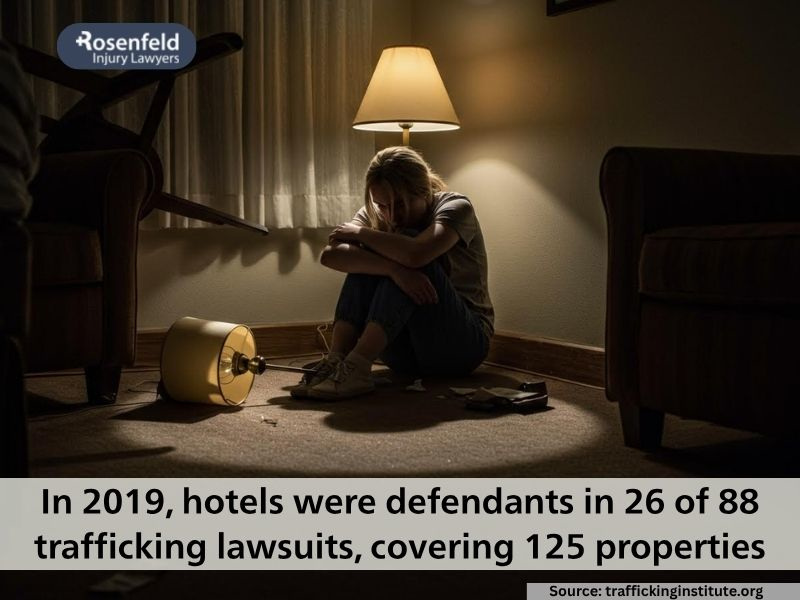
Hilton, along with 11 other international hotel brands, was sued in December 2019 for its role in forced labor and sexual exploitation. Thirteen women came forward to allege that they had been trafficked in hotels throughout the country, including Ohio, New York, Texas, and Massachusetts.
In April 2023, a survivor sued Hilton in the Eastern District of North Carolina for the chain’s role in her alleged sex abuse. The woman, named L.M. in the suit, was trafficked in a Hampton Inn, which is owned by Hilton, after meeting the trafficker in 2012.
Without her knowledge, the trafficker advertised her for sex online. They then allegedly met up for dinner, but the trafficker drove her to the Hampton Inn and forced her to have sex with strangers. When she resisted, he threatened her. The trafficker took all the money that was generated from the abuse and exerted financial control over her.
Even Hilton’s own employees have sued the company. A June 2024 lawsuit names an Elmsford, NY, Hampton Inn as a trafficking hotspot, with over a dozen employees alleging that management turned a blind eye to the sexual exploitation happening in its rooms.
Best Western
Best Western was also listed as a defendant in the December 2019 lawsuit regarding industry-wide exploitation of women and girls. In response to the Guardian regarding the allegations, Best Western representatives stated that they adhere to industry regulations; however, the multiple lawsuits filed against them suggest otherwise.
In January 2024, attorneys made a second bid to consolidate more than 50 lawsuits into multidistrict litigation, which would be heard in the Southern District of Ohio. These cases represent over 1,000 survivors who were trafficked around the country, including at Best Western hotels.
Best Western has attempted to diminish its liability by claiming it cannot be held responsible for acts occurring in specific franchises, which are locally owned and operated.
What Laws Govern Human Trafficking Cases Involving Hotels and Motels?
The Trafficking Victims Protection Reauthorization Act of 2018 (Public Law 115–425) is a renewal of the Trafficking Victims Protection Act, which was passed in 2000. This federal law combats trafficking both internationally and domestically by forming partnerships with other governments, authorizing support funding for anti-trafficking policies abroad, and conducting research into trafficking activities abroad.
Like the original Trafficking Victims Protection Act, TVPRA also establishes protections for human trafficking survivors in the United States. Non-citizen victims can apply for asylum and special visas that will shield them from deportation while also referring them to support programs.
Additionally, TVPRA enforces higher penalties for traffickers while funding assistance programs. Those who fail to adhere to anti-trafficking policies, including corporations, may be subject to both prosecution and civil claims.
Our firm assists survivors in filing civil lawsuits against hotels and other organizations that facilitated or failed to intervene in sex trafficking. While grounds for legal action vary slightly by jurisdiction, premises for a lawsuit can include the following.
- Premises Liability: Hotels can be held liable for harm that occurs on their premises as property owners.
- Negligent Security: Hotels must impose access control to ensure the safety of all guests. If they allowed multiple unaffiliated people access to the premises, this is negligent security.
- Negligent Training and Supervision: Hotels are required to teach their employees how to identify signs of sex trafficking and intervene as necessary. They also must ensure that their employees are not facilitating illegal behavior by taking bribes, as occurred in multiple of these claims.
What Damages Can Human Trafficking Survivors Recover?
Human trafficking survivors may receive both compensatory and punitive damages depending on whether their case goes to trial. Damages can include:
- Medical bills
- Lost wages
- Loss of future income
- Mental health treatment
- Disability or disfigurement
- Physical pain and suffering
- Emotional distress
- Loss of normal life
- Loss of enjoyment of life
What Factors Influence Human Trafficking Victims’ Compensation?
Compensation in a human trafficking lawsuit depends on a variety of factors, including the following.
- Available Evidence: If the victim can provide concrete evidence of illegal sexual acts, such as receipts or photographs, this can significantly increase their settlement. Medical records, police reports, and prior lawsuits filed against the defendant can also demonstrate a pattern of negligence.
- Victim’s Age: As with criminal prosecution, child sex trafficking is typically viewed more harshly and will receive higher settlements.
- Severity and Duration of Abuse: If the victim was held captive for years or was violently raped, they are likely to receive more compensation.
- Hotel Liability: While lawsuits filed against the individual perpetrator are common, the hotel chain will have insurance that can secure higher settlements. Evidence of their liability could include employee statements, previous lawsuits against the organization, or private communications demonstrating they were aware their hotel was being used for commercial sex acts.
How Much Are Hotel Sex Trafficking Lawsuit Settlements?
The average human trafficking lawsuit payout is $9,541,720. Settlements range from $110,000 to $40,000,000.
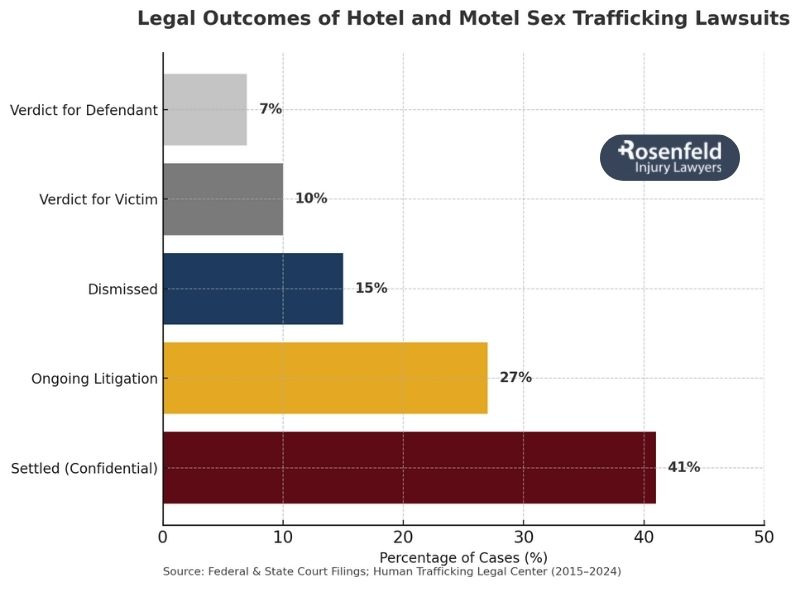
Recent settlements for human trafficking claims have included $40 million for victims in Georgia and $24.5 million for two women trafficked in Philadelphia.
How Long Do Victims Have to File Hotel Human Trafficking Lawsuits?
The sexual abuse statute of limitations depends on the specific state. Some have extended statutes of limitations for adult survivors, while others have a short statutory limit, such as only two or three years.
Federal Lawsuits
For federal lawsuits under the TVPRA, adult survivors have 10 years after the date of the last trafficking incident to file a claim (18 U.S. Code § 1595).
Child Sex Trafficking Cases
The Eliminating Limits to Justice for Child Sex Abuse Victims Act of 2022 removes all statutes of limitations for victims under the age of 18 who file a claim under the TVPRA. They must have been under the age of 28 when the bill was passed in 2022.
Cases brought at the state level may still be subject to the child sex abuse statute of limitations for that state. However, they may have additional time under delayed discovery rules, which means that the statute of limitations is tolled, or paused, until the victim discovers that their injuries are the result of an intentional tort by someone else.
Resources for Hotel Sex Trafficking Victims
If you or someone you know has been trafficked, help is available. Contact these resources for confidential and compassionate support:
- National Human Trafficking Hotline: Confidential help is available 24/7 in over 200 languages. These professionals can provide help with emergency shelter, transportation, social services, and counseling referrals. Call 1-888-373-7888 or text 233733.
- Polaris Project: This organization runs the National Human Trafficking Hotline and advocates for survivors of sex trafficking and forced labor, urging corporations and legislators to take action against abuse.
- Coalition to Abolish Slavery & Trafficking (CAST): CAST offers practical support to survivors, including assistance with counseling, legal services, and survivor advocacy.
- Freedom Network USA: Survivors can access legal, social, and health services through the network’s partnerships with organizations nationwide.
- The Salvation Army: Survivors can receive emergency and transitional housing, legal services, and employment counseling through the Salvation Army’s anti-trafficking programs.
How Injury Lawyer Team Can Help
Our compassionate attorneys have over 100 years of combined legal experience handling sexual abuse lawsuits, including those involving sex trafficking in the hospitality industry. We understand the complex legal challenges associated with these particular cases, including interstate travel and the lack of thorough records documenting the abuse.
Additionally, human trafficking takes a severe toll on an individual’s mental health, causing significant fear when interacting with law enforcement and other professionals. As caring legal advocates, we can help you navigate the complex legal process while protecting your privacy and well-being. When possible, we can file under a pseudonym that will allow you anonymity and protect you from retaliation.
We can provide the following services throughout the case:
- Case Evaluation: When you contact us for a confidential and no-obligation case review, we will assess whether you have a valid case and determine the applicable regulations for your claim. This can include both federal and state laws around sex trafficking, as well as related offenses like negligent supervision or negligent security.
- Assessing Liability: Hotel sex trafficking lawsuits are difficult because there is often a complex chain of liability. Many hotels are owned by a larger parent company, which may also operate its own hotels under the parent company’s name. Additionally, some are franchised and operated by individuals. We will use business documents to identify all liable parties and determine their level of liability.
- Investigation: Human trafficking can be difficult to prove, as the perpetrators are often career criminals who carefully cover their tracks. However, we will conduct a thorough investigation to definitively prove both that the trafficking occurred and that the hotel was liable. Evidence can include information like photos of hotel rooms, surveillance footage, hotel incident reports, police reports, and medical records.
- Witness Interviews: As one of America’s Top 100 High Stakes Litigators, we take a trauma-informed approach to witness interviews, understanding that trafficking survivors may struggle to share their stories due to stigma or fear. You can rely on us to gather pertinent details while respecting your privacy.
- Expert Witnesses: Trafficking is not just a severely traumatic experience, but a complicated network of liability, criminal activity, and coercion. We will consult with trafficking experts and mental health professionals who can attest to the intricacies of hotel trafficking and the hardships it imposes on survivors.
- Negotiation: Our Million Dollar Advocates will utilize all available evidence to advocate for the highest possible settlement, taking into account the hotel’s liability. Because these claims often involve franchises and parent companies, we will assess how much each level of the hotel was involved in the human trafficking and its associated liability. Our team will also communicate with third parties on your behalf so that you can focus on your recovery.
- Trial Representation: While many cases are settled through negotiation, some hotels will refuse to offer a fair settlement. In this case, we will file a complaint with the appropriate district court and guide you through the trial process. If your case has noted similarities to others filed against the hotel, we can collaborate with lead or co-counsel to present a stronger case.
FAQs
What is human trafficking?
Human trafficking, also known as trafficking in persons, is when a person is coerced or forced into providing labor or services. Sex trafficking is a subset of human trafficking that involves coercing a person to engage in commercial sex acts.
Human traffickers may move victims from place to place in order to evade criminal prosecution. However, trafficking does not require moving the individual, only that their labor is exploited under threat or coercion. Human smuggling, which is when a person is moved across a border, is closely connected to trafficking.
Sadly, many individuals are trafficked by someone they know, including a member of the community, family member, or partner. In other cases, the trafficker will find a vulnerable person, gain their trust, and then force them into sex work or other forms of labor in order to benefit from their work.
What types of human trafficking typically occur in hotels and motels?
According to a 2018 Polaris Project report, 80% of commercial sex acts take place in hotels, and 20% of human traffickers housed their victims in hotels.
Common forms of human trafficking that occur in hotels and motels include:
- Forced prostitution and sex trafficking of women
- Commercial sexual exploitation of children (CSEC)
- Escort services
- Brothel trafficking
- Internet-based sex trafficking activities
Is forced labor considered human trafficking?
Yes, forced labor trafficking is one of the most common forms of human trafficking, impacting approximately 28 million people worldwide.
Forced labor involves victims who are required to work long hours, often in difficult conditions, while another person financially benefits from their work. Victims may be threatened by having their personal documents stolen or be threatened with violence if they refuse to work.
In relation to the hospitality industry, this may involve forcing victims to work as housekeepers or food service workers, for the trafficker’s own financial gain.
How does hotel sex trafficking happen?
The Exodus Road, an anti-trafficking nonprofit, explains that the transient nature of hotels allows victims to be moved from place to place without anyone noticing.
Hotel employees who are not trained in how to identify sex trafficking may not realize that the frequent visitors to a given room are actually customers, and that the person staying in the hotel is the victim of a trafficking operation.
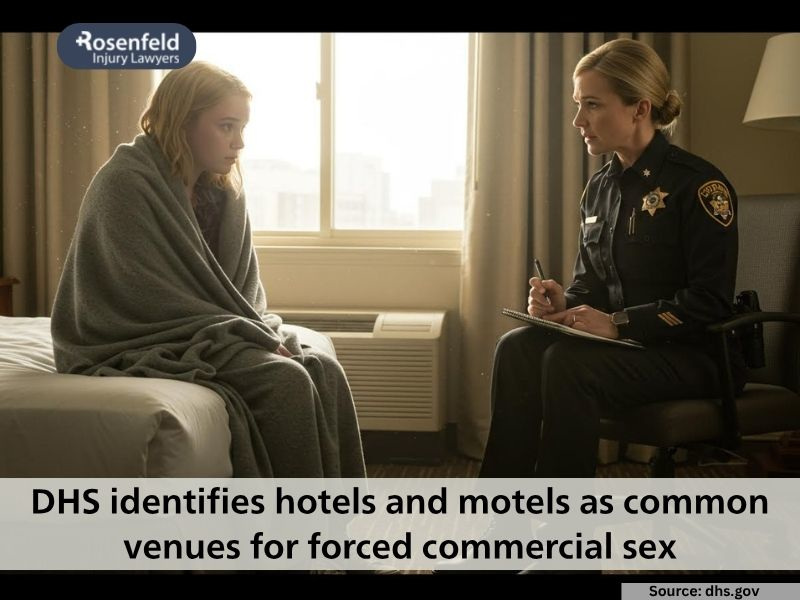
There are two types of sex trafficking occurring in hotels: incalls and outcalls. Incalls are when customers visit the hotel room for sexual services, while outcalls are when the survivor is forced to use the hotel as a base of operations for the sex trade.
Some trafficking survivors are moved from place to place, and the traffickers will keep them in hotels while moving between locations.
Sex trafficking activities often increase during large events, such as the Super Bowl. Traffickers may use local hotels as a base of operations during these events. Entertainment hubs like Las Vegas or Atlantic City also have significant commercial sex activity.
How can employees in the hotel industry recognize sex trafficking activities?
While not all trafficking operations have obvious signs, major hotel chains have an obligation to train their employees on common signs. Some of these include the following:
- Frequent Visitors: Frequent male visitors to a room are a significant warning sign. Visitors may stay for only a short period, such as half an hour to an hour, and can arrive at any time of day or night.
- Minors Accompanied by Unaffiliated Adults: Victims may appear young and quiet, followed closely by the trafficker. The trafficker may insist that the minor is older than they look or provide fake ID to prove it. An older guest may closely monitor the victim and refuse to let them leave the room alone.
- Signs of Psychological Abuse: Young women in trafficking may appear anxious, distressed, or submissive. They may not speak when spoken to or may allow the trafficker to speak for them instead. The traffickers may refuse to let anyone come near the victims and direct attention away from them.
- Lack of Luggage: Trafficking victims will have no luggage with them or minimal luggage for how long they are meant to stay.
- Inappropriate Attire: Traffickers often force their victims to dress in revealing attire regardless of the weather. In other cases, they may be dressed in unseasonable weather, like long sleeves in summer, to hide bruises and other signs of abuse.
- Physical Abuse: Victims may have bruises, including black eyes or handprints. In some cases, they may be malnourished, fatigued, or suffering from chronic infections. Additionally, victims may have poor hygiene.
- Unusual Transactions: Guests may pay in cash or use a prepaid card to avoid creating a paper trail. Guests may purchase a room for several days but leave within a few hours, as many jurisdictions have laws against pay-by-hour transactions.
- Branding: Some traffickers will brand their victims so that they can be easily retrieved should they escape. This may be a small burn or a tattoo, often of a symbol.
- Multiple Rooms: Guests may purchase multiple rooms to house their victims separately, with each room receiving numerous visitors throughout the day and night.
- Privacy and Secrecy: The trafficker will use “Do Not Disturb” signs and refuse to allow housekeepers access during their stay. Additionally, traffickers may park their cars in out-of-the-way areas with the license plate hidden from the front.
- Housekeeping: After a guest leaves, housekeepers may find large amounts of used condoms, lubricant, and other sex paraphernalia around the room. Guests may make frequent and excessive requests for toileties, linens, and other housekeeping items.
- Noise and Odor Complaints: Other guests may complain about sounds of shouting, crying, or screaming from the rooms. Housekeepers may also notice foul smells from used condoms and other evidence of sexual activity.
To combat human trafficking and other illegal activities, employees should remain alert to multiple of these signs and notify law enforcement about their concerns.
Who are common human trafficking victims?
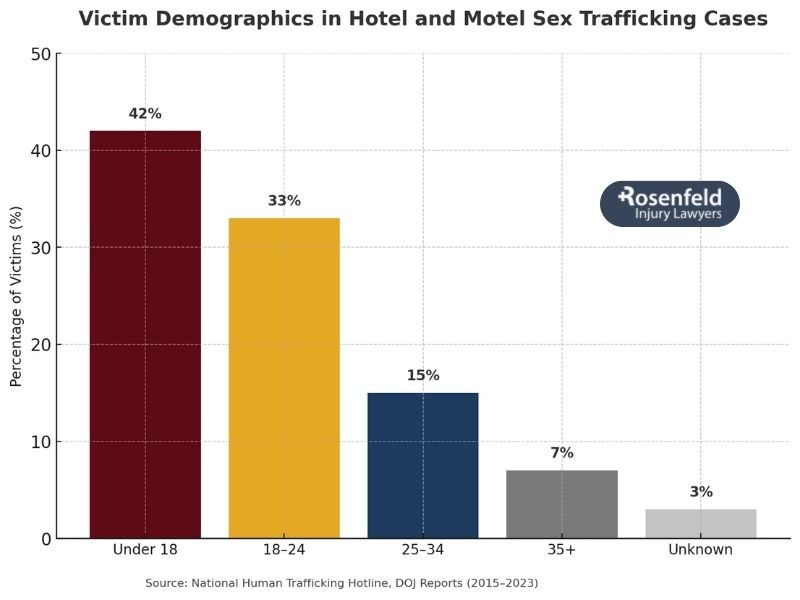
The US Department of Justice explains that trafficking victims can come from all backgrounds; they may be any age, gender, or race. However, young women are frequently victims, particularly marginalized people.
Refugees, foster children, people of color, LGBTQ+ youth, migrant laborers, disabled individuals, and individuals with mental health conditions are often sexually trafficked or exploited. In some cases, individuals with substance abuse disorders are exploited through sex trafficking.
Trafficking victims may be prevented from leaving by having their personal identification withheld from them. For example, the trafficker may take control of their passport, visa, or birth certificate so that they cannot prove their identity if they try to leave. Traffickers also target individuals who may not have a strong support system, such as former foster children or runaways.
What are common industries where human trafficking occurs?
Human trafficking encompasses a broad range of illegal activities, which include forced labor and sexual exploitation.
Labor trafficking often occurs in the following industries:
- Domestic labor, such as housekeeping and nannying
- Agriculture and fishing
- Construction
- Hospitality, including food and beverage
- Spas, massage parlors, and beauty parlors
Sex trafficking is closely connected to hospitality, as much of sex work occurs in hotels and motels. This form of forced labor includes prostitution, escort work, strip clubs and bars, brothels, and pornography.
How common is human trafficking?
Human trafficking is a global problem. The US Department of Homeland Security notes that worldwide, approximately 27.6 million people are victims of trafficking, with 77% involving forced labor. The United Nations Office on Drugs and Crime puts the population much higher than this, claiming that 50 million people worldwide are victims of some form of trafficking.
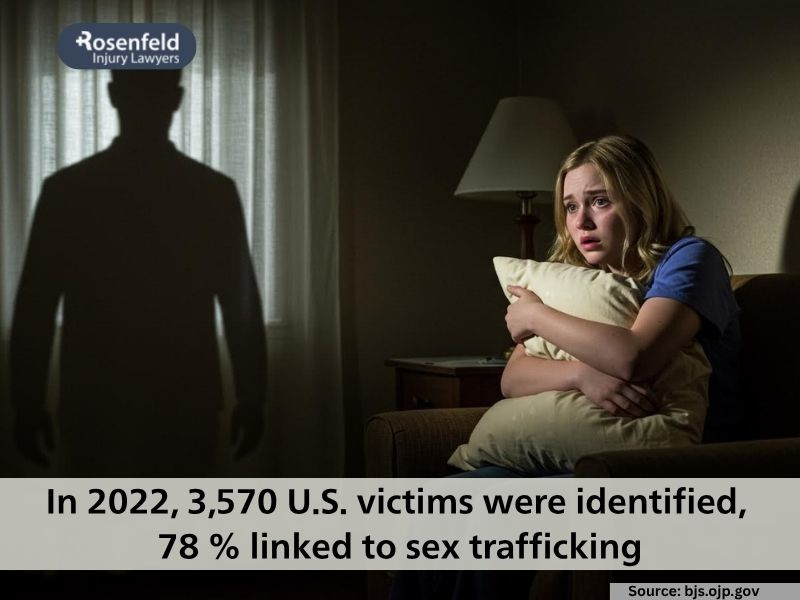
While labor trafficking is predominantly male, sex trafficking is predominantly female. The Department of Homeland Security reports that 78% of sex trafficking survivors are female, and only 22% are male.
Most trafficking occurs domestically, with about 60% of identified victims remaining in their country of origin. Trafficking is also one of the most prevalent and lucrative forms of organized crime, generating $150 billion in profits per year.
According to the Bureau of Justice Statistics, 2,027 persons were accused of trafficking offenses in 2021, up 49% from 2011.
Which hotel chains have been sued for human trafficking?
Major hotel chains that have been sued for allowing sex trafficking in their locations include Red Roof Inn, Wyndham Hotels, Marriott, Choice Hotels International, Hilton, Best Western, IHG, and Motel 6.
Is there a hotel sex trafficking class action?
In 2024, attorneys moved to consolidate numerous sex trafficking lawsuits into a multidistrict litigation. These cases alleged that hotel operators failed to enforce anti trafficking policies in accordance with federal law. Major hotel brands Red Roof Inn, Wyndham Hotels, and Best Western International are all named in this litigation. Multidistrict litigationis designed to reduce the burden on federal courts and streamline the discovery process, although it differs from a class action.
What evidence is needed to file a human trafficking lawsuit?
Evidence needed to take legal action includes:
- Medical records, including forensic exams
- Police reports and court documents
- Hotel receipts or checkout documents
- Physical evidence like tattoos, brands, restraints, or locks
- Witness statements and expert testimony about psychological abuse
- Photographs or videos of physical abuse
Human trafficking victims may have had their identification documents stolen or may otherwise be unable to identify themselves. Our firm will help you secure the proper information and direct you to resources, such as if you need to secure asylum.
Can victims remain anonymous in lawsuits against human trafficking hotels?
Yes, trafficking survivors can remain anonymous in a hotel sex trafficking lawsuit. While certain members of the case will be aware of your identity, court records will not reflect your name.
How much does a sex trafficking lawsuit attorney cost?
Our firm handles sex trafficking lawsuits on a contingency fee basis. This means that our legal fees will be deducted from your settlement. You do not have to pay us anything during the legal process, easing your financial concerns as you focus on recovery.
Book a Free Consultation
Thousands of vulnerable people have been exploited and assaulted in hotels around the company, often with the full knowledge of employees and managers. Despite robust federal laws and industry regulations requiring anti-trafficking training, these companies have continually prioritized profit over safety, causing lifelong trauma for victims.
National hotel chains must be held accountable for failing to protect vulnerable people from physical and psychological abuse by enabling trafficking. Our firm helps sex trafficking survivors on a contingency fee basis: no fees unless we win.
Everything that you share with our attorneys is kept confidential through the attorney-client privilege, and we will handle all communications with perpetrators on your behalf.
Contact Injury Lawyer Team today for a free, no-obligation, and confidential consultation about a human trafficking lawsuit.
All content undergoes thorough legal review by experienced attorneys, including Jonathan Rosenfeld. With 25 years of experience in personal injury law and over 100 years of combined legal expertise within our team, we ensure that every article is legally accurate, compliant, and reflects current legal standards.