

Sexual Abuse and Assault Injury Lawyers


How to Report a Doctor for Sexual Abuse
How to report a doctor for sexual abuse is a question many patients never expect to face, yet it becomes unavoidable when a doctor violates professional boundaries and personal safety. At our Chicago-based law firm, we stand with patients who have experienced sexual abuse or misconduct by a doctor or other medical providers.
Reporting abuse can feel overwhelming, especially when it involves a person in authority and occurs in a medical office where trust is assumed. Survivors often struggle with concerns about privacy, retaliation, relationships, and long-term well-being. Many worry they will not be believed or that the incident will be dismissed as a misunderstanding.
At Injury Lawyer Team, our role is to help clients understand their options, explain the legal process, and support them as they decide how to report, whether to file a complaint, and whether to pursue justice in court.

When Do a Doctor’s Actions Constitute Sexual Misconduct?
Sexual abuse in medical settings is uniquely complicated because examinations and treatment can involve intimate contact, sensitive body areas, and vulnerability. That said, there are clear lines that medical professionals must not cross. When those lines are crossed, it may constitute medical misconduct and a crime.
We define sexual abuse in medical settings as any sexual act, unwanted touching, coercion, or exploitation that occurs during an examination, consultation, or treatment, especially where the patient did not give informed consent or where the doctor used power, deception, or authority to obtain compliance.
Sexual abuse and misconduct often involve a power imbalance: a patient may feel pressured to comply because the doctor controls access to care, prescriptions, diagnoses, or the overall treatment plan. Even if the setting is clinical, the patient’s consent must be real, voluntary, and informed.
Examples of conduct that may constitute sexual misconduct include:
- Non-consensual touching or groping that is not medically necessary during an exam.
- Physical contact that continues after the patient says “stop,” expresses discomfort, or asks questions that are ignored.
- Inappropriate comments about a patient’s body, sexuality, appearance, or intimate areas, especially when unrelated to care.
- Performing an intimate exam without a clear medical reason, without offering a chaperone when required, or without explaining what will happen.
- Asking a patient to undress unnecessarily, or keeping a patient undressed longer than needed, or engaging in behavior that feels sexual rather than clinical.
- Using sedation, medication, or the private nature of a room to commit abuse.
- Taking photos, recording, or viewing a patient in a sexual manner without consent.
- Exploiting a patient’s trust during follow-up visits, therapy-style conversations, or “consultations” that blur boundaries.
A key phrase we often return to is “informed consent.” Patients have the right to understand what will happen, why it is necessary, what alternatives exist, and who will be present. When a doctor avoids explanation, rushes the exam, ignores objections, or reframes a sexual boundary violation as “routine,” that can be evidence of wrongdoing.
If you left an appointment feeling shocked, confused, violated, or harmed, we take that seriously. The details matter: what was said, what was done, the date, the setting, any witnesses, and whether there were prior instances or similar allegations.
Where to Report a Doctor for Sexual Abuse
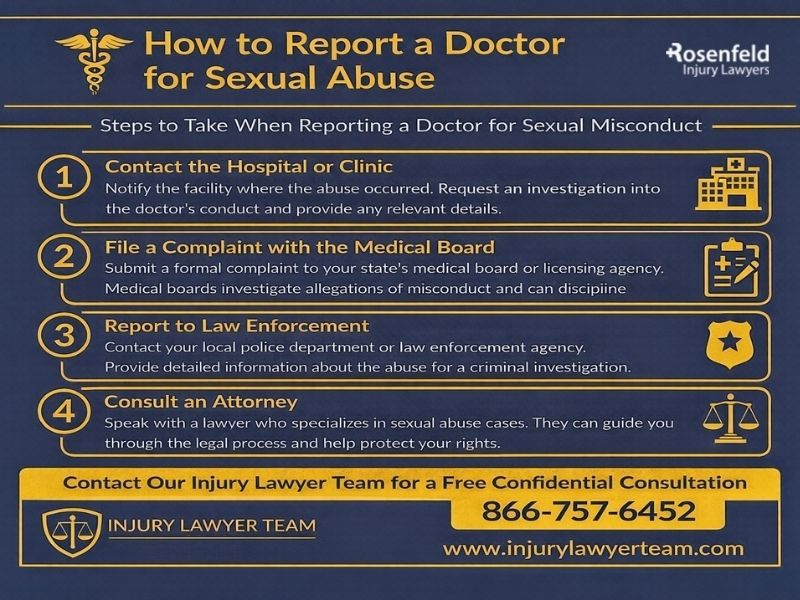
Reporting sexual assault by a medical professional can involve multiple reporting channels. Some survivors want professional discipline; others want a criminal investigation; many want both. There is no single “right” approach, and you can choose the path that best supports your safety, privacy, and goals.
Below are common reporting options, each with a brief explanation of what each organization may do.
File a Complaint With the State Medical Board
One option is to file a complaint with the state medical licensing board. This board oversees doctors and has the authority to investigate allegations of misconduct. Complaints may be submitted online, in writing, or through official forms.
When filing, patients may be asked to describe the incident, identify the doctor and office, provide dates, and submit any relevant medical records. The medical board can investigate patterns, review prior complaints of sexual abuse, and impose discipline, including suspension or revocation of a license. In some cases, patients may be able to remain anonymous during parts of the process.
Reporting to the medical board helps protect other patients and creates an official record of concerns about a doctor’s behavior.
File a Criminal Case With Local Law Enforcement
Sexual abuse by a doctor may also be reported to the local police department. Survivors can cooperate in making a police report, which may lead to a criminal investigation. Local law enforcement may interview witnesses, collect evidence, and provide records from the medical office.
If prosecutors move forward, the matter may result in criminal charges and a trial. Not every report leads to prosecution and a criminal case, but reporting can still be an important step toward accountability and prevention of future abuse.
National Sexual Assault Hotline
RAINN’s National Sexual Assault Hotline is another vital resource. It can provide confidential support, help you process what happened, and connect you with local advocates, counseling, and guidance on reporting.
Many survivors use the hotline before deciding whether to file a complaint or report to police. If you want a place to talk through options, safety planning, and next steps without pressure, this hotline can be a supportive starting point. You can also reach out online, which may feel safer for some people.
Can a Victim Pursue Legal Action After Reporting a Doctor’s Sexual Assault?
Yes. After reporting, many survivors decide to pursue a civil lawsuit to seek justice and compensation for the harm they endured, even with no criminal charges. A civil case focuses on the survivor’s losses and recovery, rather than punishment alone.
In a lawsuit, we may pursue claims against:
- The doctor who committed the abuse
- The medical practice, clinic, or hospital office that employed or granted privileges
- An organization that failed to supervise, ignored prior allegations, or allowed unsafe practices
- In some cases, an insurance company that provides coverage relevant to claims, depending on the facts and laws
A civil claim can seek financial compensation for therapy and counseling, medical treatment, lost income, diminished quality of life, pain and suffering, and other forms of harm.
For many survivors, legal action is also about being heard, breaking a pattern, and holding institutions accountable. When we represent our clients, we handle communication, evidence, filings, and court procedures so our clients do not have to carry the burden alone.
Survivors sometimes ask whether they can “prove” abuse when the exam was private. We approach that question with care. Evidence can take many forms: contemporaneous messages to a trusted person, appointment records, staff schedules, prior complaints, patterns in a doctor’s conduct, inconsistencies in documentation, and more. Our role is to investigate, gather evidence, and clearly explain the options so you can decide the next steps.
What Is the Time Limit to File a Civil Lawsuit?
Every case is subject to a time limit, known as the statute of limitations on sexual assault. These laws vary by state and may differ for adults and minors. Many jurisdictions provide extended deadlines or special rules for survivors of childhood abuse, including the statute of limitations on child abuse.
In some cases, the clock may begin when the survivor discovers the connection between the abuse and their harm, rather than on the exact date of the incident. Because these laws are complex, speaking with an attorney as soon as possible can help preserve your rights and protect access to evidence.
How a Sexual Abuse Attorney Can Help You Take Legal Action
Working with a doctor sexual abuse lawyer can provide structure and protection during a difficult process. As a sexual abuse attorney team, we support survivors at every stage.
Our services include:
- Listening carefully and documenting the incident
- Explaining reporting options and applicable laws
- Gathering and reviewing medical records and office records
- Investigating prior allegations and institutional failures
- Preserving evidence and identifying witnesses
- Handling communication with doctors, offices, and insurers
- Filing and managing the lawsuit
- Representing clients in court and negotiations
We focus on minimizing stress for our clients while pursuing accountability. Survivors remain in control of decisions, and we move at a pace that respects their needs.
Book a Free Consultation
If you are considering a sexual abuse lawsuit, we invite you to contact our office for a free, confidential consultation. We work on a contingency fee basis, meaning there are no upfront costs and no legal fees unless we recover compensation on your behalf.
Reporting abuse takes courage. Whether you want to file a lawsuit, report a crime, or simply understand your options, we are here to support you.
All content undergoes thorough legal review by experienced attorneys, including Jonathan Rosenfeld. With 25 years of experience in personal injury law and over 100 years of combined legal expertise within our team, we ensure that every article is legally accurate, compliant, and reflects current legal standards.