

Sexual Abuse and Assault Injury Lawyers


What Qualifies for a Church Lawsuit?
Many survivors who have suffered childhood sexual abuse or inappropriate contact involving clergy may be unsure about what qualifies for a church lawsuit.
Our sexual abuse lawyers can guide you through your legal options with a personalized consultation, ensuring that religious institutions and church leaders are held accountable for emotional harm. Contact us today for a free consultation about pursuing legal action.
What Types of Lawsuits Can Be Filed Against a Religious Institution?
Your eligibility to file a Catholic Church lawsuit depends on what type of abuse occurred. During your free case review with our team, we will identify what kind of personal injury case you have, explore the church’s legal liability, and identify all liable parties.
Sexual Abuse or Misconduct by Clergy, Staff, or Volunteers
One of the most common church lawsuits is for inappropriate sexual conduct by clergy members and church leaders. These legal claims are based on credible allegations of sexual abuse, sexual assault, grooming, or sexual exploitation.
Child sexual abuse cases may occur on church property with priests, youth pastors, volunteers, choir leaders, teachers, and staff. In other cases, victims are abused at camps, church-affiliated schools, community events, retreats, mission trips, or summer programs.
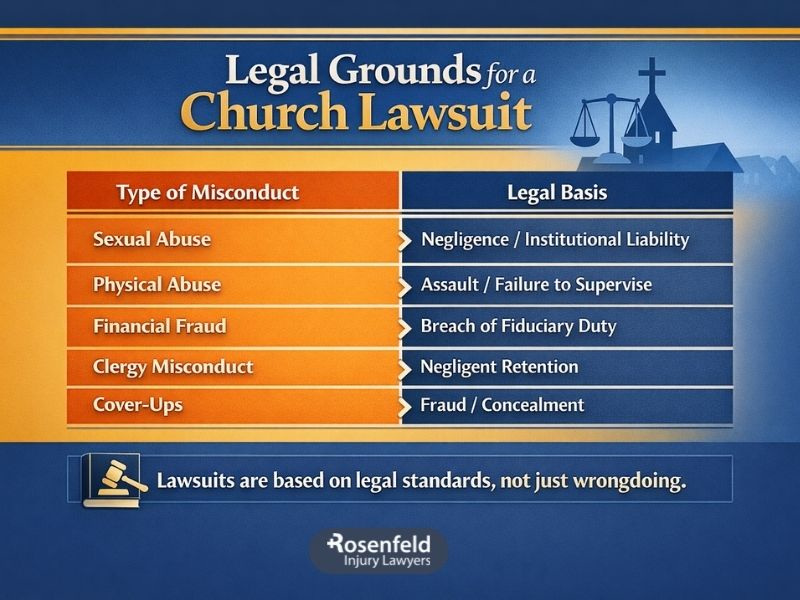
Liability in clergy sexual abuse lawsuits is not based on the acts themselves, but on institutional negligence. Our personal injury attorneys must prove that the church failed to supervise its staff, protect childhood victims from abusers, or properly investigate substantiated claims.
In some cases, powerful institutions hide or cover up wrongdoing, such as by moving an abusive priest to a different parish.
Legal Liability for Negligent Hiring, Retention, or Supervision of Church Personnel
Religious institutions have a duty of care to their congregations, particularly minors. To fulfill this duty of care, churches must perform background checks, supervise all staff members, and quickly intervene if there are any concerns about inappropriate behavior. If an institution fails to do so, victims can have legal recourse through a civil lawsuit. Common forms of negligence include the following.
- Negligent Hiring: The church may hire dangerous or unqualified individuals. In many cases, they fail to perform a proper background check or request information from prior placements that would reveal previous complaints.
- Negligent Retention: Churches may dismiss or ignore complaints about inappropriate behavior, or they may place the perpetrator on administrative leave without dismissing them.
- Unsupervised Access to Children: Many archdioceses have rules against allowing priests unsupervised contact with minors, unless while receiving the sacrament of confession. One-on-one meetings with minors should be conducted in a public area. If visiting a parishioner’s home, the priest should bring along another person who can bear witness and ensure all behavior is appropriate. However, churches may refuse to enforce this requirement.
- Failure to Monitor: Certain roles are high-risk, including church volunteers and youth leaders. These individuals often have extended contact with minors and are in a position of trust, which can easily become grooming. Any volunteers or youth leaders should be monitored by the administration and properly vetted before having any access to children.
Failure to Report Abuse or Misconduct to Authorities
While some states continue to exempt religious institutions from mandatory reporting laws, others have declared that priests and clergy are mandated reporters. In general, though, the exemption from mandated reporting is exclusive to receiving confession and does not cover other activities.
You may be able to file a church lawsuit if a religious institution ignored reports or delayed reporting misconduct to the authorities. In some cases, the church will promise to handle the issue “internally,” such as by mandating that the priest attend a rehabilitation program or removing them from duties that allow them to contact children.
While some rehabilitation programs do show promise, placing a sex offender in a rehabilitation program does not absolve the institution from responsibility for protecting minors and others. Taking prompt action is crucial to preventing further harm to vulnerable people, which includes removing the offender from their position of authority.
Religious institutions are notorious for moving offenders from parish to parish rather than dismissing them from service. In an article published by The Center for Critical Research on Religion, the researchers detail how Catholic priests are often transferred to different churches without disclosing the grounds for the transfer to anyone, including parents at the new church.
This drastically increases the risk of further sexual abuse by providing new “hunting grounds” for the perpetrator.
Personal Injury Due to Unsafe Premises or Property Hazards on Church Grounds
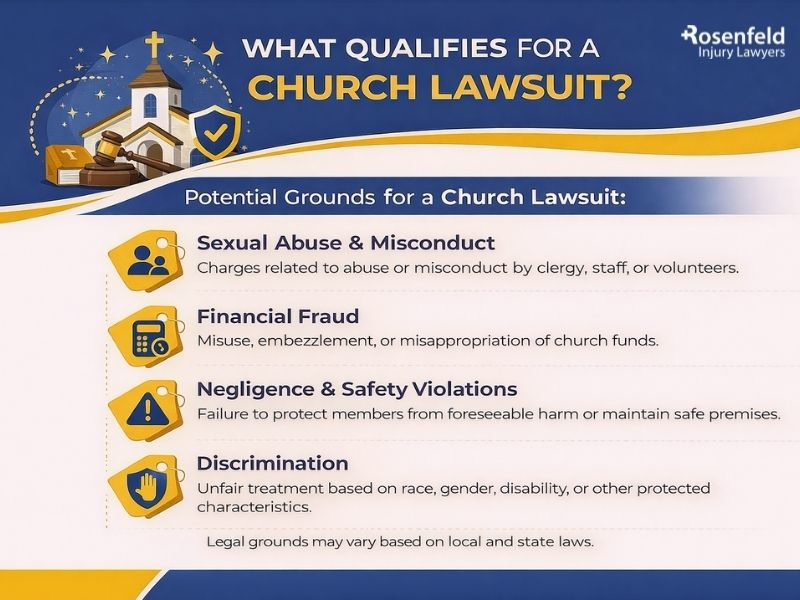
In some cases, a church lawsuit is not due to sexual abuse but for injuries that occur on the premises. These personal injury cases are based on premises liability law, which claims that property owners have a legal liability for any injuries that occur due to negligent maintenance, code violations, or negligent construction.
Common reasons for premises liability civil lawsuits include:
- Slip and fall hazards
- Unsafe walkways
- Inadequate lighting
- Dangerous stairs
- Fire safety issues, such as blocked fire exits
- Negligent security during events
- Injuries during church events or activities
Sometimes local codes may differ from statewide laws.
These lawsuits can secure damages for medical care, lost wages, physical pain and suffering, and emotional distress caused by the injuries. Unlike sexual abuse claims, these personal injury cases typically have a statute of limitations of only two years.
Financial Misconduct, Fraud, or Exploitation by Church Leadership
It is also possible to file a church lawsuit under breach of fiduciary duty. This means that a member of the religious institution failed to act in a way that would benefit the church itself, but rather their own personal interest.
While some courts have held that corporate fiduciary duties do not bind nonprofit organizations, as in Samuel & Jessie Kenney Presbyterian Home v. State, 174 Wash. 19 (1933), this does not mean that church members are entitled to enrich themselves financially using church funds.
Common reasons for financial abuse church lawsuits include:
- Misuse of donations for personal reasons
- Fraudulent fundraising
- Misappropriation of church funds
- Financial exploitation of elderly or vulnerable churchgoers
Our attorneys can seek compensation from both individuals and institutions, depending on the institution’s knowledge of the misappropriation.
Emotional or Spiritual Abuse by Clergy or Leaders
According to research, 27% to 33% of US adults have experienced some form of spiritual abuse. This is a type of emotional abuse where a religious authority uses spirituality to control someone’s behavior, justify abusive practices, or pressure individuals to conform to certain beliefs.
One sadly common form of spiritual abuse is conversion therapy, a type of counseling that attempts to force LGBTQ+ individuals to change their sexual or gender identity.
This type of abuse can cause significant damage to the victim, including feelings of shame, guilt, depression, and thoughts of self-harm. While many jurisdictions have banned conversion therapy, an estimated 20,000 LGBTQ+ minors may still be vulnerable to “reparative therapy.”
Leaders in religious institutions may abuse their spiritual authority to coerce and manipulate individuals into sexual activities or exploit the power imbalance for their own goals.
Our attorneys can take legal action through a civil lawsuit if it can be proven that the leader misused their authority, that the religious institution was aware of the harm done, and that the victim suffered economic and non-economic damages.
How to File a Church Lawsuit
Quick action is essential to winning a church lawsuit. Take these steps immediately.
- Seek Medical Care: If you were sexually assaulted, visit the nearest emergency room and request a Sexual Assault Nurse Examiner (SANE) forensic exam. Those who suffered a fall or other injury on church property should get a full examination at a local hospital.
- Contact the Police: File a police report, stating the name and position of the perpetrator. Not only can this be used in a criminal investigation, but it also provides key documentation for a personal injury case. You can pursue a civil case even if you decide not to press charges.
- Collect Evidence: Take photos of your injuries and write down key details, like names, dates, and locations. Keep any clothing worn at the time of the attack and preserve any communications with the perpetrator.
- Speak to Witnesses: If anyone else knew about what happened, ask them for statements explaining their perspective.
- Do Not Speak to Church Officials or Insurance Companies: The church may attempt to manipulate you into recanting your statement, while insurance companies will try to settle quickly and for less than you deserve. Never speak to them or sign anything without your attorney present.
- Contact a Personal Injury Lawyer: Our team works on a contingency fee basis, meaning there are no out-of-pocket expenses for our services. You can schedule a free case review by calling 866-757-6452.
FAQs
What types of clergy sexual abuse qualify for a lawsuit against the Catholic Church?
There are several types of sexual abuse in the Catholic Church, including both contact and non-contact abuse. Common forms of abuse include:
- Inappropriate touching
- Sexual or manual penetration
- Sexual assault
- Oral sex
- Masturbation
- Grooming a minor
- Inappropriate sexual discussions
- Child exploitation, including exposing children to pornography
- Sexual harassment
How long after the abuse happened can victims file a civil lawsuit?
The statute of limitations for sexual abuse claims depends on your jurisdiction and the age at which the abuse occurred. In most states, the civil statute of limitations for adult victims of sexual abuse is two years after the date of the assault.
However, in many states, there is no civil statute of limitations for child victims of sexual abuse. You may have extended time under the delayed discovery rule, such as if you didn’t realize you were sexually abused until decades later.
Every state has different legal deadlines, with many having extended the time limit for underage victims. However, it’s crucial that you contact us immediately so that we can preserve crucial evidence and begin interviewing witnesses. This ensures we have enough information to file claims and improves your chances of receiving fair compensation.
How Injury Lawyer Team Can Help
If you have experienced sexual abuse in a religious institution, you’re not alone. Our team can help you file sexual abuse lawsuits against religious institutions and individual perpetrators, securing justice and financial compensation for the harm done.
We will thoroughly investigate your claim, including gathering witness statements and requesting records from the institution to substantiate your testimony. This may include reviewing parish assignments, speaking to other victims, and reviewing private communications between church officials.
Once this is complete, our team will file a complaint with the appropriate court, such as the Circuit Court of Cook County, and initiate negotiations with the church’s insurance company. This will be based on damages such as medical bills, lost income, therapy bills, physical pain and suffering, emotional distress, and loss of normal life.
Many cases settle out of court, ensuring that the victim does not have to face the accused in court. However, sometimes the church will refuse to provide a fair settlement. In this case, we will preserve your privacy and guide you through the legal system, ensuring that you feel supported and protected every step of the way.
We are members of the American Association for Justice, committed to protecting victims and helping them share their stories. Our award-winning attorneys will charge no fees unless we win.
If you’ve been abused, you’re not alone. To schedule a consultation with a caring sexual abuse attorney, call us at 866-757-6452 or use our online contact form.
All content undergoes thorough legal review by experienced attorneys, including Jonathan Rosenfeld. With 25 years of experience in personal injury law and over 100 years of combined legal expertise within our team, we ensure that every article is legally accurate, compliant, and reflects current legal standards.