

Sexual Abuse and Assault Injury Lawyers


Impact of Bankruptcy on Clergy Abuse Lawsuits
At Injury Lawyer Team, we stand with survivors navigating the impact of bankruptcy on clergy abuse lawsuits, especially when a church institution files for insolvency protection during ongoing clergy sexual abuse cases. When a Catholic diocese or other religious order enters Chapter 11 bankruptcy, the legal landscape changes instantly, yet your rights, your voice, and your path to justice do not disappear.
We believe in your case, and our firm is here to guide you through every part of the bankruptcy proceedings, whether the institution is reorganizing, restructuring assets, or handling hundreds of sexual assault cases in bankruptcy court at once.
Why Catholic Dioceses File Bankruptcy During Clergy Abuse Investigations
Across the country, many Roman Catholic dioceses have filed for bankruptcy during waves of clergy sexual abuse lawsuits. When we talk with abuse survivors, one of the first questions they ask is why a diocese or archdiocese would take such a drastic step. The answer is complex, but understandable once you see the strategy behind it.
Managing Large Numbers of Abuse Claims
When dozens or hundreds of child sexual abuse lawsuits or adult sex abuse cases are filed at once, a Catholic diocese may argue that it does not have the resources to defend each civil action individually. Filing for bankruptcy centralizes these claims into a single court-supervised forum.
Protecting and Restructuring Assets
Religious institutions often file for bankruptcy as a way to shield assets from being depleted unpredictably across multiple jury verdicts. The institution reorganizes its money, property, and insurance coverage under the supervision of a bankruptcy court, not the traditional civil system.
Centralizing Lawsuits Into One Unified Process
Instead of litigating child sexual abuse or sexual abuse cases one by one, bankruptcy funnels all lawsuits into one bankruptcy case. This includes:
- Coordinating discovery
- Evaluating abuse survivors’ claims
- Negotiating settlements
- Resolving disputes about church insurance
Negotiating Global Settlements
Bankruptcy allows a Catholic diocese or religious order to negotiate a total payout, often millions or even hundreds of millions, to resolve all current and potential sexual abuse cases in bankruptcy court at once.
Filing Bankruptcy Is a Legal Strategy, Not a Commentary on Survivors’ Credibility
We always remind survivors this: If a diocese ran out of money and filed for bankruptcy, this doesn’t mean that your story isn’t true. It is simply a legal tool used by large organizations trying to manage high-volume litigation.
How Chapter 11 Bankruptcy Cases Change the Legal Process for Abuse Survivors
When a Catholic diocese or archdiocese has filed for Chapter 11 of the United States Bankruptcy Code (Title 11 of the United States Code), the legal process changes in important ways. We walk abuse survivors through these shifts to make sure their rights stay protected.
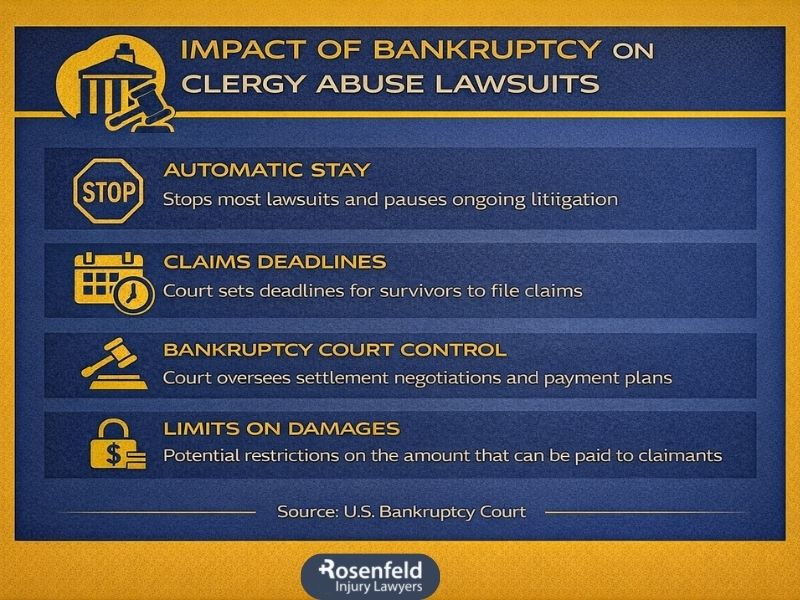
Traditional Lawsuits Are Paused (“Automatic Stay”)
As soon as the institution files, all pending civil suits stop automatically. Survivors cannot proceed in state court until the bankruptcy finishes.
All Claims Must Be Filed Through the Bankruptcy Court
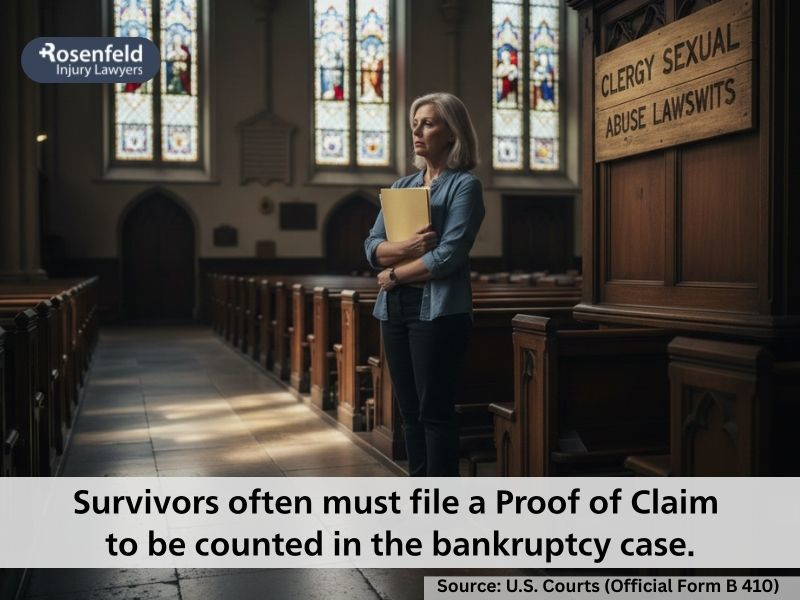
Instead of suing the church or individual clergy members in civil court, survivors must file a special form, called a proof of claim, within the bankruptcy court.
Survivors Submit Proofs of Claim
A proof of claim outlines:
- How you were sexually abused or sexually assaulted
- When the abuse occurred
- Which priest or church members were involved
- How the organization failed to protect you
- What damages you suffered
Our team prepares these on behalf of our clients so everything is accurate, complete, and filed in bankruptcy court before the deadline.
Compensation Comes From a Settlement Trust, Not a Jury
Instead of going to trial and asking a judge or jury to decide damages, survivors get paid through a bankruptcy settlement trust created during the bankruptcy proceedings.
Impact on Timelines
The bankruptcy process can be faster than the traditional discovery process and civil lawsuit, but it can also take years depending on:
- Disputes between insurers
- Valuation of assets
- Negotiations with parishes
- Objections from creditors
Despite these challenges, survivors remain part of the process and retain the right to seek meaningful recovery.
What Are Bar Dates in the Clergy Bankruptcy Process
One of the most important, and most stressful, parts of a bankruptcy case is the bar date. This is the strict deadline set by the bankruptcy court by which all victims must submit their claims.
Missing the bar date can mean permanently losing your right to recover any money.
We never use fear to motivate clients, but we do explain the reality: If your claim is not filed before the bar date, it is usually dismissed forever. That’s why reaching out early matters. We stand with you through every step and ensure nothing is missed.
How Bankruptcy Settlement Trusts Compensate Survivors
When a Catholic Church institution has filed for bankruptcy, a large settlement trust is created. These funds come from several sources:
Insurance Contributions
Most trusts include substantial contributions from insurers responsible for covering church insurance for sexual abuse claims.
Diocesan Assets
This may include:
- Bank accounts
- Investment funds
- Property
- Financial reserves
Parish Contributions
In some sexual abuse cases, individual parishes contribute funds, especially if parish leadership ignored or enabled abuse.
Religious Order Assets
When religious orders contribute, their own property and accounts are part of the trust.
Property Sales
Some dioceses have sold land or buildings to pay settlements.
Once the trust is formed, survivors’ claims are evaluated and categorized into settlement tiers. Payments are based on:
- Severity of abuse
- Duration of harm
- Age at the time
- Negligence by the diocese or organization
- Corroborating evidence
These structured processes replace jury-determined clergy sexual abuse settlements but still provide real financial accountability under the law.
What Catholic Church Dioceses Have Filed For Bankruptcy Protection?
Many dioceses across the country have filed for bankruptcy because of sex abuse litigation. Some with the largest publicly reported settlements include:
- St. Paul and Minneapolis Archdiocese (MN) – $210,000,000
- San Diego Diocese (CA) – $198,100,000
- Wilmington Diocese (DE) – $77,400,000
- Portland Archdiocese (OR) – $74,400,000
- Spokane Diocese (WA) – $48,000,000
- Duluth Diocese (MN) – $40,000,000
- Davenport Diocese (IA) – $37,000,000
- New Ulm Diocese (MN) – $34,000,000
- Milwaukee Archdiocese (WI) – $21,000,000
What Catholic Religious Orders Have Filed for Bankruptcy?
Several well-known religious orders have used bankruptcy to resolve abuse claims, including:
Oregon Province of the Jesuits
The Oregon Province of the Jesuits filed for bankruptcy after facing hundreds of sexual assault claims involving priests who worked in remote Native communities and schools across the Pacific Northwest.
Christian Brothers of Ireland
The Christian Brothers of Ireland sought insolvency protection in the United States following widespread allegations of child sexual abuse in their residential schools and training institutions.
Crosier Father & Brothers
The Crosier Fathers & Brothers filed for bankruptcy after numerous survivors came forward with accusations of clergy sexual abuse connected to their parishes, schools, and youth programs.
How Injury Lawyer Team Can Help You File a Clergy Abuse Claim
When a diocese or religious order declares bankruptcy, survivors often feel overwhelmed. We are here to help you regain control of the process. We guide our clients through:
- Filing proofs of claim: Accurate, complete filings that clearly describe how you were harmed.
- Meeting bar dates: Ensuring your claim is filed before the deadline.
- Gathering evidence: We help document the history of abuse, institutional knowledge, and failures.
- Tier placement: We work to ensure your claim is placed in the correct compensation tier.
- Navigating insurance and trust evaluations: Including the deep complexities of sexual misconduct cases, insurance disputes, and allocation of trust assets.
Every step is handled with compassion, care, and the belief that restitution is still possible, regardless of the bankruptcy proceedings.
We handle sexual abuse lawsuits on a contingency fee basis, meaning you pay no upfront costs and no attorney fees unless we recover damages for you. Your confidential consultation is always free, private, and handled with sensitivity. If you’re ready to talk, contact us.
All content undergoes thorough legal review by experienced attorneys, including Jonathan Rosenfeld. With 25 years of experience in personal injury law and over 100 years of combined legal expertise within our team, we ensure that every article is legally accurate, compliant, and reflects current legal standards.