

Sexual Abuse and Assault Injury Lawyers


Eligibility to Sue the Catholic Church for Clergy Sexual Abuse
At Injury Lawyer Team, we stand with survivors who are trying to understand eligibility to sue the Catholic Church for clergy sexual abuse, what their rights are, and how they can safely take the next step toward accountability.
Many survivors come to us with understandable fear, confusion, or uncertainty about the legal process, especially when the harm was caused by trusted clergy members, church officials, or other leaders within the Catholic Church. We believe in your case, and when you’re ready, we are prepared to guide you with privacy, compassion, and strength.
For many survivors, the sexual abuse they suffered happened a long time ago. Some were sexually abused in childhood, others in adolescence or adulthood, and many only recently learned that they are legally eligible to file a lawsuit, even if the abuse occurred years or decades in the past.
Today, changing laws, expanding time limits, and nationwide efforts to expose systemic misconduct have opened doors that were previously closed.
Our firm helps clergy abuse survivors navigate these opportunities so they can seek justice, reclaim their story, overcome emotional trauma, and continue the healing process with support.
Who Is Eligible to File a Clergy Sexual Abuse Lawsuit?
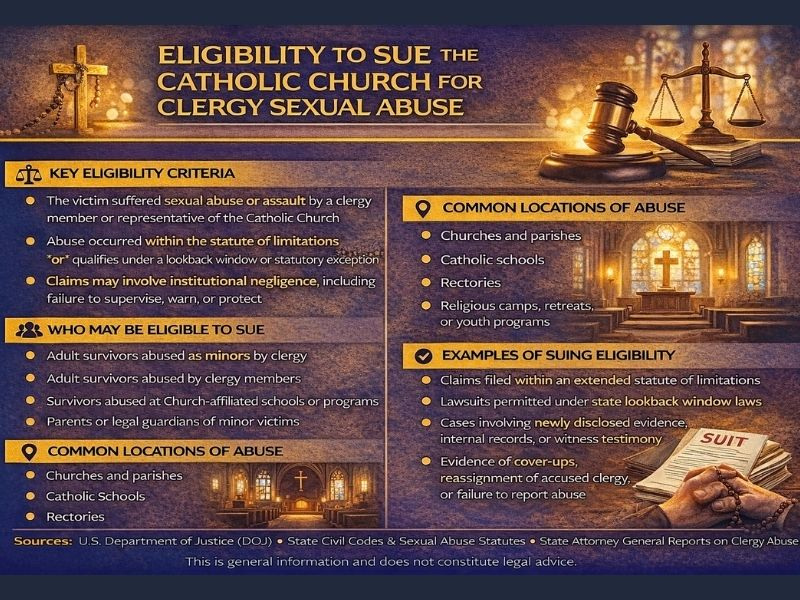
When survivors ask us who qualifies to bring clergy sexual abuse lawsuits, we explain that eligibility is much broader than many people expect. A clergy sexual abuse lawsuit can be filed against the Catholic Church, dioceses, religious orders, affiliated institutions, and sometimes individual accused priests, teachers, and church personnel.
Survivors who may be eligible include:
Adults Who Were Abused as Children
Many of our clients were sexually abused during childhood by priests, deacons, brothers, nuns, seminarians, or parish volunteers. Childhood clergy sex abuse is one of the largest categories of clergy sexual abuse cases, and most states have dramatically expanded legal rights for adults who experienced harm decades ago. Even if you were hurt in the 1960s, 70s, 80s, or 90s, you may still qualify to pursue justice today.
Adults Abused by Clergy or Church Personnel
Eligibility is not limited to childhood victims. Many adults have suffered abuse by priests, ministers, spiritual directors, and other church leaders who exploited power dynamics, counseling relationships, or pastoral authority. Sexual misconduct involving coercion, exploitation, or manipulation can qualify as sexual assault and support a sex abuse lawsuit.
Survivors Abused in Catholic Schools, Youth Programs, or Parishes
We regularly represent survivors harmed in Catholic elementary schools, high schools, youth ministries, altar-server programs, confirmation groups, and parish activities. If you were sexually assaulted by a teacher, coach, mentor, or volunteer connected to a parish or school, you may qualify to file a lawsuit even if the perpetrator was not an ordained priest.
Individuals Harmed by Systemic Cover-Ups or Institutional Failures
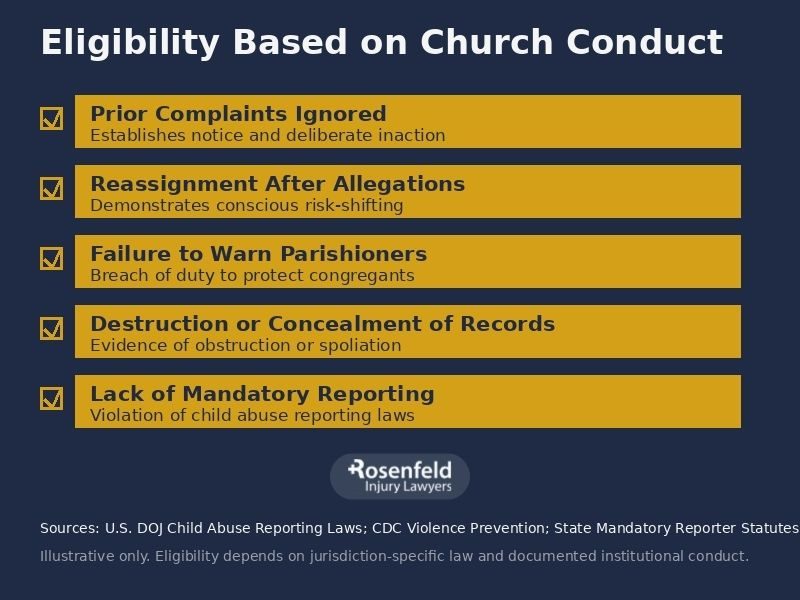
Some survivors were not assaulted by clergy members directly but were harmed because Catholic Church officials:
- Ignored complaints
- Discredited abuse victims
- Forced silence
- Failed to supervise known offenders
- Destroyed or concealed church records
- Moved offenders to new communities
Institutional negligence, especially patterns of transferring abusive priests between parishes, can form the basis for clergy sexual abuse litigation. Eligibility extends across dioceses, religious orders, monasteries, and other affiliated entities.
Eligibility Outside Parish Settings
Many survivors tell us they thought they could not pursue a case because the harm took place outside a parish church. That is simply not true. Eligibility commonly includes abuse in:
- Catholic Schools: Both day schools and residential programs qualify, especially where priests, brothers, or teachers were allowed unsupervised access to children.
- Boarding Schools: Many boarding schools run by religious orders have long histories of sexual abuse allegations, often involving patterns of misconduct and widespread institutional neglect.
- Youth Camps: Survivors abused at youth camps, including summer camps, leadership retreats, and overnights, may be eligible if the program was operated, supervised, or promoted by a Catholic entity.
- Choir Programs: Church choirs, traveling choir groups, and youth singing teams often gave offenders opportunities for isolation, grooming, and exploitation.
- Mission Trips: Missionary work, service trips, and international travel often created environments where predators had unchecked authority.
- Programs Led by Nuns, Brothers, Seminarians, or Lay Volunteers: Eligibility is not limited to abuse by ordained priests. If the program was operated, supervised, or endorsed by the Catholic Church, other clergy members and survivors may still pursue legal action for harm they endured.
We reassure our clients that these cases frequently fall under the Church’s institutional responsibility, even when the abuse occurred far from the parish where the survivor grew up.
Institutional Liability
Survivors often ask us what qualifies as a Church lawsuit. Institutional liability arises when the Catholic Church, dioceses, religious orders, or affiliated leadership contributed to or enabled the abuse through negligent or intentional actions. This includes:
- Negligent hiring or retention of predatory priests
- Transferring known offenders between parishes without warning families
- Failing to report allegations to law enforcement or child protection agencies
- Concealing complaints or discouraging victims from speaking up
- Allowing unsupervised access to children
- Enabling or covering up misconduct at any level of church leadership
A clergy sexual abuse lawsuit can be filed when institutional decisions allowed priests who committed sexual abuse to remain in ministry, gain access to new victims, or avoid accountability. These failures are well documented in grand jury reports, media investigations, and public archives.
How Statutes of Limitations Affect Eligibility
State laws and statutes play a major role in determining eligibility. Victims worry they waited too long. But today, most states recognize that many survivors delay disclosure due to trauma, shame, fear, or post traumatic stress disorder, and laws have changed to reflect this reality.
Statute of Limitations for Child Victims of Sexual Abuse
The statute of limitations for child victims of sexual abuse is often far more generous than it once was. Many states:
- Allow survivors to file until age 50, 55, or older
- Permit lawsuits decades after the abuse
- Remove civil time limits entirely
- Apply “discovery rules” that extend eligibility until a survivor realizes the full impact of the trauma
These laws acknowledge that sexual abuse cases involving minors often remain unreported for years because children may not understand the harm or may be coerced into silence.
Statute of Limitations for Adult Victims of Sexual Abuse
The statute of limitations for adult victims of sexual abuse also varies significantly by state. Some allow claims for several years after the abuse happened, while others extend the timeline based on when a survivor discovered the emotional or psychological consequences of the assault.
Acts involving coercion, abuse of power, spiritual manipulation, or pastoral counseling relationships may also extend eligibility.
We help our clients analyze their state’s laws and determine whether the claim is still timely or whether a special exception applies.
What Are Revival Windows and Lookback Laws for Clergy Sex Abuse Lawsuits
Revival windows (also called “lookback laws”) temporarily reopen expired statutes of limitations so survivors can file a lawsuit even if the deadline has long passed. These laws were created to give survivors a second chance at justice after decades of institutional silence and cover-ups.
Examples include:
- New York Child Victims Act
- New Jersey revival window
- California revival periods
- Maryland Child Victims Act of 2023
- Vermont Lookback Window
- Hawaii civil revival window
Some states have active windows, some have expired, others have pending legislation, and certain states permanently abolished civil time limits for childhood sex abuse. When survivors contact us, we review whether any past, present, or upcoming revival periods apply to their case.
FAQs
What types of clergy sexual abuse qualify for a lawsuit against the Catholic Church?
Any form of sexual abuse, exploitation, grooming, or misconduct by priests, deacons, brothers, nuns, or lay personnel may qualify. This includes childhood abuse, adult coercion, pastoral exploitation, and harm resulting from institutional cover-ups or negligence.
What types of evidence are needed to support a clergy sexual assault lawsuit?
Survivors often ask about the evidence needed for a clergy sexual abuse lawsuit. Evidence may include:
- Church assignments and transfer histories
- Witness testimony
- Therapy records or journals
- Prior complaints against the perpetrator
- School or parish documentation
- Police records or archived reports
- Expert testimony on trauma
Even if you have no documents, you may still have a strong case. Many survivors rely primarily on their testimony, supported by patterns in church records.
What damages can be recovered through a clergy sexual abuse lawsuit?
Most dioceses and religious orders carry significant liability insurance. Understanding churches’ insurance for sexual abuse claims is crucial, as these policies often provide the financial resources needed to compensate survivors. We identify all applicable policies, challenge denials, and pursue every responsible insured entity.
Compensation may include medical expenses, therapy costs, lost income, emotional distress, and long-term psychological harm. Abuse victims may also seek punitive damages intended to punish the institution when church leaders acted with reckless disregard or intentional concealment.
How Injury Lawyer Team Can Help
When victims contact us to discuss sexual abuse lawsuits, we approach their case with privacy, dignity, and deep respect for their trauma. We help survivors:
- Evaluate eligibility
- Understand how the legal process works
- Identify all liable parties and responsible institutions
- Navigate complex insurance structures
- Pursue claims against multiple dioceses or orders
- Access trauma-informed support throughout the case
- Challenge wrongful denials
- Maximize available coverage for survivors
Your safety, privacy, and healing matter to us. We handle these matters on a contingency fee basis, meaning you pay no upfront costs and no legal fees unless we recover compensation for you.
Our consultations are free and confidential, and when you’re ready to take the next step, you can contact us to begin the legal action that may help you reclaim your voice and continue your healing process with support.
All content undergoes thorough legal review by experienced attorneys, including Jonathan Rosenfeld. With 25 years of experience in personal injury law and over 100 years of combined legal expertise within our team, we ensure that every article is legally accurate, compliant, and reflects current legal standards.