

Sexual Abuse and Assault Injury Lawyers


Eligibility for a Catholic Church Lawsuit
Those who experienced childhood sexual abuse at religious institutions can pursue justice through a civil lawsuit. Eligibility for a Catholic Church lawsuit depends on the available evidence, the type of clergy abuse, and state laws.
Injury Lawyer Team is here to help survivors with Catholic Church sexual abuse cases. We will support your healing process by handling third-party communications and recovering compensation to cover your therapeutic needs. Contact us today for a free consultation about the legal process.
Who Is Eligible to File a Lawsuit Against the Catholic Church?
A survivor qualifies for a Catholic Church lawsuit if they can demonstrate that the church failed to protect them from abusive clergy members or church officials.
To determine whether they can pursue legal action, sexual abuse survivors must first understand the legal concept of negligence. This is the theory that the defendant failed to prevent harm to someone with whom they had a duty of care.
Our legal team can file a lawsuit against the Catholic Church for a range of abusive behaviors. These can include the following.
Grooming: This type of clergy abuse case argues that the perpetrator manipulated the victim into sexual contact through special favors, attention, and reassurance. Many survivors state that they were slowly led into a sexual relationship through gifts, one-on-one experiences, and being treated as unique.
Child Sexual Abuse Material (CSAM): Federal law prohibits the production, transmission, storage, or dissemination of any material that depicts an underage person in a sexually suggestive or explicit way (18 U.S.C. § 2252). In the modern era, this can include AI-generated images or doctored images that appear to show an underage person. The photos or videos do not have to show sexual abuse in order to be considered CSAM.
Digital Child Exploitation: Sexting, sexually explicit social media messages, or attempting to solicit sex via forums are all illegal when they occur with an underage person.
Sexual Assault: In some cases, particularly with adult victims, clergy members or church officials will forcibly assault the individual.
Spiritual Abuse: Perpetrators may commit spiritual abuse, which is when they use their position of authority and religious scripture to force a victim into a sexual relationship. This can cause tremendous harm to churchgoers and may lead to disenfranchisement from the Catholic Church.
Adult Sexual Misconduct: Priests, pastors, and other religious figures may use their position of authority to pressure adults into sexual activities. For example, they may use spiritual counseling or pastoral work to manipulate vulnerable people into offering sexual favors.
Sexual Harassment: While Title VII of the Civil Rights Act of 1964 has a ministerial exceptionthat allows religious agencies to discriminate by gender or sexual orientation, this does not exempt them from civil litigation regarding sexual harassment. This type of abuse includes inappropriate comments, demands for sexual favors, or creating a hostile work environment.
Exploitation of Vulnerable Individuals: Some forms of abuse in the Catholic Church do not involve sex, but rather financial exploitation of elderly or disabled people. For example, clergy members may misappropriate parishioner funds for personal use or attempt to extract favors from elderly individuals.
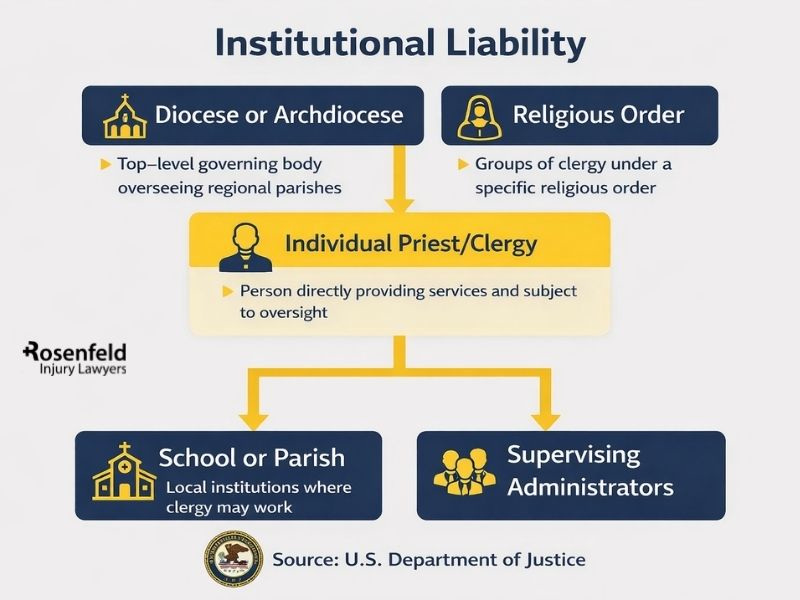
While a Catholic Church lawsuit can be against the direct perpetrator, the church can also be held liable for the harm you suffered. For example, if abuse occurred on church property or during a church-affiliated event, then this implies vicarious liability for the Catholic Church itself.
Potential lawsuits against the church itself can include the following.
Negligent Hiring, Supervision, or Retention: Churches must thoroughly vet anyone who will be working with vulnerable individuals, particularly minors, and provide adequate oversight. Should there be any complaints, the church should remove the individual from working with children and investigate the matter. Unfortunately, many refuse to do this, siding with abusers over survivors.
Coverups and Institutional Negligence: In some cases, churches will conceal evidence of wrongdoing, stonewall victims, or complete internal investigations rather than report concerns to the authorities. These are all considered institutional negligence and can be grounds for a church lawsuit.
Breach of Fiduciary Duty: Churches can be held liable if one of their employees misuses church funds or financially exploits churchgoers.
Premises Liability: You can take legal action if you were hurt on Church property, whether that was a slip and fall accident or an assault.
The sexual abuse or other personal injury does not have to take place within the church itself, but can occur during Church-sponsored activities or premises. These can include:
- Church retreats or camps, such as Camp Manitoqua & Retreat Center
- Church-sponsored events, like retreats, volunteer activities, or festivals
- Sunday schools and daycares
- Youth groups and programming
- Religious schools and private academies
- Vacation Bible School or other summer activities
- Church-affiliated nursing homes, hospice centers, or respite care
- Church-affiliated homeless shelters, food banks, or donation centers
A range of individuals beyond priests or other clergy can also perpetrate sexual abuse and other forms of abuse. This includes youth pastors, choir directors, teachers, administrators, maintenance workers, volunteers, or outreach coordinators.
Most states have joint tortfeasor acts. This means that you can file a lawsuit against multiple parties who were all culpable for the harm you experienced. For example, you could sue the direct perpetrator, their supervisor, and the diocese in which the assault took place.
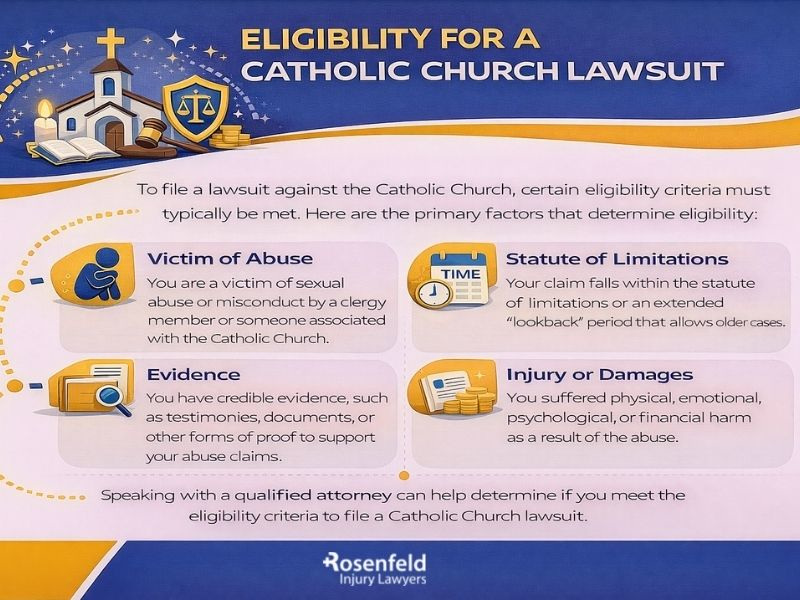
When you contact us for an initial consultation, we will determine what type of claim you may have. This also includes determining any statutory restrictions that may make it more difficult to file a claim. Even if the deadline has passed, we may be able to prove that delayed discovery kept you from filing sooner.
You may receive both economic and non-economic damages. These can include:
- Medical bills
- Lost income
- Loss of future income
- Physical pain and suffering
- Emotional distress
- Loss of normal life
In some cases, a court may award punitive damages. These damages are meant to punish the perpetrator and keep them from reoffending. However, not every state allows for punitive damages, and they are treated as a separate category from compensatory damages.
There is no set settlement amount for a Catholic Church lawsuit. The compensation you receive depends on factors such as available evidence, the victim’s age at the time of the incident, the severity and duration of the abuse, and who is considered liable. Our team will thoroughly evaluate your damages and push for the highest compensation that will cover your needs.
How State Laws Impact Eligibility to File a Catholic Church Clergy Sexual Abuse Lawsuit?
Each state has a different statute of limitations for clergy abuse lawsuits, and these are often different depending on the victim’s age when the abuse occurred. The civil statute of limitations for adult survivors of sexual abuse is typically the same as for other personal injury lawsuits.
However, many states have extended or eliminated the civil statute of limitations for survivors of child sexual abuse.
Our legal team is familiar with the shifting legislation around Catholic Church lawsuits and can help you determine whether you are eligible based on current statutes. As we work on a contingency fee basis, there is no risk to contacting us for an initial consultation about your case.
FAQs
Can victims file a lawsuit if the Catholic Church abuse happened years ago?
This depends on the state. Some states and cities that extended their timelines offered a lookback window to file a Catholic Church lawsuit. For example, the New York City Council recently passed Intro 1297, which enabled survivors to file claims against individual perpetrators and religious organizations for abuse that happened decades prior.
The New York State Senate is also in the process of passing Senate Bill S6978, which would eliminate the deadline for some civil actions related to childhood sex abuse. It’s not clear whether this will include retrospective claims.
In some states, victims can claim delayed discovery of their injuries, allowing them to file a Catholic Church lawsuit decades after the incident.
The legal frameworks around clergy abuse cases continue to evolve in state legislatures. This makes it essential that survivors consult a lawyer as soon as possible to determine whether they can pursue justice no matter how much time has passed.
Are there any class actions for abuse in the Catholic Church?
Yes, there have been a number of class action clergy sexual abuse lawsuits across multiple archdioceses. One recent case was a Roman Catholic diocese in Long Island, New York, where a judge approved a $320 million bankruptcy deal for over 600 survivors.
Another class action lawsuit was filed against the Archdiocese of Washington, where three men claimed that they suffered irreparable harm due to abuse by Catholic priests.
These Catholic Church lawsuits require significant legal expertise and coordination, making it crucial that you work with a skilled attorney like Injury Lawyer Team. We will
What evidence is needed to file a Catholic Church lawsuit?
A range of evidence can be used to file a lawsuit against the Catholic Church. Some of the most valuable evidence includes the following.
Church Records: These substantiate sexual abuse claims by showing that the perpetrator worked in the facility at the time of the incident or was affiliated with the facility in some capacity. These church documents can include employment records, transfer requests, and payroll documents.
Private Communications: Our team can subpoena the church to request private documentation that may demonstrate the church’s awareness of the abuse.
Surveillance Footage: Some churches have surveillance cameras, or there may be cameras pointing toward the facility from neighboring homes. In conjunction with your testimony, these can demonstrate that the perpetrator was on-site at the time.
School Reports: For abuse cases involving religious schools, attendance records and school documents can be used to support your claim.
Police Reports: Though survivors may not always file a police report, this and forensic testing can be invaluable for a civil claim.
Medical Records: Many survivors do not disclose abuse immediately, but they may consult with a mental health specialist about issues like post-traumatic stress disorder, dissociative disorders, depression, anxiety, or challenges with interpersonal relationships. These records can demonstrate a correlation between emotional distress and sexual trauma.
Witness Statements: Friends, family, and fellow Church staff can assist us in understanding what occurred. They can also attest to the tremendous psychological harm caused by the abuse and help to prove your damages.
Expert Testimony: Mental health professionals and academics can provide their unbiased opinions on your situation, which can strengthen your Catholic Church lawsuit.
How Injury Lawyer Team Can Help
Our attorneys are committed to helping victims get justice through sexual abuse lawsuits. To begin, we will complete an initial consultation, where we determine what type of case you have and whether current statutory guidelines enable us to pursue a claim. We’ll gather background information about your case, such as when it occurred, who was involved, and what types of damages you have suffered.
We will then begin gathering evidence to support your claim. This can include police reports, church records, medical reports, psychological evaluations, and witness statements. Our team will also reach out to trusted experts who can provide expert testimony about the harm you have suffered.
Once this is complete, our team will file a complaint with the appropriate court. In many cases, we can file anonymously so that you are protected from third parties.
We’ll then initiate negotiations with the Catholic Church. This involves sending a demand letter, waiting for a counteroffer, then negotiating for a reasonable settlement.
Many of these cases settle out of court, sparing victims the need to face their attacker in court. However, we are committed to protecting your privacy and comfort should we have to pursue a trial. We will use all available legal protections to keep you from having to see the perpetrator, such as requesting that you provide your testimony over video or arranging hearings so that you don’t have to be in the same room as the defendant.
Our goal is to help you feel safe, supported, and confident so that you can move forward in your healing journey. As trauma-informed legal advocates, we are members of the American Association for Justice and regular contributors to the National Law Review.
Injury Lawyer Team is an award-winning law firm that has secured over $450 million in settlements and verdicts over the past 25 years. We work on a contingency fee basis: no legal fees unless we win. To schedule your free consultation with a compassionate sexual abuse attorney, call us at 866-757-6452 or use our online contact form.
All content undergoes thorough legal review by experienced attorneys, including Jonathan Rosenfeld. With 25 years of experience in personal injury law and over 100 years of combined legal expertise within our team, we ensure that every article is legally accurate, compliant, and reflects current legal standards.