

Sexual Abuse and Assault Injury Lawyers


Clergy Sexual Abuse Statute of Limitations
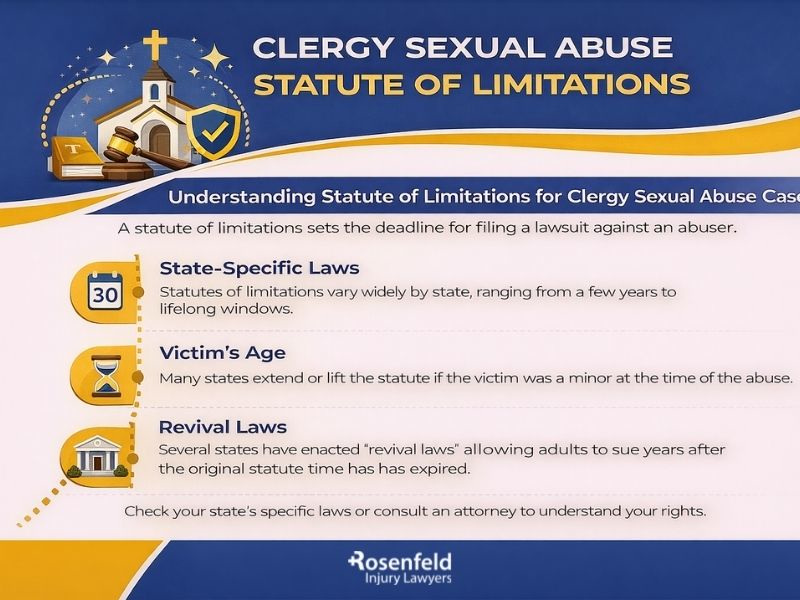
There are strict deadlines to file a civil action for abuse by a religious leader, but the clergy sexual abuse statute of limitations is different depending on where the abuse occurred.
Our clergy abuse lawyers can assist you in determining whether you can file civil lawsuits based on current law in your area. Contact us today for a free, confidential consultation on your legal rights.
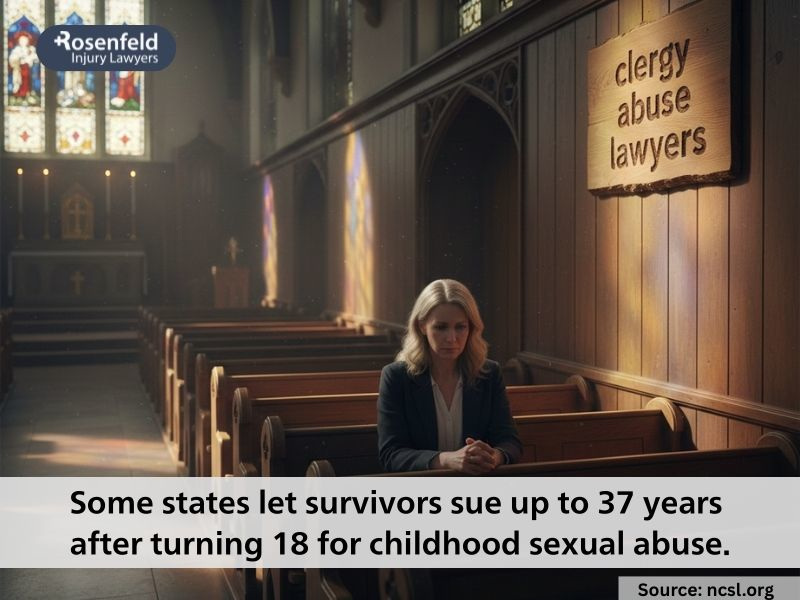
Does a Civil Lawsuit and Criminal Prosecution Against a Clergy Member Have the Same Statutes of Limitations?
No, there are different statutes of limitations depending on whether you are pressing charges or filing civil claims. There are two legal processes that you can use to pursue accountability: civil and criminal cases.
The criminal justice system focuses on proving that a crime occurred, like aggravated sexual assault or rape.
Typically, a prosecutor will bring criminal charges against the individual perpetrator, though some criminal sexual abuse cases do focus on institutional aspects like fraudulent concealment. Criminal statutes impose strict time limits and require strong evidence to prove, beyond a reasonable doubt, that the crime occurred.
In contrast, civil claims focus on institutional liability, such as proving that Church officials knew that Catholic priests were harming children. Civil cases center on securing monetary damages from churches or other institutions, like schools. The time limit for a claim may be shorter or longer.
What Is the Clergy Abuse Statute of Limitations to File a Civil Claim?
To ensure you can secure financial compensation, you must check the civil statutes of limitations on sexual assault in the jurisdiction where the abuse was committed. This varies by state and the victim’s age at the time of the assault. In general, adult survivors have the same statute of limitations as for other personal injury claims.
For Illinois clergy abuse lawsuits, those who were assaulted as adults have two years to file a claim (735 ILCS 5/13-202).
Michigan clergy abuse lawsuits have several statutes of limitations depending on the type of sexual abuse. Adult survivors who could have pressed charges have up to ten years, while the statute is five years for intimate partner violence (Section 600.5805).
For adult victims in California, they can file California clergy abuse lawsuits within ten years of the event, or within three years of discovery of any injury or illness resulting from the assault (CA Civ Pro Code § 340.16).
Our attorneys remain alert to any proposed legislation that may help survivors bring a civil case and will ensure your right to pursue a claim is protected.
Is There an Extended Statute of Limitations for Childhood Sexual Abuse Survivors?
Yes, there is often a longer statute of limitations for childhood sexual abuse survivors, and many states have passed new legislation to help more survivors get justice.
In Illinois, survivors have up to 20 years after they reasonably should have discovered the injury, or by age 38. There is no statute of limitations for felony sexual abuse (735 ILCS 5/13-202.2). This new law was signed in 2024 but is not retroactive (IL HB0222).
Michigan lawsuits must be filed before childhood victims of sexual abuse turn 28 (Act 236 of 1961, Chapter 58). In 2018, the state passed a law refining the discovery rule, letting childhood abuse victims seek justice past the age of 28 (Public Acts 2018, Nos. 333-337). This law lets survivors initiate legal proceedings within three years of discovering they were sexually abused, even if they are older than 28.
However, the Michigan Supreme Court ruled in McLain v. Roman Catholic Diocese of Lansingthat the 2018 law is not retroactive. Claims that would have been time-barred before 2018 cannot be filed.
California has strong advocacy for child abuse survivors. Lawsuits based on abuse occurring after January 1, 2024, do not have any time limits (Section 340.1). Claims arising from abuse prior to this have a 22-year statute of limitations (Section 340.11).
Should Child Sexual Abuse Victims Wait to Take Legal Action Until Adulthood?
While many survivors understand the statute of limitations to mean that they cannot bring claims before the age of majority, this is not true. Minors cannot file suit on their own, but a parent or legal guardian can initiate the legal process for them, allowing a claim to be filed before they turn 18.
Filing promptly improves the chances of a viable claim by preserving valuable evidence. It also prevents the cover-up of institutional abuse, such as destroying records. Parents seeking justice for child sex abuse committed against their children should contact us as soon as possible to discuss legal options.
Do Clergy Abuse Cases Have Extended Statutes of Limitations in Cases Involving Catholic Church Cover-Ups?
Recent government investigations have found that religious institutions have attempted to conceal widespread sexual abuse.
For example, the Michigan Attorney General found that the Diocese of Lansing repeatedly concealed evidence of childhood sexual abuse. Some victims were not aware that they were being abused because priests and other religious figures claimed that the behavior was appropriate or religiously sanctioned.
Institutional cover-ups can also traumatize victims into not disclosing until much later in life. Scholars have called clergy sex abuse a form of “soul murder,” which causes victims to lose trust in themselves, their religion, and their community as a whole. This can result in significant challenges in addressing childhood sexual abuse or seeking treatment for the harm caused.
In these cases, states use the discovery rule to pause the statute of limitations until the information becomes available. This could occur when a victim realizes that their distress is connected to prior sexual abuse. As an example, some survivors suffer from chronic pain, nightmares, or substance use, which they may not recognize as being related to the harm they suffered.
How Our Law Firm Can Help Victims of Clergy Sex Abuse
Injury Lawyer Team can help survivors file a sexual abuse lawsuit based on the current statute of limitations in their jurisdiction. These claims can be challenging, as many survivors do not disclose until years later. Not only must we demonstrate that the claim meets the statutory guidelines, but vital evidence may also have been lost or destroyed.
With a 98% success rate and the prestigious Super Lawyers designation, we are highly skilled at securing evidence while preserving a survivor’s right to privacy.
We will meticulously examine Church records, identify and contact potential witnesses, and use a trauma-informed interviewing process to build a robust case. This includes assessing your potential damages, such as lost wages, medical bills, pain and suffering, and emotional distress.
When this is complete, we will file a claim with the appropriate court and enter negotiations with the applicable diocese. We handle all third-party communications on your behalf, protecting you from the perpetrator and enabling you to focus on your healing journey.
Many claims are successfully resolved out of court. However, some claims have complex legal questions, such as whether the case was previously time-barred or when the specific dates of the assault are not fully known.
When these questions arise, cases may proceed to trial. Having been named as one of America’s Top 100 High Stakes Litigators, we have a proven track record of success in courts nationwide.
Our team is passionate about serving survivors and ensuring their stories are heard. We work on a contingency fee basis: no legal fees unless we win. To request a free consultation with an experienced clergy abuse attorney, call us at 866-757-6452 or use our online contact form.
All content undergoes thorough legal review by experienced attorneys, including Jonathan Rosenfeld. With 25 years of experience in personal injury law and over 100 years of combined legal expertise within our team, we ensure that every article is legally accurate, compliant, and reflects current legal standards.