



Who Pays the Settlement in a Sexual Abuse Lawsuit?


At Injury Lawyer Team, we stand with survivors who are trying to understand who pays the settlement in a sexual abuse lawsuit, what financial compensation may be available, and how the legal system assigns responsibility.
Many of our clients come to us overwhelmed by fear, confusion, and the psychological and physical toll of what happened. You’re not alone. We believe in your case, and we guide you through every step of the legal process with compassion, clarity, and strength.
Understanding who ultimately funds sexual assault settlements is an essential part of helping vulnerable victims reclaim stability, rebuild their lives, and pursue justice. Below, our legal team walks you through how liability works, how compensation amounts are determined, and how we help survivors move forward toward healing and accountability.
How Liability Works in a Civil Sexual Abuse Case
In sexual abuse cases, liability refers to who is legally at fault and, therefore, responsible for paying the settlement agreement. Civil law allows survivors to bring legal action against the perpetrator as well as institutions or entities whose negligence or failures within the organization enabled the abuse.
Individual Liability (The Perpetrator)
The abuser, the person who committed the sexual assault or physical violence, is always legally responsible. However, because many perpetrators do not have a meaningful financial status, they are often unable to pay substantial damages on their own.
Institutional Liability
Most sexual assault cases involve institutional responsibility. This may include:
- Schools and universities
- Religious organizations
- Hospitals and medical groups
- Youth programs or athletic organizations
- Employers
- Childcare programs
Institutions are often the primary source of substantial compensation because they carry insurance policies, maintain assets, and have a legal duty to protect survivors. When an institution knew, should have known, or failed to prevent abuse, it can be held responsible for significant portions of the settlement value.
Third-Party Negligence
Other parties can share fault when their negligence contributes to the incident. Examples include:
- Failure to report abuse
- Inadequate supervision
- Negligent hiring or retention
- Unsafe premises or inadequate security
- Supervisors who ignored warnings
In civil law, financial responsibility follows the liable party or parties. These layers of responsibility significantly influence settlement outcomes and determine who ultimately pays.
When the Perpetrator Pays the Settlement
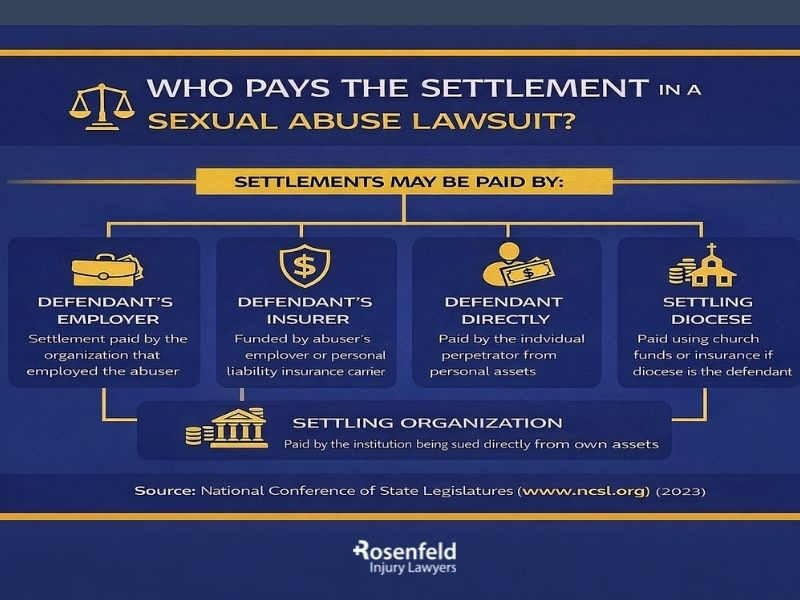
Although institutions and insurers usually fund the majority of compensation for sexual misconduct, there are circumstances where the perpetrator personally pays financial compensation.
High-Net-Worth Individuals
When a perpetrator has substantial personal assets, such as a high-earning professional, business owner, or otherwise wealthy individual, they may be able to contribute meaningfully to a substantial settlement.
Professionals With Liability Insurance
Doctors, therapists, and other licensed professionals often have:
- Malpractice insurance
- Professional liability coverage
- Specialized endorsements
In these situations, even when the abuser is directly responsible, there may be insurance covering sexual assault settlements through professional policies.
Cases Where Institutional Liability Is Limited
If the abuse occurred outside an institutional setting, or if the survivor chooses not to pursue institutional defendants, the perpetrator may be solely or primarily responsible.
However, limitations are common. Most abusers lack significant monetary resources. Many have no assets to seize or insurance policies that apply. That is one reason institutional involvement and insurance coverage are crucial for survivors seeking fair settlement outcomes.
When Institutions Pay the Settlement
In most sexual abuse cases, institutions pay the bulk of the settlement. Institutions often hold the legal and moral responsibility when their negligence, inaction, or misconduct enabled the abuse.
We frequently pursue legal action against:
- Religious organizations and church systems
- Schools, universities, and educational programs
- Hospitals, clinics, and medical networks
- Daycare centers and childcare facilities
- Youth programs like athletic clubs or scouting organizations
- Residential facilities, boarding schools, and treatment centers
These entities typically have substantial financial assets, including:
- General liability insurance
- Sexual misconduct endorsements
- Litigation reserves
- Self-insurance risk pools
- Excess or umbrella policies
Because institutions can prevent future abuse and protect survivors by adopting safer practices, holding them accountable is a critical part of achieving systemic change.
Vicarious Liability and Direct Negligence
Institutions can be liable in two major ways:
- Vicarious liability: when an employee, volunteer, or agent commits abuse within the scope of their role
- Direct negligence: failure to screen, supervise, train, report, or intervene
In our experience, institutional negligence often affected survivors’ lives just as much as the perpetrator’s actions, and identifying these failures leads to stronger settlement positions and higher payout totals.
How Insurance Policies Cover Settlements Involving Sex Abuse
Insurance is often the primary source of financial compensation in sexual abuse cases, especially those involving schools, churches, medical facilities, or youth organizations.
Types of policies that may contribute include:
- General liability insurance: Covers negligent supervision, unsafe premises, or institutional misconduct.
- Sexual misconduct or abuse endorsements: These policies exist specifically to address sexual misconduct claims and are often required for youth-based organizations.
- Professional liability or malpractice insurance: Applies in cases involving doctors, therapists, nurses, counselors, and other licensed professionals.
- Homeowner’s or renter’s insurance: In limited cases, these may cover abuse committed inside a home, depending on exclusions and policy language.
Insurance carriers evaluate:
- The legal claims
- Evidence such as medical documents
- Liability exposure
- The institution’s role
- The defendant’s financial resources
They also negotiate damages, contribute to settlement funds, and are often instrumental in calculating settlements. Understanding how insurance covering sex abuse settlements works is essential to identifying all available sources of compensation and building a fair settlement.
What Happens When Multiple Defendants Share Responsibility
Sexual abuse cases often involve multiple defendants. For example, the perpetrator, a school, a supervisor, and a contracting agency may all share responsibility.
How Payment Is Divided
Courts or settlement agreements may allocate payment according to:
- Fault percentages
- Policy coverage
- Asset availability
- Contractual agreements
Legal doctrines that apply include:
- Contribution: defendants share payment proportionally
- Indemnification: one defendant reimburses another
- Joint and several liability: one defendant may be required to cover the full amount if others cannot pay
Settlements frequently involve multiple insurers pooling resources to protect victims and fulfill legal obligations.
How Are Sex Abuse Settlement Amounts Determined?
Every survivor’s experience is unique, and we fight to ensure your story, your healing, and your needs guide the settlement process.
Common categories of compensation include:
- Therapy, counseling, and mental-health treatment
- Medical care
- Relocation expenses
- Lost wages
- Long-term emotional support
- The emotional and physical toll of abuse
- Future care or treatment for trauma
- Punitive damages in cases involving repeated abuse and egregious misconduct
These categories reflect the survivor’s ability to rebuild after the abuse, hold wrongdoers accountable, and regain stability.
What Factors Influence Settlement Value?
Compensation value is shaped by:
- Severity of the abuse
- Whether the abuse occurred repeatedly
- Age of the survivor
- Long-term mental health impact
- The defendant’s financial ability
- Policy coverage and policy limits
- Strength of the evidence
- The presence of confidentiality clauses
- Institutional negligence and failures
- The survivor’s needs requiring lifelong financial support
- How the abuse affected every aspect of the survivor’s well-being
Appropriate settlement outcomes are based on a detailed review of evidence, medical records, psychological impacts, and the survivor’s long-term healing journey. Settlements provide financial relief, support recovery, and help prevent future misconduct by forcing institutions to adopt safer practices.
How Injury Lawyer Team Can Help
At Injury Lawyer Team, we stand with survivors every step of the way. We know the emotional toll, the uncertainty of entering the civil justice system, and the courage required to pursue justice through legal action. Our experienced attorney team handles sexual abuse lawsuits with compassion, strength, and confidentiality.
Our services include:
- Full case evaluation and legal guidance
- Identifying all defendants and financial assets
- Investigating institutional failures
- Gathering evidence and hospital records
- Determining settlement figures and negotiating compensation
- Filing legal action and representing you through the legal process
- Protecting your privacy every step of the way
- Fighting to prevent future harm by holding institutions accountable
- Advocating for a fair financial relief for medical bills, lost wages, and pain and suffering that supports your healing
We take these cases on a contingency fee basis, so you never pay upfront costs or legal fees unless we successfully recover compensation for you. Consultations are always free and completely confidential.
If you’re considering filing a sexual assault lawsuit, you’re not alone. We believe in your case. When you’re ready, we’re here to listen, guide, and stand with you as you pursue justice, safety, and long-term healing.
All content undergoes thorough legal review by experienced attorneys, including Jonathan Rosenfeld. With 25 years of experience in personal injury law and over 100 years of combined legal expertise within our team, we ensure that every article is legally accurate, compliant, and reflects current legal standards.