



The Role of Civil Lawsuits in Holding Perpetrators Accountable


There are two primary types of law in the United States: criminal and civil. Criminal proceedings are used to determine whether defendants are guilty of crimes defined in local, state, or federal law. The person may be acquitted or sentenced. With that being said, what is the role of civil lawsuits in holding perpetrators accountable?
There are important differences between the civil justice system and the criminal court.
First, the plaintiff has a lower burden of proof in a civil lawsuit, requiring only enough evidence to find that the defendant is more likely than not responsible for the harm. Civil actions also focus on compensating the victims rather than punishing the offenders.
Injury Lawyer Team can help you understand these distinctions and will stand by your side throughout the claims process to fight for fair compensation.
Why Do Civil Lawsuits Matter When Criminal Prosecution Is Limited or Unavailable?
A civil proceeding is another way to hold someone accountable for the harm they caused another person. Often, the burden of proof is too high in criminal cases, allowing guilty individuals to go free. However, the civil justice system can ensure accountability by imposing financial penalties on offenders, maintaining public records of their conduct, and issuing court findings.
Many hurdles may prevent true justice in a criminal setting. A lack of evidence is far more likely to lead to a declaration of innocence. The statute of limitations may be stricter in criminal actions, reducing the time a person can be prosecuted.
Meanwhile, the statute of limitations for child sexual abuse is more lenient for civil cases than criminal actions in many states. The same may be true of the deadlines for adult sexual assault cases, but it is important to seek justice quickly in either case.
Compensatory Economic and Non-Economic Damages
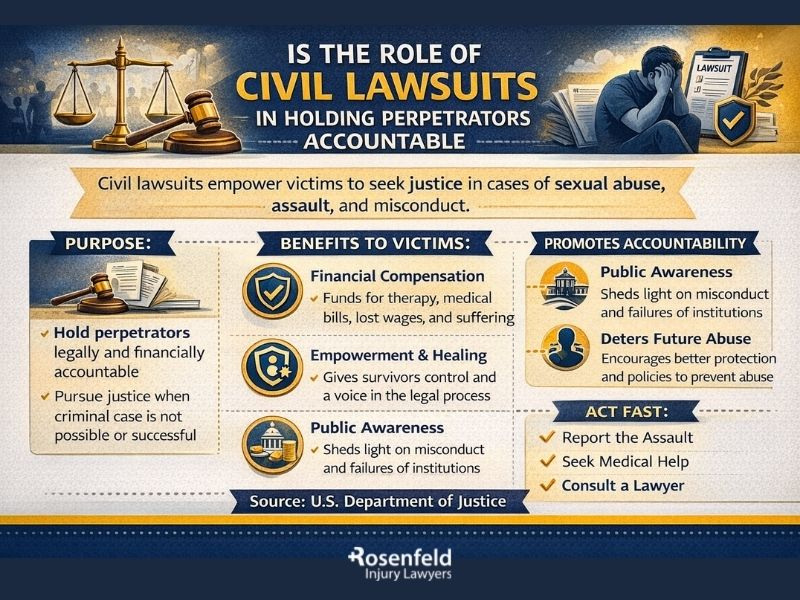
The purpose of the civil justice system is to give victims an opportunity to seek compensation for their legal damages caused by the defendant. Most recoverable losses are classified as compensatory damages, which include both economic and non-economic categories.
Economic Damages
- Lost wages – Lost income due to missed time at work during recovery
- Medical expenses – Costs of medical treatment for injuries or emotional trauma
- Property damage – Losses to owned property caused by the incident
Non-Economic Losses
- Emotional distress – Psychological suffering, such as depression, anxiety, and Post-Traumatic Stress Disorder
- Pain and suffering – Pain caused by physical injuries
- Disability and disfigurement – Permanent alterations to your body or abilities
- Loss of enjoyment of life – A diminished ability to experience joy due to the trauma of the injury
Punitive Damages
In a civil court, a plaintiff may be awarded additional compensation in a case involving gross negligence or reckless conduct. For example, punitive damages are common in sexual abuse cases due to the level of trauma many victims suffer.
Why Can the Civil Justice System Succeed Where Criminal Charges Fail?
Sentencing someone to prison or probation is a serious matter, so it is essential to get it right. This is why the burden of proof is much higher in criminal actions. The prosecution must provide supporting evidence to meet the standard of “beyond a reasonable doubt.”
In the civil justice system, the standard is usually the “preponderance of the evidence.” This essentially means that it is more likely than not that the defendant committed the act against the plaintiff. It allows victims to hold perpetrators accountable, even when the proof is insufficient to secure a criminal conviction.
Can Civil Cases Hold Institutions Accountable for Enabling Abuse or Harm?
An individual is not always solely responsible for a victim’s suffering in a civil action. If you leverage this legal system to sue an institution, you can hold it accountable for your legal damages even if it didn’t take direct action against you.
Here are a few scenarios where an institution may be at fault in a lawsuit:
- Negligent supervision in a nursing home for elderly residents
- Inadequate security at a public event
- Failure to protect students from harm in an educational setting
- Medical malpractice that involves a misdiagnosis
- A failure to maintain safe premises, leading to premises liability
- Negligent retention of an employee who could harm others
How Do Civil Proceedings Expose Systemic Failures That Criminal Cases Overlook?
Although civil actions do not result in sentences or imprisonment, they can still drive systemic change through public exposure. Deficient policies in a nursing home may be uncovered during the discovery process when multiple residents report a lack of fall-prevention measures. A pattern of abuse by a priest could demonstrate the church’s policy of reassigning abusive clergy members to new parishes.
The discovery process can be a powerful tool in holding perpetrators accountable and the institutions they are connected to. During the legal process, attorneys will leverage subpoenas, depositions, and internal documents to hold these entities accountable for improper patterns or policies. This is why discovery is crucial for both civil and criminal issues.
How Does Civil Law Give Survivors a Voice and Control Over the Process?
Personal injury survivors have more freedom to control the process in a civil setting. They can file a claim, settle outside of court, proceed anonymously, or go to trial. These options ensure the victim’s voice is heard on their terms, which is not always the case in the criminal justice system.
How Do Civil Lawsuits Create Public Records That Drive Transparency?
Civil lawsuits can also lead to the publication of facts about the case. This helps uncover corruption and patterns of misconduct within institutions and raises awareness of dangerous individuals. For example, the impact of media coverage on sexual abuse cases can give the public fair warning about certain organizations that may be dangerous.
Book a Free Consultation to Explore Your Legal Options
The Injury Lawyer Team is prepared to believe in your story and pursue justice on your behalf. Together, we will fight to recover damages through fair financial compensation, ensuring the defendant is held accountable, whether or not criminal charges are brought.
Contact us today at 866-757-6452 to schedule a free and confidential consultation with our sexual abuse attorneys.
All content undergoes thorough legal review by experienced attorneys, including Jonathan Rosenfeld. With 25 years of experience in personal injury law and over 100 years of combined legal expertise within our team, we ensure that every article is legally accurate, compliant, and reflects current legal standards.