



How Often Do Sexual Assault Cases Go to Court?


At Injury Lawyer Team, survivors often ask us: “How often do sexual assault cases go to court?”, whether they will need to testify, and if they will ever have to confront the person who harmed them.
These questions are deeply tied to trauma and fear, especially for sexual assault victims, many of whom never imagined they would be forced to deal with the judicial system after what happened. You’re not alone, and we stand with you. We understand the reality of these cases and know that the process feels overwhelming.
The truth is that most sexual assault claims, both civil and criminal, never make it to trial. For survivors, that can be reassuring or concerning, depending on what they need to feel safe and believed.
Many cases settle or resolve without a courtroom because survivors prefer privacy, and institutions want to avoid public scrutiny. But when a trial is necessary, we stand by our clients the entire way and make sure their voices are heard.

How Sexual Abuse Claims Move Through the Civil Process
Civil sexual abuse claims allow survivors to pursue accountability and compensation separate from criminal litigation. These claims exist to help survivors regain a sense of control after the perpetrator is held accountable, whether the defendant is the individual offender or an institution that failed to protect you.
Investigation
We begin by listening to your story and gathering information about the sexual abuse. We identify every potentially responsible party, whether it’s an individual, a school, a medical facility, an employer, or another institution.
Evidence Collection
We collect:
- Sexual assault nurse examiner (SANE) documentation
- Medical records
- Text messages and digital evidence
- Screenshots of conversations indicating grooming
- Prior complaints
- Photos and videos
- Timelines
- Expert evaluations
Often, evidence includes investigative findings and institutional cross-communications uncovered in criminal or administrative inquiries.
Pre-Litigation Negotiation
We send a demand outlining what happened, the damages, and supporting evidence. Many sexual assault lawsuits settle here because defendants want to avoid public exposure.
Filing the Civil Lawsuit
If negotiation fails, we file your case in civil court and begin litigation.
Discovery
This is when both sides exchange evidence, review court records, request documents, take depositions, and gather additional proof.
Mediation
Most civil cases settle at or shortly after mediation. This gives survivors closure without prolonged conflict.
Trial
A small percentage of cases go to trial, but even then, settlement may occur immediately before a verdict.
Throughout, we explain the difference between civil and criminal sexual abuse cases, so you can make informed decisions.
Why Are Civil Sexual Abuse Cases More Likely to Settle?
Civil lawsuits settle at high rates because:
Institutions Want Privacy
Hospitals, churches, youth organizations, and employers do not want their failures exposed. Trials can reveal systemic negligence that harms credibility in the community.
Financial Risk
Civil juries can award substantial damages, including punitive damages, which punish reckless or outrageous conduct.
Survivor Priorities
Many survivors understandably want to avoid facing the perpetrator in court. Confidential settlement helps survivors heal without prolonged trauma.
Defense Strategy
Defense attorneys often prefer a settlement when:
- Evidence is strong
- Digital evidence corroborates the survivor
- There are multiple survivors
- Institutional negligence is clear
Overall, the number one reason most cases settle is that, in the last decade, juries have grown increasingly sympathetic to survivors, especially in cases involving minors, power imbalances, or institutional failures.
How the Criminal Justice System Interacts With Civil Sex Abuse Cases
Criminal and civil cases are entirely separate, though connected in important ways.
Criminal Case
A criminal case involves:
- Police departments
- Prosecutors
- Investigation
- Arrest
- Plea bargaining
- Prosecution
- Conviction or acquittal
- Sentence
- Monitoring by the probation department
Criminal cases aim to punish the accused, protect the public, and deter future sexual abuse crimes. A criminal case may end in a guilty plea, a reduced charge, or probation, but none of those outcomes control what happens in the civil claim.
Civil Case
A civil case focuses on:
- Survivor healing
- Compensation
- Holding institutions accountable
- Closure
- Safety
- Long-term recovery
A criminal case does not need to succeed for a civil case to be strong. Different burdens of proof apply, which is central to understanding the difference between civil and criminal sexual abuse cases.
Even when criminal charges fail due to lack of evidence, civil claims may still succeed.
How Sex Crimes Investigations Affect Civil Settlement Leverage
Even if prosecutors decline to press charges, sex-crime investigations can generate powerful evidence for civil claims.
This includes:
- Police interviews
- Witness statements
- Forensic evidence
- DNA evidence
- Digital records
- Suspect statements
- Institutional emails
- School or employer reports
Criminal investigations often produce structured documentation, which can significantly increase settlement value.
Reporting Sexual Assault
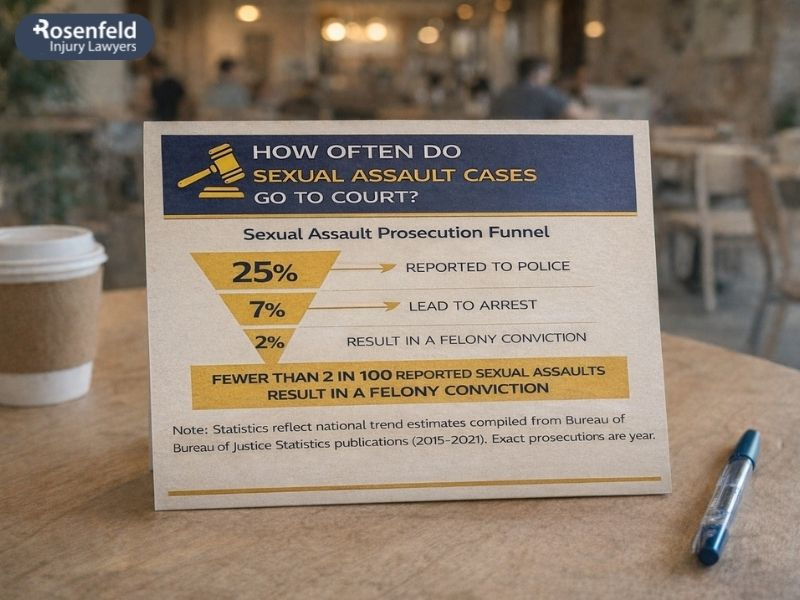
A Bureau of Justice Statistics study found:
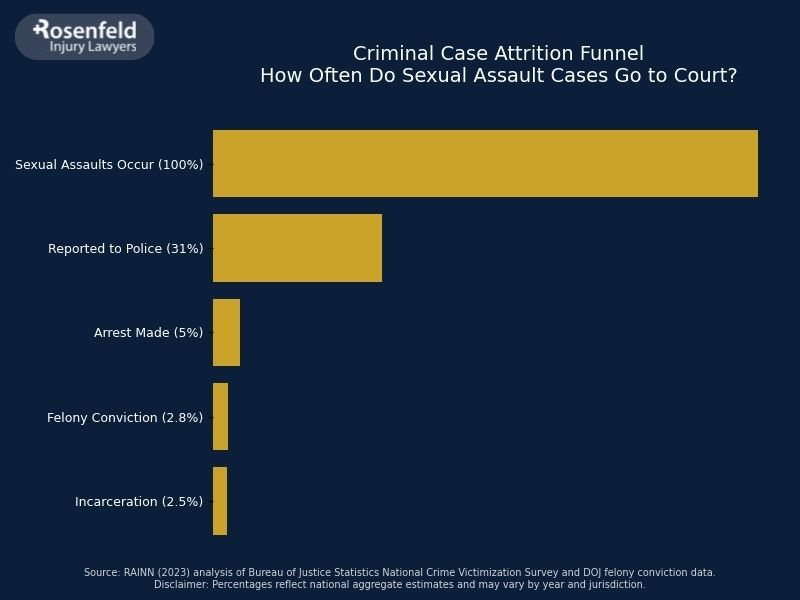
- Just 36% of rapes, 34% of attempted rapes, and 26% of all sexual assaults were ever reported to police.
- Among rape cases reported, most did not result in prosecution.
- Survivors cited fear of retaliation, shame, and distrust of authorities.
These findings are just an example of why sexual abuse survivors turn to civil cases when the criminal system does not deliver justice.
We help survivors navigate the difficult process of reporting sexual assault when they choose to do so, while reassuring them that civil options remain available even if they choose not to report or if criminal charges never materialize.
How Severe Assault and Rape Cases Influence Civil Trial Likelihood
Serious assault cases and violent rape cases often push institutions toward early and substantial settlement. This is because:
- Severe cases carry higher damages
- Institutions fear public exposure
- Patterns of abuse may emerge
- Media attention can spark more rape victims coming forward
In sexual violence cases, especially where multiple survivors exist or an institution failed to act, defendants often want to settle before court proceedings reveal damaging evidence. In other countries as well, institutions often settle sexual abuse cases quickly to avoid public exposure.
How Attorneys Evaluate Whether There Is Enough Evidence for a Civil Trial
The civil standard, preponderance of the evidence, does not require proof beyond a reasonable doubt as a criminal conviction does. We assess whether there is sufficient evidence to show the survivor’s account is more likely than not to have happened.
We evaluate:
- Survivor testimony
- Medical evaluations
- SANE records
- Messages, emails, social media
- Photos and screenshots
- Grooming patterns
- Witness accounts
- Timelines and digital fingerprints
- Institutional failures
- Criminal investigative files
- Employment or facility documents
This is where we explain that the evidence needed for a civil sexual assault lawsuit is far less demanding than that needed for criminal prosecution. Many successful cases rely heavily on credibility, corroborating details, and institutional negligence, not necessarily on forensic proof.
How Law Enforcement Findings Influence Civil Negotiations and Trial Decisions
Law enforcement investigations, even when they don’t result in charges, provide important evidence that shapes civil strategy.
Police departments often compile:
- Incident reports
- Forensic exam summaries
- Statements from survivors and witnesses
- Timelines
- Suspect interviews
- Background checks
- Digital evidence lists
These documents help us demonstrate what ultimately happened, even when criminal outcomes do not reflect the truth.
NBC News’ analysis of sexual abuse cases in recent years found that:
- Only 4% of reported rapes resulted in convictions.
- In some jurisdictions, less than 1% of cases ended in a trial conviction.
- Conviction rates varied widely depending on resources, staffing issues, and systemic barriers.
These numbers show why civil lawsuits are often the only effective means for survivors to be heard and for defendants to be held accountable.
Are Most Sexual Assault Cases Reported to Law Enforcement?
Most sexual crimes are never reported. Survivors often avoid reporting due to:
- Fear of retaliation
- Shame
- Threats from the perpetrator
- Family or community pressure
- Fear of not being believed
- Retraumatization
- Navigating police may feel unsafe
- Concerns about children
- Immigration status
- Desire to avoid court
- Conflicting victim’s wishes
Many survivors, especially women or children harmed by trusted authority figures, feel overwhelmed by the idea of reliving trauma in court. This lack of reporting means far fewer cases enter either civil or criminal court. Underreporting does not invalidate what happened, and it does not limit your ability to pursue a civil case.
How Injury Lawyer Team Can Help
When sexually abused survivors come to us, they often do so quietly, cautiously, and with a heavy emotional burden. Many have spent years trying to understand their trauma, wondering whether seeking justice is worth the pain. We focus on helping victims heal by creating a legal process that protects their privacy and emotional well-being.
We assist with:
- Filing sexual assault lawsuits
- Building evidence
- Identifying institutional negligence
- Navigating police investigations
- Obtaining court reports
- Working with medical experts, therapists, and SANE nurses
- Preparing survivors for statements
- Negotiating for confidential settlements
- Litigating when needed
- Ensuring survivors are respected and heard
We also help survivors access emotional and legal resources so they can rebuild and recover. Every case is handled on a contingency fee basis, meaning you pay nothing unless we recover compensation for you.
We are here to fight for survivors, protect their rights, and help them begin a path toward healing, on their terms. Give Injury Lawyer Team a call when you’re ready for a free and confidential consultation.
All content undergoes thorough legal review by experienced attorneys, including Jonathan Rosenfeld. With 25 years of experience in personal injury law and over 100 years of combined legal expertise within our team, we ensure that every article is legally accurate, compliant, and reflects current legal standards.