



Expert Witnesses in Sexual Abuse Cases


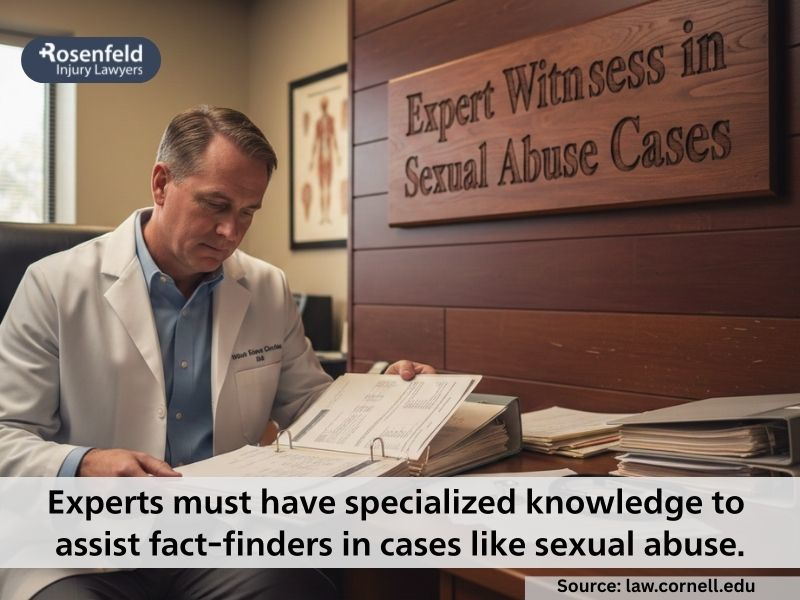
Expert witnesses in sexual abuse cases play a critical role in helping juries understand the realities of trauma, memory, and long-term harm.
At Injury Lawyer Team, we represent survivors of sexual misconduct, and we see firsthand how misunderstood these cases can be. Many survivors come to us carrying deep emotional wounds and fear that no one will believe them.
As attorneys focused on civil justice for survivors, we know that expert testimony often becomes the bridge between a survivor’s lived experience and what a jury can fairly evaluate.
Expert witnesses provide clarity, science, and context, especially in cases where abuse happened years earlier, where physical evidence is limited, or where the defense tries to exploit common myths about how victims “should” behave.
How Does Expert Testimony Help Prove Child Abuse?
In many child sexual abuse cases, jurors come into the courtroom with assumptions shaped by television, movies, or criminal cases they’ve heard about in the news. They may expect immediate disclosures from children, clear physical injuries, or emotional reactions that conform to a narrow stereotype. Real life is rarely that simple.
Expert testimony helps correct these misconceptions. Medical experts explain that childhood abuse often leads to counterintuitive behaviors, including delayed disclosure, partial or fragmented memory, and even continued contact with the abuser. These reactions are not signs that abuse did not occur, but well-documented trauma responses.
For example, delayed disclosure is one of the most common features of child sexual abuse cases. Children may fear retaliation, blame themselves, worry about breaking up their family, or simply lack the language to explain what happened.
An expert witness provides scientific context for why a child may wait years or decades before speaking out. This testimony helps jurors evaluate evidence based on reality rather than expectation.
Expert witnesses also help juries understand emotional trauma. Survivors may appear calm, detached, or inconsistent when describing traumatic events. Through testimony from experts, jurors learn that trauma affects memory encoding and recall. What may appear to be an inconsistency to a layperson may, in fact, be a hallmark of abuse.
In short, expert witnesses play a vital role in translating trauma science into plain language, providing insight that allows juries to assess child abuse claims fairly.
Can an Expert Witness Testify That Abuse Definitely Occurred?
Generally, an expert witness cannot vouch for a victim’s credibility or directly state that abuse occurred as a fact. Courts prohibit experts from telling juries who is telling the truth. That role belongs solely to the jury, even in criminal cases.
Instead, they testify that a survivor’s symptoms, behaviors, and mental conditions are consistent with those observed in individuals who have experienced child sexual abuse. This distinction is critical. An expert does not replace the jury’s role. They provide context to help jurors make informed decisions.
There are limited circumstances in which medical experts may testify regarding physical evidence, such as documented injuries, infections, or forensic findings. Even then, many child sexual abuse cases involve little or no physical evidence, especially when abuse occurred years earlier. Experts explain why the absence of physical findings is medically expected and does not disprove abuse.
Defense attorneys often attempt to weaponize these limitations, arguing that because no expert can say “this definitely happened,” the claim is weak. We push back by showing juries that civil cases rely on patterns, consistency, and corroboration, not unrealistic standards of certainty.
How Do Mental Health Experts Quantify Damages for a Lawsuit?
Survivors know their pain is real, but juries must assign a value to that harm. Medical experts help turn lived suffering into measurable damages.
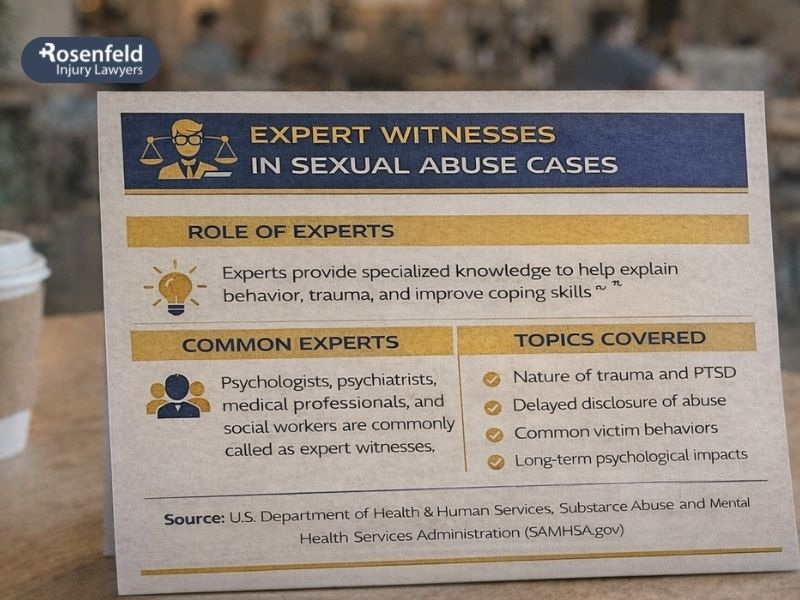
Psychiatrists, psychologists, and trauma specialists evaluate survivors for conditions such as PTSD, major depressive disorder, anxiety disorders, and other long-term impacts linked to child sexual abuse cases.
Experts then project future care costs, which may include:
- Decades of trauma-informed therapy
- Medication management for chronic psychiatric conditions
- Periodic inpatient or intensive outpatient treatment
- Lost earning capacity due to disrupted education or career instability
- Ongoing medical issues linked to chronic stress and trauma
This process transforms emotional distress from an abstract concept into a concrete financial picture. It helps juries understand that the harm from sexual assault does not end when the abuse stops. This harm can shape relationships, employment, health, and stability for decades.
By presenting credible, well-supported projections, expert witnesses provide juries with the tools needed to award damages that reflect the full scope of harm, not just what is visible in the courtroom.
How Is Testimony by Experts Admitted Under the Daubert Standard?
Judges act as gatekeepers when it comes to testimony from experts. Under the Federal Rule of Evidence 702 and the Daubert Standard, the court must determine whether an expert’s methods are reliable before the jury ever hears their opinions.
This means the expert’s work must be:
- Based on sufficient facts or data
- Grounded in reliable principles and methods
- Peer-reviewed and widely accepted in the scientific community
- Properly applied to the facts of the case
This process protects survivors. It ensures that expert witness testimony is not speculative, exaggerated, or based on unsupported theories. At our firm, we work only with highly qualified experts whose work can withstand rigorous scrutiny by defense attorneys.
When clients hear about Daubert hearings, they often worry that expert witness testimony is unreliable. In reality, this standard reassures juries and survivors that expert opinions are grounded in science, not advocacy.
What Are the Different Types of Expert Witnesses Used in Child Sexual Abuse Cases?
Civil child sexual abuse cases often involve a coordinated “trial team” of experts, each addressing a different aspect of harm and responsibility.
Mental Health Experts
Psychiatrists, psychologists, and licensed therapists evaluate survivors and diagnose trauma-related conditions. They explain how child sexual abuse affects emotional regulation, memory, relationships, and long-term mental health. Their testimony connects abuse to ongoing emotional distress and future care needs.
Medical Experts
Forensic nurses, pediatricians, and other medical professionals address physical proof and medical issues. They explain injury patterns, why physical findings may be absent, and how abuse impacts the body over time. Their role is especially important when defense lawyers argue that a lack of visible injury means abuse did not occur.
Institutional Experts
In cases involving schools, churches, foster care systems, or other organizations, institutional experts testify about standard practices and institutional responsibility. These experts, often former administrators or law enforcement professionals, explain how policies should work, where safeguards failed, and how institutions ignored warning signs or mishandled child disclosures.
Together, these experts provide a comprehensive picture of harm, causation, and accountability.
Book a Free Consultation
If you or someone you love is considering a civil claim for a child sexual abuse case, we are here to listen. We offer a free, confidential consultation and handle these cases on a contingency-fee basis, meaning there are no upfront costs, and you do not pay unless we recover compensation for you.
At Injury Lawyer Team, our sexual abuse attorneys work closely with expert witnesses, mental health professionals, and other organizations to build strong, evidence-based cases rooted in compassion and accountability.
Contact us today to speak with our team and learn how testimony from experts can help your case move forward.
All content undergoes thorough legal review by experienced attorneys, including Jonathan Rosenfeld. With 25 years of experience in personal injury law and over 100 years of combined legal expertise within our team, we ensure that every article is legally accurate, compliant, and reflects current legal standards.