



Can You Sue Someone if You Don’t Know Their Name?


Can you sue someone if you don’t know their name? This is one of the most common and painful questions we hear from survivors of sexual abuse. Many of our clients come to us knowing what happened to them and that they were harmed, but lacking one critical detail: the name of the person responsible.
Sometimes the abuse happened years ago. Sometimes the abuser used a fake name. Sometimes the survivor only knows a screen name, an online account, a job title, or a vague description tied to a business, property, or institution. It’s important to note that federal law allows survivors to file suit even when the defendant’s name is unknown.
At Injury Lawyer Team, we work with survivors who feel stuck at this exact point. We want you to know this clearly from the start: not knowing a defendant’s name does not mean you are out of options. We stand with you, you’re not alone, and we believe in your case.
The civil legal system provides tools designed specifically for situations like this, allowing survivors to pursue civil action, establish identity, and seek accountability.
This article explains how that process works in the context of sexual abuse, including John Doe lawsuits, subpoenas, service requirements, and how our sexual abuse attorneys help clients move from uncertainty to clarity.
What Is a John Doe Lawsuit in Sexual Abuse Cases?
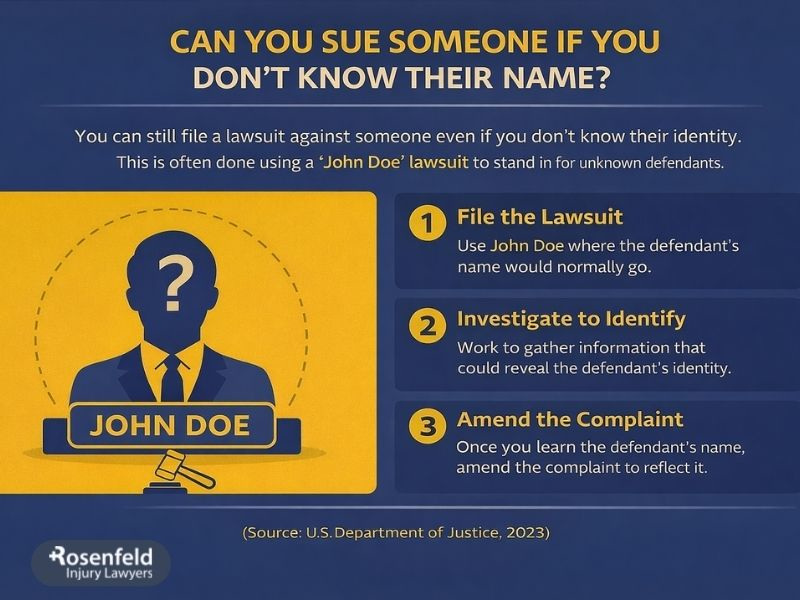
A John Doe lawsuit is a legal action filed against an unidentified defendant when the plaintiff does not yet know the defendant’s legal name.
In sexual abuse cases, this is not a loophole or a technical trick. It is a recognized, legitimate strategy used to preserve the plaintiff’s rights while allowing time to identify the responsible person. Even if no criminal charges were commenced, survivors may still pursue civil action.
When we file a John Doe lawsuit, we are not guessing or assuming. We are telling the court, truthfully, that the abuse occurred, that evidence exists, and that the defendant’s identity can be obtained through lawful investigation once the lawsuit is on file. This allows us to protect our clients from statutes of limitations while actively working to uncover the facts.
Importantly, submitting a lawsuit creates access. Once a case is in court, a licensed attorney can begin using formal legal tools to obtain records, documents, and proof that are otherwise inaccessible to private individuals.
This is especially critical in sexual abuse cases involving:
- Online abuse or grooming
- Anonymous attackers
- Institutional cover-ups
- Abuse tied to a business, employer, or property
- Situations where the survivor was a child at the time
We guide our clients through this process carefully, respectfully, and with full attention to emotional safety.
The “Doe Subpoena” and Pre-Service Discovery
One of the most powerful tools in a John Doe lawsuit is pre-service discovery, sometimes referred to informally as a “Doe subpoena.”
Under Federal Rule of Civil Procedure 45, attorneys may issue subpoenas to third parties who are not defendants in the lawsuit but who control records that can identify the anonymous person. These formal requests do not accuse the third party of wrongdoing. Instead, they request access to information necessary to identify the defendant so that lawful service can occur.
In sexual abuse cases, we may issue subpoenas to:
- An internet service provider, in order to identify the account holder behind an IP address
- A social media platform connected to an account used to facilitate abuse
- A business or employer that controlled access to a location
- A hotel, landlord, or premises owner with surveillance or guest records
- An institution holding internal records or complaint files
These records often contain the missing link: a real name, a defendant’s address, employment records, or access logs that place the person at the scene on a specific date.
We do not rush this process. We request permission from the court where required, tailor subpoenas to the jurisdiction, and present a clear factual basis for why the information is relevant. Judges understand the risk survivors face when abusers hide behind anonymity, and courts regularly authorize this type of discovery when the factual context justifies it.
Who Are Considered John Doe Defendants in Institutional Abuse?
In many sexual abuse cases, the primary abuser is known, but other parties involved are not.
For example, a survivor may know the name of the coach, teacher, clergy member, or staff person who committed the abuse, but not know:
- Which administrators ignored complaints
- Which supervisors concealed evidence
- Which employees enabled access
- Which decision-makers failed to act
In these cases, we often name John Doe defendants (sometimes listed as “John Doe Defendants 1–10”) to represent individuals whose names will be revealed through internal paperwork, records, emails, or testimony.
This approach is especially common in lawsuits connected to:
- School districts
- Religious organizations
- Youth programs
- Foster care systems
- Medical facilities
- Detention centers
Under the Federal Rule of Civil Procedure 10(a), the complaint must list the names of all parties. When names are unknown, “Doe” designations are placed directly in the caption, preserving the right to amend later once identification occurs.
This is not speculation. It is a structured, lawful way to ensure that every party responsible, not just the most visible one, can be held accountable.
How Is a Defendant Properly Served Once Their Identity Is Known?
Once we identify the person behind a John Doe designation, the lawsuit does not restart; it evolves.
The next step is filing an amended complaint that replaces “John Doe” with the defendant’s real name. This amendment is submitted to the court, and once approved, the defendant must be properly served with the summons and complaint.
Proper service is not optional. It is a constitutional requirement tied to due process. The defendant must receive formal notice of the lawsuit, including:
- The complaint
- The court where the case is pending
- The deadline to answer
- The claims being made
Service is typically completed by delivering documents to the defendant’s last known address, but alternative methods may be allowed if the responsible party cannot be easily located. In some circumstances, courts permit service via a business, a registered agent, or another legally approved means.
We handle this entire step for our clients. Our role is to ensure service is valid, documented, and defensible so that the case can proceed without unnecessary delay or risk.
Statutes of Limitations and the “Relation Back” Doctrine
One of the biggest fears survivors have is time. Many worry that by the time they identify the defendant, the statute of limitations will expire.
This is where Federal Rule of Civil Procedure 15(c), known as the relation back doctrine, becomes critical.
Under this rule, when a complaint is amended to replace a John Doe defendant with a named individual, the amendment can “relate back” to the original filing date, as long as certain legal conditions are met. In practical terms, this means the defendant is treated as if they were sued on day one.
This doctrine prevents someone from escaping liability simply by concealing their identity or delaying discovery. It is a powerful safeguard in sexual abuse cases, particularly those involving institutional secrecy or anonymous accounts.
We carefully structure lawsuits against John Doe defendants with this rule in mind from the very beginning. Every decision, how the complaint is drafted, how defendants are described, what corroborating material is cited, is made to protect our clients’ ability to move forward, even as identities are later uncovered.
How We Can Help Victims of Sexual Abuse Take Legal Action
From the first call to final resolution, we guide our clients through every stage of the legal proceedings. Our services in sexual abuse cases include:
- Providing a free, confidential consultation
- Explaining the attorney-client relationship clearly and respectfully
- Evaluating evidence, records, and facts that prove what happened and who was responsible
- Identifying all possible defendants, including Doe defendants
- Filing a lawsuit to preserve your claim
- Seeking court authorization for subpoenas when required
- Obtaining records from businesses, institutions, and online platforms
- Locating defendants and confirming identity details
- Amending complaints and ensuring the defendant is properly served
- Managing communication with the judicial system and opposing parties
- Preparing the case for settlement or trial
- Supporting our clients throughout every step
We understand the emotional weight of these sexual abuse claims. Our role is not only legal but also protective, strategic, and supportive. We take on the burden of the legal procedure so our clients can focus on healing.
Contact Us If You Have Further Questions
If you have additional questions about whether you can sue someone or proceed without knowing their name, we are here to help. Our sexual abuse attorneys offer free, confidential consultations, and we work on a contingency-fee basis, meaning there is no upfront cost and no fee unless we recover on your claim.
You do not need all the answers to reach out. You do not need every detail. If something happened to you, that is enough to start the conversation. We encourage survivors to consult with a licensed attorney before deciding how to proceed. Contact us today, or whenever you are ready.
All content undergoes thorough legal review by experienced attorneys, including Jonathan Rosenfeld. With 25 years of experience in personal injury law and over 100 years of combined legal expertise within our team, we ensure that every article is legally accurate, compliant, and reflects current legal standards.