



Can You Sue for Sexual Assault If You Have a Criminal Record?


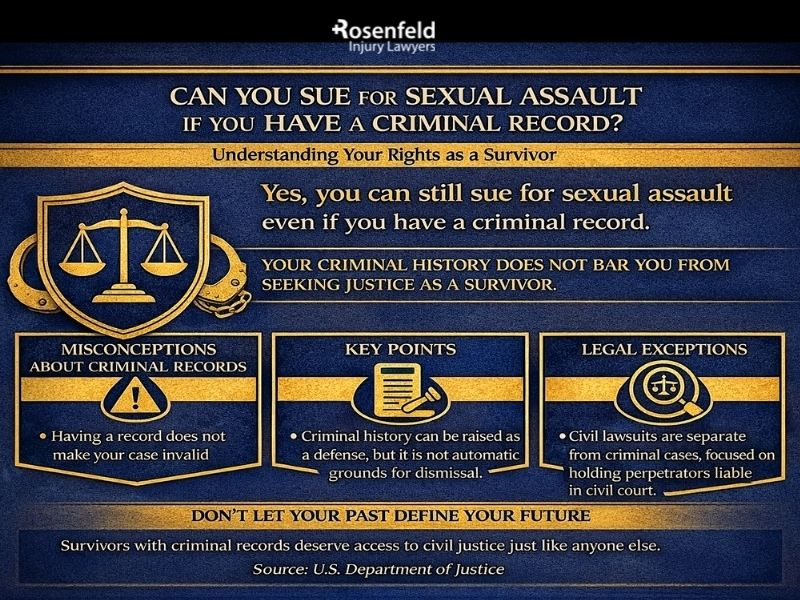
Can you sue for sexual assault if you have a criminal record? This is one of the most common and most painful questions we hear from survivors who are trying to understand their rights while carrying the weight of past convictions. Having a criminal history does not take away your right to seek justice through civil action when sexual assault or sexual abuse has happened.
At our firm, we regularly represent survivors with complex backgrounds, including adult survivors, people with prior convictions, and individuals who were assaulted while incarcerated or under state supervision.
Our role is not to judge your past, but to focus on the abuse that occurred, the harm you suffered, and the legal avenues available to you now. A criminal record does not excuse sexual violence by abusers, nor does it prevent you from pursuing a civil sexual abuse case.
Can Sexual Assault Survivors Take Legal Action If They Have a Criminal Record?
Yes. It is common for sexual assault survivors to have a criminal record, particularly in cases involving incarceration, probation, or juvenile custody. We often see survivors who were sexually assaulted in settings where the accused had power or authority over them, including prison sexual abuse and juvenile detention sexual abuse cases.
Sexual abuse occurs in many environments, not just in everyday civilian life. Many survivors were harmed while under the control of institutions that had a legal duty to protect them. When that duty is violated, civil claims may be available regardless of a survivor’s past.
Criminal Cases
The state, not the victim, brings a criminal case. Law enforcement investigates the crime, files a police report, and prosecutors must prove guilt beyond a reasonable doubt in criminal court. This is a high burden of proof, and many criminal cases never result in a guilty verdict, even when the assault clearly took place.
Criminal cases often rely heavily on forensic evidence, physical evidence, witness testimony, and cooperation from law enforcement. When evidence is limited, delayed, or challenged, prosecutors may decline to move forward, even if the victim is credible.
Civil Cases
A civil case is different. In a sexual assault civil lawsuit, survivors file suit themselves in civil court. The goal is not to punish through incarceration, but to establish liability, hold the accused accountable, and seek financial compensation for the harm caused.
The burden of proof in the civil system is lower than in criminal court. Survivors do not need to prove guilt beyond a reasonable doubt. Instead, we must show that it is more likely than not that the sexual abuse occurred. Because of this lower burden, many survivors can succeed in civil lawsuits even when no criminal conviction exists.
This distinction is why legal representation is so important. Our legal team understands how to build civil sexual abuse cases using medical records, therapy bills, expert testimony, text messages, social media posts, and other evidence that may not have been enough for a criminal case but can still prove wrongdoing in civil court.
Can Victims File Civil Lawsuits If Their Sexual Abusers Were Never Criminally Convicted?
Yes. Survivors can file civil lawsuits even if their abusers were never charged, never prosecuted, or never found guilty in criminal court. A criminal case and a civil case operate independently of one another.
Many survivors hesitate to initiate civil action because the accused was never convicted. We want to be clear: a lack of criminal charges does not mean the abuse did not occur. It often reflects limitations in the criminal justice system, not the truth of the incident.
Civil courts are designed to determine responsibility and provide compensation. Abusers can be found liable even when they avoided criminal punishment. For many victims, this civil accountability is a crucial step toward justice and healing.
How Long Do Survivors Have to File a Sexual Assault Civil Lawsuit?
Every civil lawsuit is subject to time limits, known as sexual assault statutes of limitations. These deadlines vary by state and may depend on factors such as the survivor’s age, whether the abuse involved minors, and when the survivor discovered the harm.
Many states apply the discovery rule, which allows the clock to start when a survivor reasonably discovers that their injuries or emotional distress were caused by sexual abuse. This is especially important in cases involving childhood sexual abuse, where survivors may not fully understand or process what happened until later in life.
Cases involving minors often have extended or paused limitations periods, recognizing the long-term impact of trauma and the power dynamics involved. However, every state’s statute is different, and missing a filing deadline can permanently bar a claim.
Given the strict time limits, we encourage survivors to speak with our legal team as soon as possible. Even if you believe your case may be too old, there may still be legal options available.
What Damages Can Victims Recover in a Civil Sexual Assault Case?
A civil sexual assault case is about accountability and support. Survivors may be entitled to compensation that reflects the full scope of their harm.
Economic Damages
Economic damages cover measurable financial losses, including:
- Medical expenses related to treatment after the assault
- Therapy bills and ongoing mental health care
- Lost wages or reduced earning capacity
- Costs associated with relocation or safety planning
These damages recognize that abuse often disrupts a survivor’s life, work, and stability.
Non-Economic Damages
Non-economic damages address the human impact of sexual abuse, including:
- Emotional distress and psychological trauma
- Pain and suffering
- Loss of enjoyment of life
- Damage to relationships and personal well-being
Many victims carry the effects of assault long after the incident. Courts recognize these losses.
Punitive Damages
In cases involving egregious conduct, courts may award punitive damages. These are designed to punish particularly harmful behavior and deter future abuse. While not available in every case, these damages may apply when sexual abusers act with intentional cruelty, abuse of power, or repeated misconduct.
Can Survivors Remain Anonymous When Filing a Sexual Abuse Lawsuit?
Yes. In many cases, survivors can maintain anonymity when pursuing legal action. Courts may allow survivors to file a sexual assault lawsuit anonymously, often using initials or a pseudonym, especially when privacy and safety are concerns.
Filing under a pseudonym can protect survivors from public exposure, retaliation, or further emotional damage. We understand how difficult it can be to come forward, and we work to preserve confidentiality whenever possible. Protective orders and non-disclosure agreements may also be used to limit the spread of sensitive information.
Every court handles anonymity differently, but protecting survivors is a priority we raise early in the filing process.
Book a Free Consultation
If you are considering a sexual abuse lawsuit, we are here to help. At Injury Lawyer Team, we offer free, confidential consultations so you can speak with us safely and privately about what happened and the options available to you.
We handle sexual abuse civil lawsuits on a contingency fee basis. There are no upfront legal fees, and you owe nothing unless we secure compensation on your behalf. Our goal is to remove financial barriers so survivors can pursue justice without added stress.
Our services include:
- Evaluating legal options and time limits: We assess your case, applicable statutes, and filing deadlines.
- Identifying all responsible parties: We look beyond the abuser to institutions or organizations that may be liable.
- Gathering evidence and building the civil case: We collect records, testimony, and documentation to establish liability.
- Coordinating medical and mental health support: We document emotional harm and treatment through qualified professionals.
- Handling communication with the police and investigators: We protect your rights during any police or investigative involvement.
- Managing all contact with defense attorneys and insurers: We shield you from pressure and handle all legal communications.
- Filing and litigating the civil lawsuit: We prepare pleadings, motions, and court filings on your behalf.
- Protecting privacy and anonymity when possible: We seek anonymity and confidentiality protections where available.
- Negotiating a settlement when appropriate: We pursue fair resolutions that reflect your goals and the harm you have suffered.
- Preparing the case for trial: We develop a trial strategy, identify witnesses, and outline the evidence presentation.
- Trial representation through verdict: We advocate for you in court when fair financial compensation is not offered.
- Post-resolution support: We assist with enforcement and next steps after settlement or verdict.
We stand with survivors. If you are ready to take the next step or simply want answers, contact us today to book a free consultation with our sexual abuse attorneys.
All content undergoes thorough legal review by experienced attorneys, including Jonathan Rosenfeld. With 25 years of experience in personal injury law and over 100 years of combined legal expertise within our team, we ensure that every article is legally accurate, compliant, and reflects current legal standards.