



Are Sexual Assault Settlements Taxable?


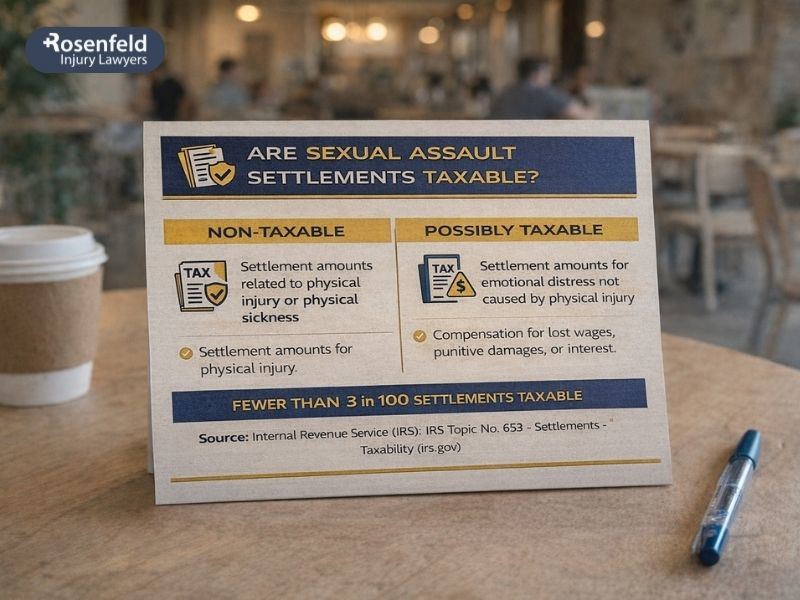
The answer to “Are sexual assault settlements taxable?” depends on the specific type of damages awarded. You may have to pay federal taxes on particular parts of your sex abuse settlement.
Working with a skilled attorney from Injury Lawyer Team ensures that such settlements are structured to reduce your tax burden. Contact us to discuss the tax implications of an abuse or sexual harassment settlement during a free, confidential consultation.

When Do Victims Have to Pay Taxes on Personal Injury and Sexual Abuse Case Settlements?
To understand whether you must pay federal income tax on monetary settlements, it’s important to understand the general rule and the personal injury exception in the tax code.
The General Rule states that any compensation must be reported and counts toward your gross income, whether it comes from monetary awards or employment (26 U.S. Code § 61).
However, if the settlement compensates someone for personal physical injuries or physical sickness, then it is exempt (IRC § 104(a)(2)). Such physical injuries must result in observable physical harm, such as cuts, bruises, lacerations, sprains, or fractures.
If the unwanted sexual contact only resulted in mental and emotional distress, then the IRS may classify it as taxable.
How Does Current Tax Law Define a Physical Injury?
Under current law, the IRS uses the “observable harm standard.” While sexual violence is inherently physical, as it is done against a person, it does not always result in observable injuries like bruising or lacerations. There must be visible evidence of harm to qualify for an exemption.
However, the Tax Court is coming to recognize that emotional distress can result in physical injury or illness, as is discussed in the 2018 Taxpayer Advocate Service report to Congress. The way that the case is presented can significantly change how damages are classified.
US House Representatives Gwen Moore (D-Wis) and Lloyd Smucker (R-Pa) of the House Ways and Means Committee have introduced the Survivor Justice Tax Prevention Act, a narrowly tailored legislation meant to revise the tax code to help survivors of sexual abuse.
This proposed act would tie the IRS tax exemption to the definitions of sexual act and illegal sexual contact in the federal criminal code (18 U.S. Code § 2246).
According to Gwen Moore, the act would “remove the burdensome and unfair requirement” on sexual abuse survivors of proving they suffered physical harm in order to qualify for tax-free treatment.
What Payments Related to a Sex Abuse Settlement Agreement Are Taxable?
Punitive Damages
Punitive damages do not compensate the victim for the harm done; they are solely meant to punish the perpetrator. As such, they are always 100% taxable and must be listed as income.
Interest
Sometimes, survivors receive interest payments related to their settlement while the case is pending. They must pay taxes on the interest payments, even if they do not owe any tax on the settlement itself.
Lost Wages
If a portion of the settlement is specifically allocated to replace lost wages, then it is treated the same as the expected income. You would need to claim these payments on your federal return.
Emotional Distress Damages
Emotional distress damages for sexual abuse cases may or may not be taxable. It depends on the specific nature of the damage done and its initial origin.
The US Supreme Court case United States v. Gilmoreestablished the concept of “origin of the claim.” While this case was related to a divorce proceeding, it has had significant implications for other aspects of the tax code.
The case in question involved a man who was concerned about losing his income-producing property due to a divorce. The justices held that, because the issue arose from a personal matter, the plaintiff could not deduct legal fees from his return. It did not matter that the divorce would have tax implications for his business.
In other words, the case’s origin and nature, not its potential outcome, determine its tax classification.
For a sexual abuse case, this means that if the emotional distress arose from a physical injury, then the survivor would not have to pay taxes. For example, if they were violently assaulted, suffered a fractured arm, and also developed PTSD, then the emotional distress would be presumed to have flowed from the injury.
However, if the distress is not connected to physical injury, then it is taxable. The only exempt portions would be for financial losses, such as therapy or medical bills.
Let Us Help You Structure Your Settlement Income
Our sexual abuse lawyers will work to minimize your tax burden. This requires gathering strong evidence proving that you suffered injuries at the time of the assault, such as medical records and police reports. Even small injuries, like bruises and cuts, can be used to justify a tax-exempt status.
Emotional distress is often taxable unless it can be directly connected to physical sickness or harm. As such, we will consult with experts who can explain the complex nature of conditions like PTSD.
For example, a medical professional can explain that physical trauma, such as assault, can lead to neurological changes connected to chronic hyperarousal, insomnia, and diminished cognitive function. When combined with contemporaneous records, such as police reports and medical examinations, this can be compelling evidence of physical harm.
During negotiations, we will emphasize the physical burden of the assault, particularly if it resulted in sicknesses such as chronic fatigue, pelvic pain, or obstructive sleep apnea. Because these are diagnosable conditions, they can satisfy the observable harm doctrine the IRS uses to classify returns.
Contact Us If You Have Further Questions
The trauma and stress of being sexually assaulted can make legal actions and tax returns difficult to manage. Our sexual abuse attorneys are here to help you understand nondisclosure agreements, compensatory damages, and settlement structures so that you can move forward with your life.
Our attorneys are members of the National Association of Personal Injury Attorneys and are recognized as one of America’s Top 100 High Stakes Litigators. With a 98% success rate, we’re known for our compassionate sexual abuse advocacy and personalized approach.
We work on a contingency fee basis: all legal fees are deducted from your settlement, not billed during the legal process. This ensures that survivors of sexual abuse can focus on healing, not paying bills.
Injury Lawyer Team is here to help you move forward with confidence. Call us at 866-757-6452 or use our online contact form to schedule a free and confidential consultation.
All content undergoes thorough legal review by experienced attorneys, including Jonathan Rosenfeld. With 25 years of experience in personal injury law and over 100 years of combined legal expertise within our team, we ensure that every article is legally accurate, compliant, and reflects current legal standards.