



Are Companies Responsible for Preventing Sexual Abuse?


Are companies responsible for preventing sexual abuse? This is a question we hear from survivors who expected an employer or institution to protect them, only to feel exposed. At Injury Lawyer Team, we stand with our clients when harm occurs in spaces a company controls, and we focus on accountability when preventable failures increase the likelihood of abuse.
When an organization ignores risk, the fallout is rarely limited to one incident. Survivors often describe anxiety, lost trust, and disruptions that touch daily life and well-being. Teams fracture, and the entire work environment can fall silent. That is why we evaluate not just what one person did, but what the organization did, or failed to do, to prevent workplace sexual abuse.
Do Companies Have a Legal Duty to Prevent Abuse?
In civil cases, the starting point is the duty of care: the obligation to protect people from sexual abuse in environments that an organization controls.
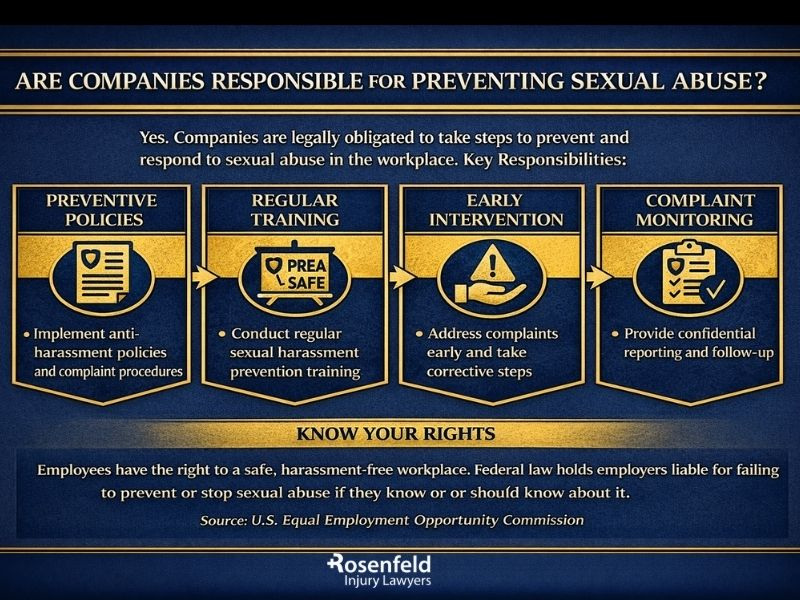
For many employers and institutions, that obligation is a legal duty under state law tied to how they manage access, supervision, and safety rules. If a company controls the premises, sets expectations for conduct, and has authority over hiring, scheduling, and discipline, it must take reasonable steps to reduce foreseeable risk.
We look for proactive steps and other proactive measures that align with the setting. Preventing workplace sexual abuse can include thorough background checks for positions involving authority or access to vulnerable people, clear workplace rules, and regular training that teaches boundaries, consent, and reporting.
Strong programs also provide training for supervisors to respond appropriately when concerns arise, and include bystander intervention training so staff know how to interrupt risky situations and escalate concerns.
Just as important are systems that make reporting realistic. Effective reporting procedures should not require a survivor to report only to a direct supervisor, especially when that supervisor may be involved in, or protective of, a favored employee.
Companies should offer multiple channels for complaints and document intake, and clearly explain what happens next. When these systems don’t exist, or exist only on paper, organizations often fall short of legal standards.
How Does Company Responsibility Differ From Individual Criminal Liability?
When an individual commits a crime, the criminal court focuses on punishment. Company liability is different: it focuses on prevention and whether organizational choices created avoidable risk. Civil cases examine supervision, safety policies, training, and enforcement, not criminal sentencing.
This distinction matters because companies often respond to sexual abuse allegations by framing them as “one bad actor.”
But if a company failed to address sexual harassment after earlier complaints, ignored warning signs, or kept someone in a position of power despite red flags, the organization’s conduct becomes part of the story. Corporate accountability is about whether the company built and enforced safeguards that could have prevented harm.
When Can a Company Be Held Liable for Sexual Abuse?
A company may be held liable when harm was foreseeable, and it failed to take reasonable care. Foreseeability can come from prior incidents, clear warning signs, or patterns that leadership should have recognized. Liability often arises when management fails to investigate, delays immediate action, or allows abusive behavior to continue after receiving notice.
We see this most often in workplace sexual abuse and other abuse in the workplace, where power, access, and silence can intersect. Sometimes workplace sexual harassment escalates into coercion, such as unwelcome sexual advances, pressure for sexual favors, retaliation threats, or grooming behavior that becomes more aggressive over time.
In other cases, the problem starts with comments of a sexual nature, stalking, or escalating boundary violations by a co-worker who learns the company won’t intervene. When a company tolerates harassment, it can create a hostile environment that normalizes boundary violations.
We also examine the company’s response tools. Did leaders act quickly, separate the accused from potential victims, and preserve evidence? Did the Human Resources department follow policy, protect confidentiality, and avoid retaliation? Or did the company rely on written warnings, quiet transfers, or vague coaching while the behavior continued?
Meaningful accountability includes appropriate disciplinary action when warranted, including suspension, removal from supervision, or termination. What matters is whether the response was proportional and protective, designed to stop such behavior and prevent recurrence.
A zero-tolerance stance on workplace sexual abuse without consistent enforcement is not a real safeguard, and survivors often notice the gap immediately, no matter how many times leadership says “zero tolerance.”
What Types of Companies Can Be Responsible for Preventing Sexual Abuse?
Organizations across many sectors control environments where abuse can occur. Employers must keep a workplace free from discrimination and harm.
Schools and districts have duties related to school sexual abuse, while universities must address risks connected to college sexual assault in housing, athletics, and campus programs. Religious organizations must confront clergy sexual abuse and implement safeguards for youth and congregants.
Healthcare systems must protect patients and staff from hospital sexual abuse and boundary violations in clinical settings.
Across settings, prevention is not only a policy issue; it is cultural and operational. Companies should ensure employees understand boundaries, reporting options, and consequences, and they must apply rules consistently regardless of an employee’s position.
When powerful people are protected, risk increases for other employees and for the community. A safe environment depends on leadership that treats every report as a safety issue, not a public relations problem.
Organizations should also offer support services and support resources, such as clear pathways to accommodations, schedule changes, counseling referrals, and crisis assistance. Supporting victims early means they are more likely to report and less likely to be pushed out of the workplace.
That support is also a business reality: unchecked harm damages employee morale, drives turnover, and undermines trust.
What Options for Legal Recourse Do Sexual Harassment and Abuse Survivors Have?
Survivors often ask what choices exist. A civil vs. a criminal case is a key distinction: criminal matters are pursued by the state, while civil cases allow survivors to seek accountability and compensation from individuals and institutions. Civil legal recourse can include claims against an employer, school, hospital, or other organization when negligence or policy failures contributed to harm.
Through the civil legal process, survivors may pursue damages for emotional distress, therapy, lost income, and other harms. Civil cases can also force change by requiring safer policies, training, and oversight. For some survivors, the primary goal is security and stability; for others, it’s ensuring the organization is held accountable so the same pattern does not repeat.
Many survivors also navigate internal processes at work. Those processes can be useful, but they can be incomplete, especially when leadership is defensive. That is why we help clients evaluate options, preserve evidence, and decide whether legal action is appropriate, even if an internal report was made or ignored.
How Does the Equal Employment Opportunity Commission (EEOC) Relate to Responsibility for Sexual Abuse?
In workplace settings, the Equal Employment Opportunity Commission (EEOC) enforces federal laws that prohibit discrimination and harassment. Its process is administrative and employment-focused: it can receive a complaint, investigate, seek conciliation, and in some circumstances bring enforcement actions.
EEOC records can overlap with civil claims. An investigation may document repeated complaints, confirm failures to address sexual harassment, or reveal gaps in reporting procedures and training.
Those findings can support a civil case by showing what the employer knew and whether it took reasonable steps to protect people. At the same time, administrative action generally does not replace a civil lawsuit aimed at broader accountability for safety failures.
Why You Need Experienced Legal Representation
Institutional cases are rarely straightforward. Companies often have insurers, internal investigators, and defense counsel ready to challenge claims or minimize harm. That is why experienced legal support matters. We build cases by identifying where prevention broke down, what should have happened, and how the company’s decisions contributed to harm.
Our services include listening to what happened, evaluating timelines, preserving evidence, and reviewing training records, complaint histories, supervision practices, and disciplinary files.
We assess whether the organization maintained a workplace culture that tolerated sexual misconduct or consistently enforced standards. We also look at whether managers took appropriate action and whether safety investments were real or cosmetic.
We also document impact: whether people felt pressured to stay silent, whether others were exposed to risk, and whether the company’s response protected the survivor or pushed them out. We coordinate with support services when needed.
If a fair settlement is possible, we pursue a resolution that respects the survivor. If not, we prepare for litigation and trial, using discovery and testimony to prove what happened and why the company should be held responsible.
Book a Free Consultation
If you’re considering next steps, our sexual abuse attorneys can help you understand options and choose a path that fits your goals. We offer a free consultation and handle these cases on a contingency-fee basis: no upfront costs, and you owe nothing unless we recover compensation for our clients. Contact us to discuss what happened and how we can pursue accountability together.
All content undergoes thorough legal review by experienced attorneys, including Jonathan Rosenfeld. With 25 years of experience in personal injury law and over 100 years of combined legal expertise within our team, we ensure that every article is legally accurate, compliant, and reflects current legal standards.